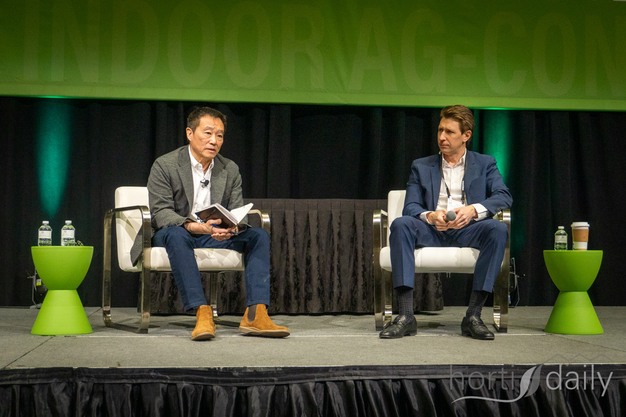
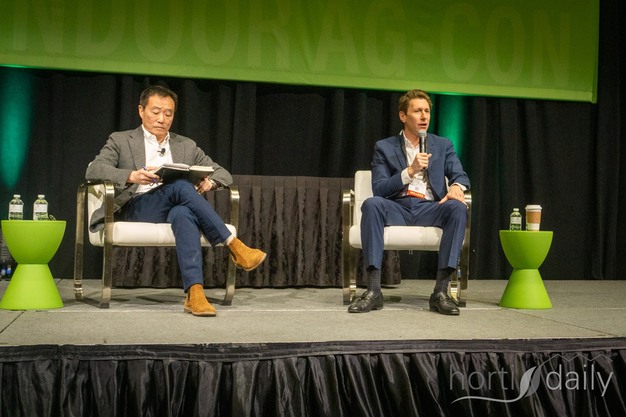
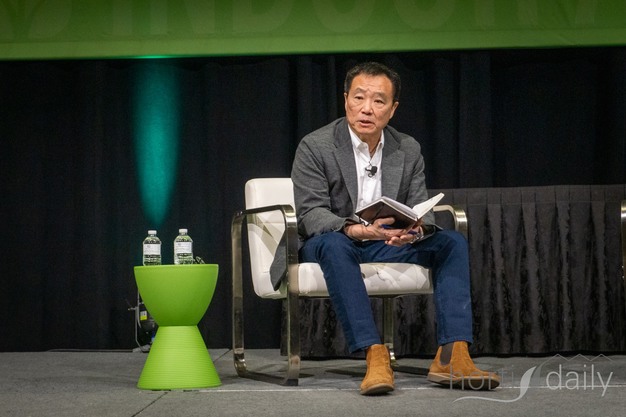
The second day of Indoor Ag-Con opened with a keynote focused on capital allocation in controlled environment agriculture (CEA). Dave Chen, Co-Founder & CEO of Equilibrium, and David Verbitsky, President & Managing Director of Verbitsky Capital, discussed lessons from recent years and the current investment climate for indoor farming.
Both speakers pointed to a shift in tone across the sector. Dave described what he observed on the show floor as "a sober energy," adding: "People are talking about getting to the business of the business and much less about the buzz of the business."
 © Arlette Sijmonsma | FreshPlaza.com
The identity shift: tools, not business models
This shift in energy stems from a fundamental reassessment of what these companies actually are. For years, the sector was branded as a high-growth tech play, but the keynote speakers were quick to dispel that notion.
"We're watching survivors in vertical farming realize that they're a tool, a technology, not a business model," Dave said. "Whether it's a hoop house, a low-tech greenhouse, a high-tech greenhouse, or a vertical farm, they're all tools to build a better product."
David agreed: "Stop differentiating about what kind of technology you're using. It's a spectrum. What matters is what you're producing and your economics." Dave echoed that message, noting that one of the "brutal shocks" of the last five years was realizing this is not a tech business model. "This is farming. There are very few aspects of this sector that exhibit tech leverage or tech margins. It's a commodity," he said.
From growth-at-all-costs to operating discipline
Accepting that CEA is a "farming-first" business has forced a pivot in how companies manage their balance sheets. Reflecting on the last five years, the conversation centered on overexpansion, capital structure mismatches, and operational realities.
"If I look at the last five years," Dave said, "the industry overreached. We overbuilt before stabilization. We built ahead of both the market and our capability to be consistent and productive." He added that some operators expanded to second and third facilities before stabilizing the first, leading to balance sheet strain.
Dave argued that when companies are valued as if they will deliver "tech multiples," it drives premature scaling and overcapitalization. CEA operators are "farmers that use technology," not technology companies themselves, and structuring capital as if exponential margins are achievable can distort decision-making.
On the topic of sale-and-leaseback structures, Dave described them as a tool best suited to mature, creditworthy operators with predictable cash flows. "The sale-leaseback is actually only applicable as a tool for balance sheet management for very mature creditworthy companies. It's a terrible tool when you're a startup," he said. Real estate capital should follow operational proof, not precede it.
 © Arlette Sijmonsma | FreshPlaza.com
Market realities: commodity economics and retail integration
Once a company stabilizes its capital structure, the focus must shift to the retail shelf. David Verbitsky emphasized that product-market fit remains the starting point. "First and foremost is the product itself. Do consumers respond to it? Are you building a strong brand and is it a differentiated product?" he said. "If consumers aren't responding to your product, then the underlying value won't be there."
David framed the issue in terms of extracting incremental margin: "The consumer has to understand why they're paying more for it. Is it shelf life? Is it taste? Is it convenience? Is it local?"
Dave added that in categories like leafy greens, CEA is already proving its worth. "We're past the half-percent stage. We're seeing month-over-month incline and store-level data where CEA products are beating field-grown in velocity," he said. However, he suggested that future growth would favor scaled operators integrated into retail supply chains. "The next few years will be about understanding what makes the retailer tick. It's about shelves being stocked, managing shrink, forecasting supply, and consistent quality. The shelves are stocked by supply chains."
Investment outlook: Capital is returning (with conditions)
While the path to the retail shelf is becoming clearer, the path to funding those operations has become more rigorous. Investors are still at the table, but they are looking for "bottom-line" reality.
"There is interest," David said. "We are seeing interest from strategic players and growing interest from financial parties—private equity, infrastructure funds, family offices. But if you're looking at growth where you just have to get to the third or fourth farm and then you'll be profitable, that model has been challenged. This isn't about top-line growth at any cost. It's about sustainable cash flow."
Debt markets are also evolving. David noted that traditional bank lenders and private credit funds are increasingly evaluating greenhouse projects, though he advised caution: "Debt is becoming more available. But be very mindful about what you take on." Dave Chen added that the style of your investor dictates your decisions: "Trying to make a farm into a tech company is a dangerous thing."
 © Arlette Sijmonsma | FreshPlaza.com
Cycles and timing
Ultimately, the speakers viewed this period as a standard maturation of the asset class. "Ag is always viewed as the next big sector. It goes in waves," David said. "There's a lot of interest, then it goes away, then it comes back. We are coming back up, but we're still near the bottom of the curve." Dave added: "Timing is everything. Every decade investors rediscover agriculture. Then they remember it's a commodity business. And then we start over again."
The keynote closed with a message that while enthusiasm may be more measured, the sector is not without momentum. As David summarized: "There's definite interest. Now it's about execution."