Global onion markets are showing a largely stable but cautious tone, with ample supply in several regions, steady retail demand, and price pressure in selected markets. Quality concerns, shifting export flows, and seasonal transitions are shaping trade dynamics across key origins.
Italy reports stable conditions, with sufficient European supply keeping prices steady, while ISMEA data confirms week-on-week stability across most varieties despite mixed year-on-year trends. In Spain, heavy rainfall has disrupted early plantings in Andalusia and delayed sowing in Castilla-La Mancha, while exports remain subdued due to high Dutch supply and ample stocks in European destination markets. Germany's export market remains selective for top-quality coarse onions, while domestic retail demand is satisfactory amid abundant volumes and ongoing quality issues.
The Netherlands recorded 860,000 tons in exports during the first half of the season but has seen slower activity since December as uncertainty grows over second-half demand. Austria's market remains unchanged, with steady retail sales and stable producer prices, while France continues to face a quiet market following earlier overproduction, with limited sales but stable pricing.
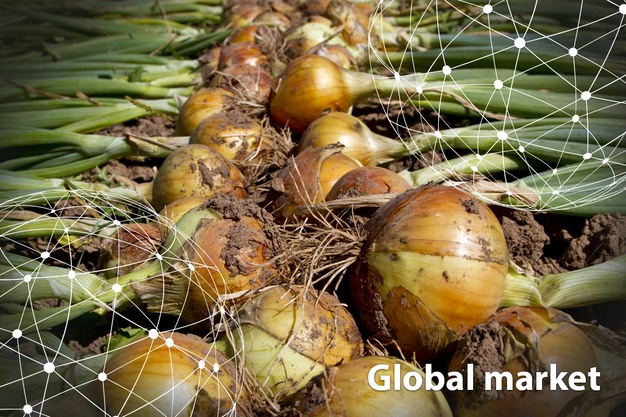 © Viola van den Hoven-Katsman | FreshPlaza.com
North America reports ample domestic supply following favourable growing conditions and expanded acreage, although storage quality issues and early arrivals from Texas are influencing trade. South Africa is currently supplied mainly by the Northern Cape, Free State, and Ceres, with prices 7% higher year on year, and a seasonal shift to Limpopo expected within weeks. India is experiencing a sharp decline in wholesale red onion prices as arrivals increase, while exports remain active, supported by steady Gulf demand. In Peru, exporters are navigating lower returns, declining yields, and sustained cost pressures as the 2025–2026 yellow onion season unfolds.
Italy: Supply ample, prices largely unchanged
There are no significant fluctuations in the Italian onion market. According to an operator in the north of the country, European markets are well supplied, which is keeping prices at relatively moderate levels. At this time of year, the trader buys yellow onions at €0.25 to €0.30 per kg, white onions at €0.60 to €0.70 per kg, and red onions at €0.30 to €0.35 per kg on the free market. Retailers are purchasing continuously and remain highly price-conscious, as they receive offers not only from Italy but also from abroad. Overall, product quality is considered satisfactory.
According to ISMEA data for the first week of February 2026, average producer prices for onions remained stable compared to the previous week, although developments differ from last year. Yellow of Parma onions are trading at €0.38 per kg, unchanged both week on week and year on year. White round onions reached €0.56 per kg and yellow round onions €0.51 per kg. Both recorded week-on-week stability at 0%, but showed year-on-year increases of 11.3% and 22.4%, respectively. Red round onions diverged from this trend, with a price of €0.50 per kg, unchanged from the previous week, but down 8.7% compared to the same period last year.
Spain: Heavy rains disrupt planting and raise concerns for early campaign
Heavy rainfall across much of Spain in recent days has created uncertainty for the upcoming onion season. Flooding in Andalusia has affected early plantings, while continued rain is complicating sowing in Albacete and Ciudad Real, the country's main onion-producing areas.
"The overflowing of several rivers in Andalusia following a series of storms has significantly affected a large number of onion fields located in their basins, primarily in Cordoba, Seville, and Malaga," explains a representative of the country's largest onion grower and exporter association. "There is great concern about how the crops will develop, as the flooding of the fields causes root asphyxiation in the plants. The damage will be substantial. It should be remembered that the harvests in Andalusia are fundamental to covering the start of the Spanish campaign."
In Castilla-La Mancha, persistent rainfall has hindered field preparation for planting. "The threat of one rain front after another poses a major setback when it comes to planting. We have recommended that farmers carry out direct sowing as soon as possible in Albacete to anticipate upcoming rain events and avoid the delays that occurred last season," he adds.
Regarding the current marketing season, the market is described as calm, particularly for exports. "There are large quantities of onions stored in various destination countries in Europe, with the high Dutch supply having a particularly significant impact on our sales," the representative says.
Large onions, considered Spain's most distinctive product, are achieving the highest prices, though demand remains limited due to restricted supply and elevated price levels. Medium-sized onions, which are relatively large compared to other origins, are trading at acceptable prices, while small onions are quoted at low levels and show limited commercial activity.
"It's also worth noting the premature—and in my view, unnecessary—arrival of the first imports from the Southern Hemisphere," he points out.
Germany: Exports under pressure, retail demand steady
According to the trading company Weuthen GmbH, the export market is continuing to accept only coarse onions of top quality. In the first half of the marketing year, a notable export surplus was recorded, despite a large harvest. Contract volumes are moving as planned. Supply pressure from lower-quality onions remains evident, alongside ongoing issues with bacterial rot, Fusarium, and increased sprouting.
Exports to Eastern Europe remain weak, with prices at the lower end of the range. In contrast, the German domestic market is performing more favourably, with satisfactory demand from food retailers. However, supply volumes are particularly abundant.
The Netherlands: Record exports followed by slower market from December
In the first half of the season, Dutch onion exporters recorded a total export volume of 860,000 tons. Despite this record performance, market activity slowed in December 2025. Growers and traders are now reviewing stocks and preparing for the traditionally quieter second half of the season.
Senegal, the main export destination, is largely stepping back from the market. Alongside the remaining West African countries, European markets will need to absorb volumes, with potential opportunities in overseas destinations.
Uncertainty regarding demand in the second half of the season is resulting in a slower market pace. Final harvest forecasts indicate that yields for yellow seed onions are projected at 54.3 tons per hectare, representing a 1.9% increase compared with preliminary estimates.
Austria: Market remains unchanged, prices steady
The Austrian onion market shows no changes. Farmers remain willing to sell, and traders are well supplied. Sales in the domestic food retail sector have remained steady for another week. Exports are also possible on a manageable scale.
Producer prices are unchanged compared to the previous week. At the start of the week, cleaned and sorted onions in boxes were mostly sold for €10 to €13 per 100 kg, depending on quality. Lower-quality onions are traded at correspondingly lower prices.
France: Quiet market following early overproduction
The French onion season began with overproduction, but issues with fusarium wilt ultimately helped to regulate national output. The campaign opened with a very quiet market and sharply declining prices, followed by a period of stabilisation.
At present, there are no signs of a reversal in the trend. The market remains very quiet, with limited interest in the product and sluggish sales, further affected by the lack of promotional activities in stores. Prices, however, are holding stable.
North America: Ample supply, quality concerns in storage
Domestically, onion supplies are ample. Growing conditions were favourable, and additional acreage was planted this year across storage regions. With some commodities under price pressure, certain grain growers in the Pacific Northwest shifted to onion production.
Quality concerns are reported for PNW onions. Mild temperatures persisted until January in facilities without cold storage, resulting in higher-than-normal shrinkage. There are also reports of neck rot and internal decay across several growing regions.
Texas onions are running approximately one month early, with volumes expected to arrive within a few weeks. Mexico is also shipping onions. Volumes may be slightly lower this season, as tariff uncertainties influenced planting decisions for products typically destined for the U.S. market. Peru and Canada are also shipping onions.
Demand has been described as normal. Yellow onion prices are low and below the cost of production. Red onions are stable and steady, though likely at break-even or below production costs. The white onion market remains profitable, with fluctuations depending on quality.
South Africa: Cape supply dominates market as prices edge higher
Between the Northern Cape, the Free State, and Ceres, these regions are currently supplying most of the South African onion market. Market prices are around €2.20 per kg for 10 kg bags, which is 7% higher than a year ago. Prices are expected to increase over the coming months as the Cape concludes its onion season.
"The Western Cape and Northern Cape are in the market right now with a lot of low-quality onions pulling down the average price at the moment," says a market analyst. "The lower middle month demand will also not help the situation."
In approximately one month, Limpopo, a short-day onion production area, will begin harvesting, gradually taking over supply from the southern long-day onion production regions.
India: Red onion prices decline with higher arrivals
Wholesale red onion prices at Nashik's Lasalgaon APMC have fallen by nearly 25% over the past 8–10 days, decreasing from €15.25 per quintal to €11.18 per quintal as daily arrivals increased from 15,000 quintals to 25,000–30,000 quintals.
The late kharif crop, delayed due to heavy rains last year, is now dominating supply. With a shelf life of less than one month, growers are selling quickly, adding further pressure to the market.
Exports from Nashik mandis continue through late February despite softer domestic prices. Dubai is absorbing up to 60 containers per day for repacking and onward shipment to Saudi Arabia, Oman, Qatar, and Bahrain. Bangladesh imports remain capped at 50 trucks via Benapole.
Farm gate prices are reported at €0.13–0.17 per kg, while export realisations range between €0.18–0.20 per kg, supported by premiums in Gulf markets.
Red onion shipments are expected to remain steady through the end of February, before quality declines and summer varieties with a 7–8 month shelf life replace the current supply, targeting larger Gulf demand.
Peru: Lower returns and declining yields in yellow onion exports
The 2025–2026 season has been unfavorable for yellow onion exports from Peru. After a 2024–2025 year in which producers generally recovered their investments, the current cycle has delivered reduced returns and, in some cases, losses, according to Fernando Gómez, general manager of Semiagro.
In Peru, sweet yellow onion harvests, primarily of the Granex variety for export, begin in June and can continue until February or March of the following year, depending on market conditions. In recent years, the harvest window has been extended as new markets have opened, although economic results remain inconsistent.
Weather conditions have been a key factor. "During 2024 and 2025, mild to normal La Niña conditions prevailed, supporting stable production and strong volumes not only in Peru but across other countries in the continent. This created an international oversupply, leading to regular to low prices," Gómez explained.
While climatic conditions favored good harvests, average yields per hectare have been declining. "If some years ago it was possible to reach potentials close to 100 tonnes per hectare on the Peruvian coast, nowadays the averages are closer to 70 tons. This reduction has a direct impact on the costs per kilo produced," he said.
Rising labor costs in Peru have further affected the crop's competitiveness, particularly compared to sectors such as blueberries, grapes, and avocados, which can absorb higher wages.
Phytosanitary challenges linked to monoculture also continue to pressure the sector. "Problems such as Fusarium (soil fungus), Stemphylium (leaf fungus), and thrips impact yields and lead growers to seek new varieties with greater tolerance. In this context, the replacement of varieties has increased in order to restore productivity and stability," he emphasized.
Yellow onion production for export is concentrated in the south of the country. Around 85% of the cultivated area is located in the Ica region, followed by Arequipa. In recent years, the planted area has expanded from approximately 2,500 to 3,200 hectares, reflecting steady growth up to the current season.
"However, growers are feeling discouraged about the 2026–2027 season, which might lead to a decrease in the area they plant. If this happens, supply could decrease, and prices could recover," he stated.
"The United States remains the primary market for Peruvian yellow onions. Meanwhile, Europe is experiencing rising demand. Notably, there is a shift in size preference: medium-sized onions, which were previously common for pre-packing, are now being replaced by a growing interest in larger onions, which could indicate lower availability at the source," he concluded.
Next Topic: Grapes