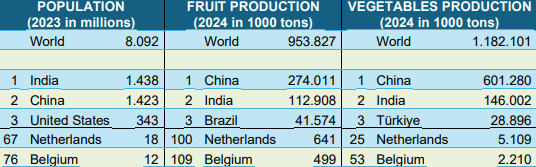
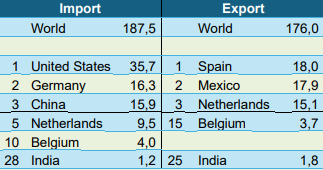
With nearly 1.5 billion inhabitants, India is the most populous country in the world. The country also plays an important role in global fruit and vegetable production. India ranks second globally in this regard, well ahead of China. However, as a trading nation in fresh fruit and vegetables, India's position remains limited, ranking between approximately 25th and 30th place worldwide.
Diet largely plant-based
India's diet differs markedly from that of Europe. On average, nearly 90 per cent of calorie intake consists of plant-based products; in the Netherlands, this share is around 60 per cent. Cereals, especially rice, account for about half of total calorie intake in India, compared to roughly 20 per cent in the Netherlands. According to FAO figures, India produces more than 200 million tons of rice and over 100 million tons of wheat annually.
 © Jan Kees Boon
Within fruit and vegetable production, bananas are the most important crop, with a volume of 38 million tons by 2024. They are followed by mangoes at 28 million tons, onions at 24 million tons, tomatoes at 21 million tons, aubergines at 13 million tons, and cabbage and cauliflower at around 10 million tons each. Although fruit and vegetables contribute relatively little to overall calorie intake, they are essential sources of key nutrients.
Net exporter, but imports increasing
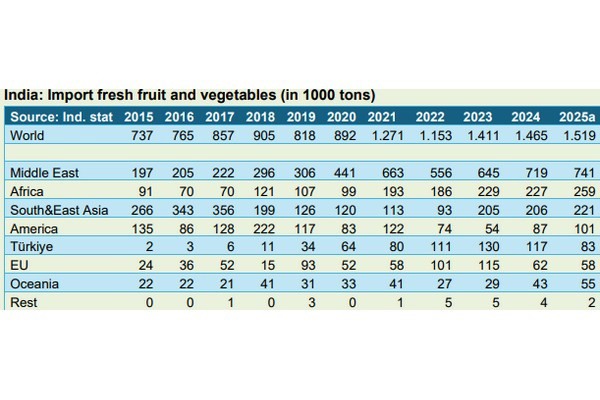
India is a net exporter of fresh fruit and vegetables. However, imports have increased significantly over the past decade, reaching around 1.5 million tons last year, approximately double the level of ten years ago. Exports are more volatile. Last year, 3.8 million tons were exported. This was higher than in 2024, but lower than in 2023, when exports reached 4.1 million tons.
 © Jan Kees Boon
Around half of India's imports originate from Middle Eastern countries, with Iran as the main supplier. The United Arab Emirates and Iraq follow at some distance. Other relevant source countries include South Africa, Egypt, Turkey, and Afghanistan.
Dates and apples dominate imports
Each accounting for about one-third of total import volume, and together exceeding 500,000 tons, dates and apples are by far the most important imported products. In addition, India imports approximately 150,000 tons of oranges annually.
From Iran, imports consist mainly of apples, supplemented by dates and kiwis. The United Arab Emirates primarily supplies dates, as well as apples, garlic, kiwis, and oranges, and in some years also onions. South Africa mainly exports apples, oranges, and pears to India, while Egypt exports almost exclusively oranges. Turkey supplies mainly apples, and Afghanistan apples and figs, and in some years also substantial volumes of onions.
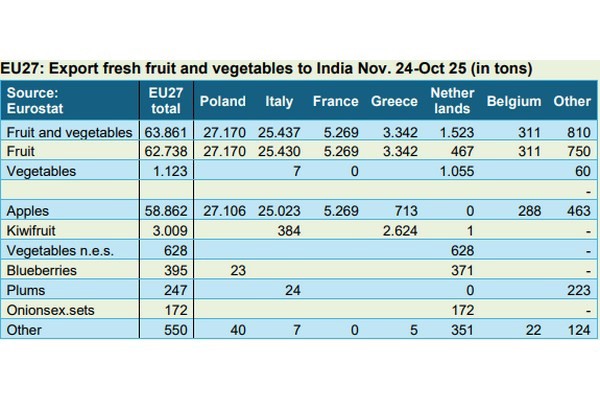
Imports from EU countries are limited to around 60,000 tons per year. Poland and Italy are the main suppliers, particularly of apples. There is also a notable inflow of kiwis from Greece. Exports from the Netherlands and Belgium are very small. According to Eurostat, the Netherlands exported around 1,500 tons to India last year and Belgium over 300 tons, mainly apples. Growth is visible in some smaller product groups, including kiwis, mandarins, pears, and grapes.
 © Jan Kees Boon
Highly volatile exports due to onions
India's fresh fruit and vegetable exports fluctuate considerably, mainly due to variations in onion exports. Onions are by far the most important export product. In 2023, exports peaked at 2.5 million tons. In 2024, this fell to less than 0.9 million tons, before increasing again to 1.5 million tons last year.
Approximately two-thirds of onion exports are shipped to countries within the region, supplemented by significant volumes to the Middle East. The greatest fluctuations occur in exports to Bangladesh. Exports to Europe are relatively small and also highly variable: in 2019 and 2023, they amounted to 38,000 tons and 33,000 tons respectively, while in 2024 this declined to 6,500 tons and reached 16,500 tons last year.
Grapes important for the Netherlands
After onions, bananas are the second-largest export product. Exports have grown strongly in recent years, reaching around 1 million tons last year. These shipments are entirely focused on Asian markets.
 © Jan Kees Boon
Grape exports have also increased sharply, reaching 270,000 tons in 2021. The volume exceeded 300,000 tons in 2024, before declining slightly to 282,000 tons last year. The Netherlands is the main buyer of Indian grapes. Last year, around 100,000 tons were shipped to the Netherlands, approximately 10 per cent less than the record level of 2024. Other major markets include Bangladesh, Russia, the United Arab Emirates, Nepal, and the UK.
According to Eurostat, a total of approximately 120,000 tons of fresh fruit and vegetables from India were imported into the EU last year. Grapes accounted for by far the largest share at 100,000 tons. Around 11,000 tons of onions were also imported, while volumes of other products were considerably smaller.
Click here for background information.
For more information:
Jan Kees Boon
Fruit and Vegetable Facts
[email protected]
www.fruitandvegetablefacts.com