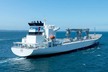
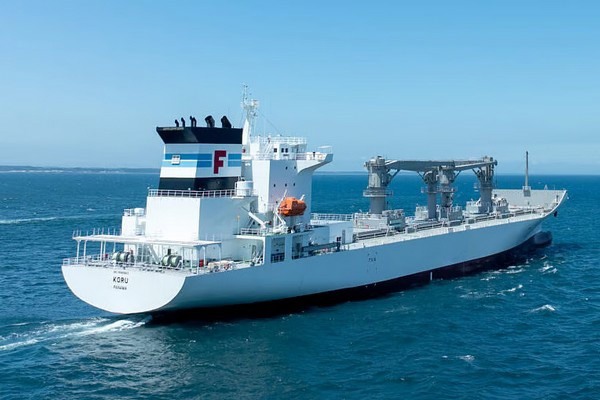
Japan's Kitanihon Shipbuilding has delivered a new refrigerated cargo vessel to Fresh Carriers. The Panamanian-flagged Koru will be operated under charter by New Zealand-based Oceanic Navigation and deployed primarily on kiwifruit export routes from the Port of Auckland.
The vessel will mainly transport kiwifruit from New Zealand to markets in East Asia, Latin America, and the United States. In addition to fruit, the vessel has also been used for other cargo types. During a call at Auckland in August, Koru offloaded more than 400 used vehicles imported from Japan, demonstrating its multi-cargo capability.
 © Kitanihon Shipbuilding
The newbuild has a length overall of 158 metres and a beam of 25 metres, with a summer draught of 10.02 metres and a moulded depth of 14.35 metres. The vessel has a deadweight of 14,600 tons and a gross tonnage of 13,295. Cargo capacity includes space for 154 forty-foot refrigerated containers, alongside temperature-controlled cargo holds designed for low-temperature transport.
Cargo handling is supported by onboard cranes with lifting capacities of 40 tons and eight tons. This enables loading and unloading operations in ports with limited shore-based infrastructure, supporting flexibility across different export destinations.
Propulsion is provided by a Japan Engine Corporation main diesel engine with an output of 9,860 kW, driving a single propeller. The vessel is also equipped with a Miura auxiliary boiler and five generators rated at 6,120 kVA each to support onboard power requirements, including refrigeration systems.
Koru has been constructed in compliance with ClassNK standards. She will operate on the same trade routes as her earlier sister ships, Kowhai, Kakariki, and Whero, which have been deployed on similar refrigerated cargo services.
According to the shipbuilder, another vessel from the same series is scheduled for delivery in the coming months. The addition of Koru expands capacity for temperature-controlled logistics supporting New Zealand's horticultural export flows, particularly during peak kiwifruit shipping periods.
Source: Baird Maritime