Ethylene is one of the most powerful drivers of post-harvest behavior, accelerating fruit ripening but also ensuring uniform ripening, better texture, enhanced flavor for consumers, and reduced food waste. However, even extremely low concentrations can trigger ripening and aging processes, including increased respiration, softening, pigment changes, and overall senescence. "Ethylene has become essential in fruit ripening, but verification and control are necessary in managing ethylene output," says Galen George with Felix Instruments.
"If ethylene accumulates – even slowly – is shortens shelf-life and amplifies quality variability across the lot," George added. Because fruit is variable to begin with, ethylene exposure tends to make that "variability problem" worse and more noticeable at retail. Even when a room looks fine based on occasional checks, unmeasured spikes have the potential to quietly add up and cause real losses.
 © Felix Instruments
Measuring ethylene output
Felix Instruments has developed a toolkit that helps facilities measure ethylene output, enabling intentional ethylene management instead of guesswork. The toolkit supports the full workflow:
- Portable ethylene measurement for spot-checking, troubleshooting, audits, and validation.
- Multi-gas analysis (ethylene plus CO₂ and O₂) when teams need a fuller picture of storage atmosphere and respiration behavior.
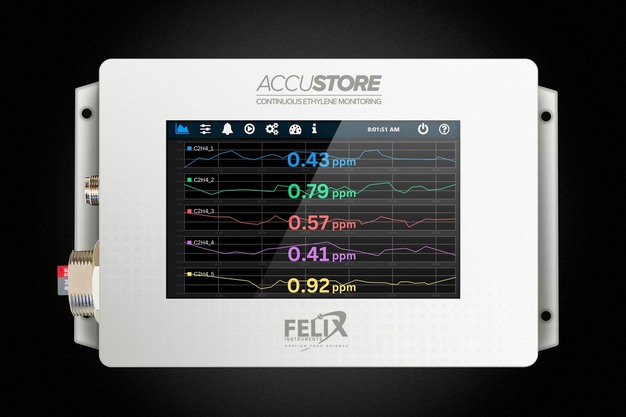
- Continuous monitoring for cold rooms and storage environments where the real issue isn't "is ethylene present?" but "what's the pattern over time, where are spikes occurring, and is our abatement actually working day-to-day?"
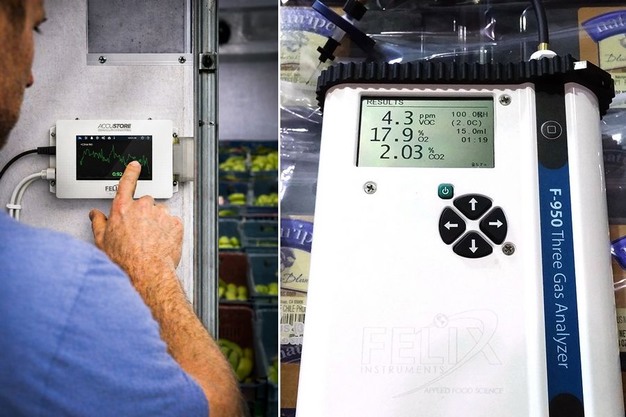
The F-900 Portable Ethylene Analyzer is the tool most commonly used for measuring. It's built for real-world environments where accurate readings are needed quickly, not a lab process that takes days. The F-900 measures ethylene in real time and is designed to be sensitive enough for storage and post-harvest work—down to 25 ppb (0.025 ppm) on its high-sensitivity range—while also covering higher concentrations with a wider range sensor.
For continuous environments, Felix Instruments also supports fixed and networked monitoring approaches where high-resolution data (second-by-second) is collected from one or multiple points in a room. "That's where you stop seeing "random readings" and start seeing repeatable patterns—daily cycles, spikes, decay rates after door openings, and differences by location in the room," commented George.
 © Felix Instruments
Total exposure over time
What's really important in measuring and controlling ethylene amounts is total exposure over time. A lot of facilities validate ethylene control with periodic grab samples. However, those methods capture moments, not patterns. "We've seen many environments where the average ethylene reading looks acceptable, but continuous monitoring reveals regular spikes that last hours—often tied to operational events like restocking, door openings, airflow disruptions, or warm air mixing." Those spikes can account for a disproportionate share of total exposure and that's exactly the kind of exposure that accelerates aging and reduces shelf life. Controlling ethylene is really about making a storage environment more physiologically stable, resulting in a more consistent product, fewer surprises, and lower shrink.
Fruit Logistica Berlin
At Fruit Logistica in Berlin this week, George will speak about verifying ethylene control in storage environments. He will share a real-world case study from a high-throughput retail produce cooler where Felix Instruments ran 14 weeks of continuous ethylene monitoring, collecting one data point per second across multiple sensing locations.
During the monitoring process, the real problem was identified, which was a repeatable afternoon ethylene spike almost every day. Without changing the technology, placement and airflow were optimized by adding a second unit, reducing the spike amplitude and improving recovery time after spikes. This resulted in a total ethylene exposure drop of roughly 40 percent, a drop of baseline levels of 50 percent and spike amplitude was cut roughly in half - under real operating conditions, not a lab chamber.
"The bigger takeaway is that facilities can start simple: use portable measurement to map hotspots, then place one or two continuous points where variability is highest and iterate one operational change at a time (fan settings, intake height, unit placement, airflow direction) while watching the impact in the data." Participants will leave with a framework they can apply immediately to reduce ethylene exposure, improve storage consistency, and protect product quality.
Attend the session on Thursday, February 5 at 17:00 hrs. in Hall 21, Insights Stage. The stand of Felix Instruments can be found in Hall 3.1, stand D-33.
 For more information:
Galen George
Director of Applied Science
CID Bio-Science / Felix Instruments
Tel: +1 (360) 833-8835
[email protected]
www.cid-inc.com