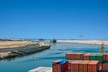
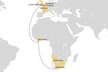
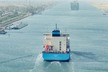
CMA CGM, the world's third-largest liner, has taken a different position from analysts who expected container lines to return to the Suez Canal following a three-month ceasefire on merchant shipping by the Houthis. Referring to the "complex and uncertain international context", the French carrier announced that three services, FAL 1, FAL 3, and MEX, will again be routed via the Cape of Good Hope. These services had returned early to the Suez route last year.
The announcement contrasts with recent developments involving Danish carrier Maersk. Last week, Maersk rerouted its MECL service back into the Red Sea, reconnecting the Middle East and India with the U.S. East Coast. As Maersk has previously been among the most cautious major carriers regarding a return to the Red Sea, its decision was seen by analysts as a potential signal for a broader return to the traditional Asia–Europe route. The decision by CMA CGM now introduces uncertainty around that expectation.
The change in routing comes against a backdrop of rising geopolitical tension in the Middle Eastern waters. Over the past 10 days, relations between the U.S. and Iran have become more confrontational. Iran has stated that any U.S. strike would likely result in commercial shipping being targeted by Tehran. Iran has also been the main supporter of the Houthis in terms of military hardware and intelligence.
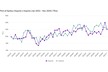
From a logistics perspective, routing decisions remain closely linked to operational parameters in global container shipping. "The return to the Suez Canal route is one of this year's key influencing factors for capacity, freight rates, transit times and fuel consumption," said Philip Damas, managing director of shipping consultancy Drewry.
For shippers and growers dependent on predictable transit times and stable capacity, liner deployment strategies remain subject to geopolitical developments and risk assessments, with routing choices continuing to influence lead times and cost structures in international supply chains.
Source: Splash 247