Taiwan-based vertical farming operator and technology provider, YesHealth Group, through its joint venture with Saudi Arabian agriculture company, Mowreq Specialized Agriculture, has begun supplying the retail chain Panda in Riyadh under the brand name Jana Farm, as the new facility ramps toward full capacity. "It's fully operational, and it's selling in the market," said Jesper Hansen, Chief Commercial Officer at YesHealth.
Hansen said the facility is planned to reach "around 2000 kilos or two tons per day" within the next 12 months, with volumes increasing in stages rather than jumping straight to full output. He described the Saudi project as a deliberate shift away from automation-first storytelling and toward operational pragmatism, arguing that the farms that endure will be differentiated by execution. "Building a farm, though difficult, is many times easier than running the farm," he said.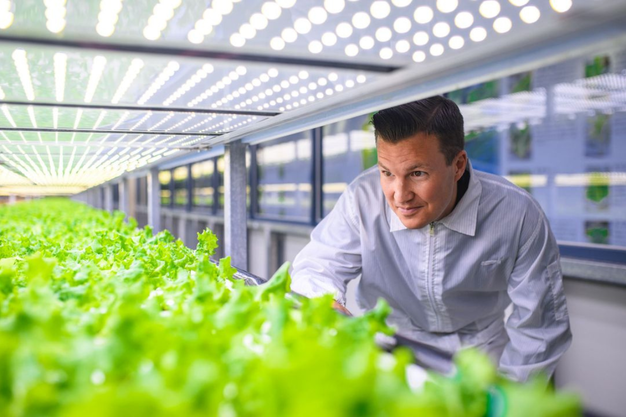 © YesHealth Group
Jesper Hansen
A Taiwan operator, and a global build-and-operate model
YesHealth is best known in Taiwan for its commercial vertical farming operation in Taoyuan, where it sells produce under the YesHealth iFarm brand. Hansen said that domestic operating experience shaped the company's approach to international expansion, where it typically stays involved long after construction is complete.
"We design, we build, and we operate. Typically, we also co-invest," Hansen said. "We have a small shareholding in each of our international projects." For YesHealth, he said, the point of remaining involved is simple: the value is created in day-to-day operations, not in the build itself.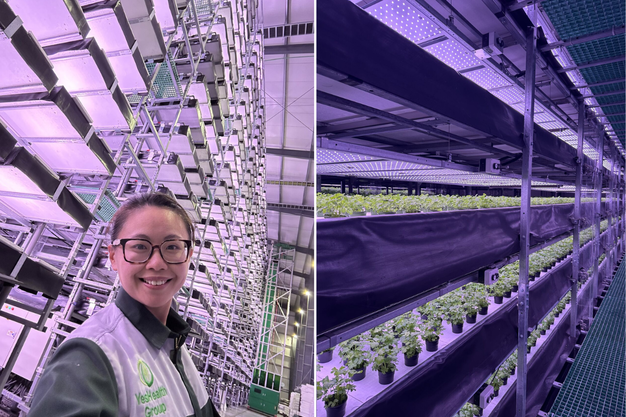 © YesHealth Group
Stella Tsai, Group Facilitator for YesHealth Group, alongside the 15-meter-tall racks inside the Riyadh farm
Why Saudi Arabia is a fit for vertical farming
Hansen positioned the Riyadh project as an example of where vertical farming can deliver clear advantages, rather than a model that can be copied everywhere. "I've always thought that vertical farms have their specific value proposition and utilization," he said. "I think they're far more meaningful to build in a desert or in a cold area or on an island somewhere where there's not traditional agriculture that works flawlessly."
In Saudi Arabia, Hansen pointed to both climate pressure and supply-chain constraints, including products that are difficult to ship by sea or road within an acceptable freshness window. "We grow items like arugula (rocket), which is flown into Saudi from Italy, because you cannot ship it in. The shipping time is longer than the flight," he said. "When you can grow locally, you just have a huge advantage."
He also highlighted the operational challenge posed by heat. "Outdoor temperatures reached 54 degrees Celsius last year," Hansen said. "It's an insane temperature that even the most advanced or high-tech greenhouses would also struggle to cope with."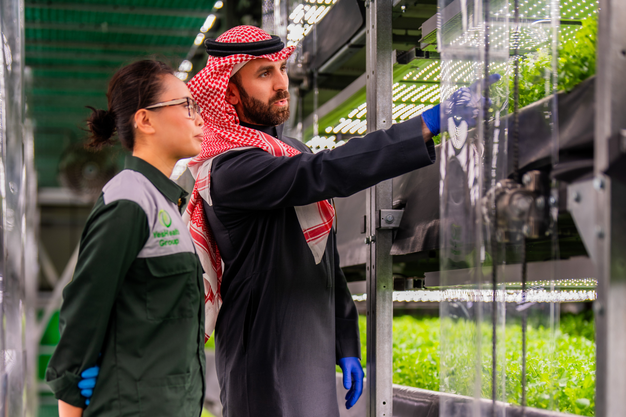 © YesHealth Group
Stella Tsai with Danny Alhussamy, COO of Mowreq
A planned ramp, with volume increasing in stages
Hansen emphasized that "fully operational" does not mean instant full capacity. Instead, he described a planned ramp, developed in coordination with market partners, where volumes increase over time as distribution and demand build.
"We have over 20 different SKUs, and all of the products are in the market, just at lower volumes," he said. "We'll reach full production capacity within a year." He said the product range spans multiple categories, including lettuces such as butter, romaine, and iceberg, as well as cruciferous greens and herbs. The joint venture also plans to supply microgreens and edible flowers, with edible flowers positioned for hospitality buyers.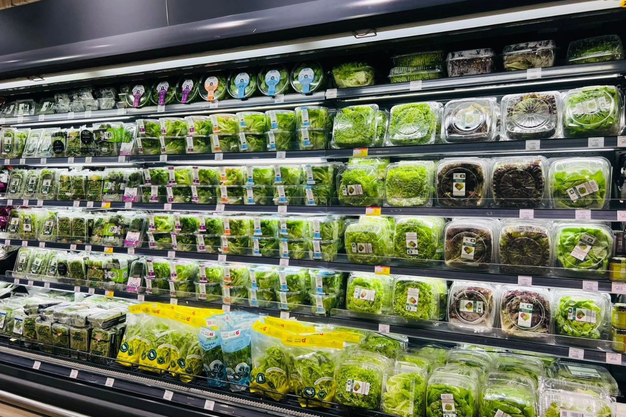 © YesHealth GroupJana Farm produce is available at Panda stores across Saudi Arabia, from Riyadh to Jeddah and the Eastern Province, with the first deliveries made on Christmas Day 2025
Staffing and knowledge transfer inside the Riyadh farm
Hansen described YesHealth's international role as distinct from its domestic consumer brand in Taiwan. "In Taiwan, we're known as a fresh produce and health brand," he said. "But really, with projects like Saudi Arabia, we act as a technology provider."
In Riyadh, he said YesHealth is operating under a multi-year management agreement that places technical leadership with YesHealth staff while building local operational capacity. "All the specialized or technical roles within the farm are occupied by YesHealth staff, dispatched from Taiwan," Hansen said. "All the processes like seeding, harvesting, and operating the machines are done by operators that we hire locally."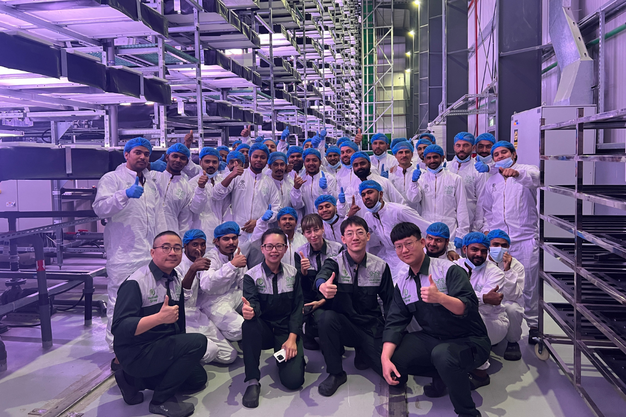 © YesHealth Group
Stella Tsai and YesHealth specialists, together with local Mowreq operators
A lean approach to automation, starting with manual packaging
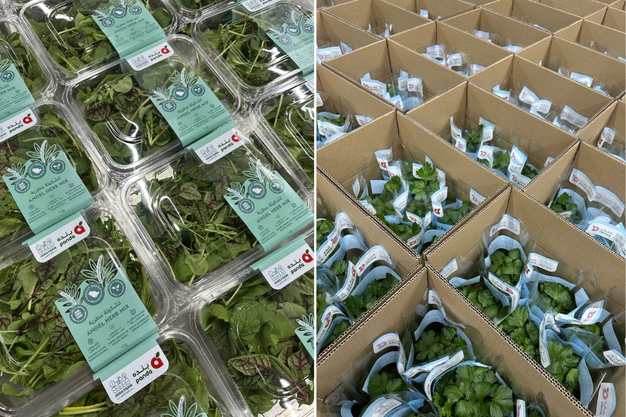
One of Hansen's clearest examples of YesHealth's operating philosophy in Saudi Arabia was packaging. "Despite the scale of the Riyadh facility, all the packaging is manual. We have 20 to 30 people packing every day." Hansen said the decision reflects a broader principle: avoid automating too early, before the market has proven which products and formats will win.
"We have experienced over and over again that you shouldn't automate before you have a stable product assortment," he said. "We always do the opposite. We say take it easy and start to sell in the market, even though it's labor-intensive to pack by hand in the beginning. Once you have a clear idea of your long-term product assortment, then you go out and automate."
He argued that early automation can lock a facility into packaging configurations that do not match what the market ultimately demands, especially when product mix changes after launch. "Let's just say kale actually is not selling in the market, but the other product, iceberg lettuce, is selling much more," Hansen said. "So you end up with a machine design that doesn't fit your needs."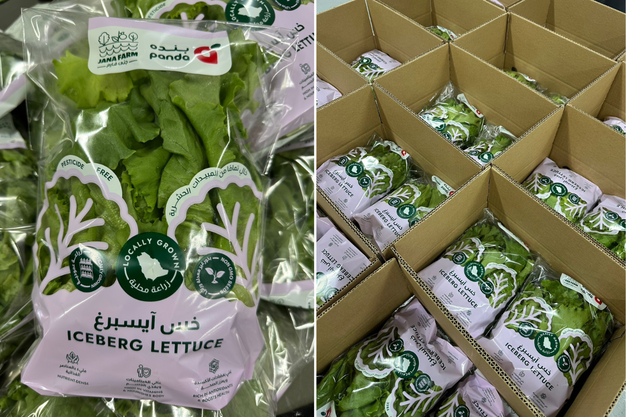 © YesHealth Group
 © YesHealth Group
Leafy greens, packed by hand, for local retail chain, Panda
Building the region's tallest vertical farm
Hansen said the Riyadh facility was built to 15 meters with 19 levels, higher than YesHealth's standard of 10 meters with 14 levels, making it the tallest vertical farm in the MENA region. He describes construction and commissioning in Riyadh as materially different from other regions due to environmental conditions, particularly extreme heat and sand infiltration.
"The complexities of building under very high temperatures and in an environment with frequent sandstorms were the most difficult," he said. "You cannot completely seal it off until the very end." As a result, teams spent significant time cleaning surfaces to remove sand dust before operations could fully stabilize.
"We spent a lot of time washing down every single surface inside the farm due to a very thin film of sand," Hansen said. "But that's what happens when you build in the middle of the desert."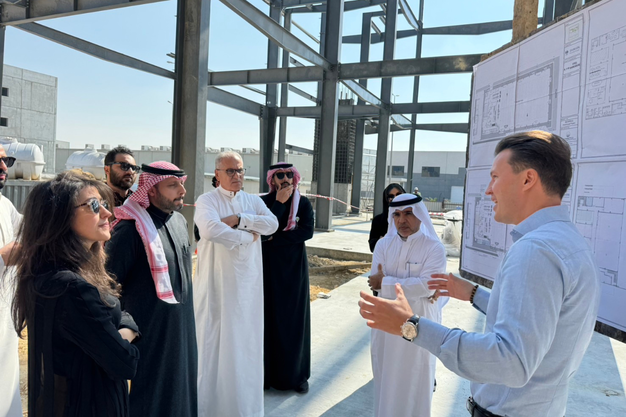 © YesHealth Group
Hansen briefs guests from the Kingdom of Saudi Arabia's Agricultural Development Fund, backers of the joint venture, during the early construction phase of the farm
Energy economics in Saudi, and a note on renewables
Energy is a dominant theme in global indoor farming, but Hansen said it is not the primary constraint in Saudi Arabia due to low electricity costs, contrasting it with colder, higher-cost markets where energy strategy becomes central to the business case. "In Saudi Arabia, energy is cheap," he said. "In other places, we have to implement strategies around how we use electricity, but it's not the main concern for this facility."
He added that the Riyadh facility is not integrated with renewable energy at the outset, but it is a consideration for future facilities. "The project is not initially integrated with renewable energy, but that's because of the space limitations," Hansen said. "However, we imagine that subsequent farms that are built under this partnership will be integrated with renewables like solar."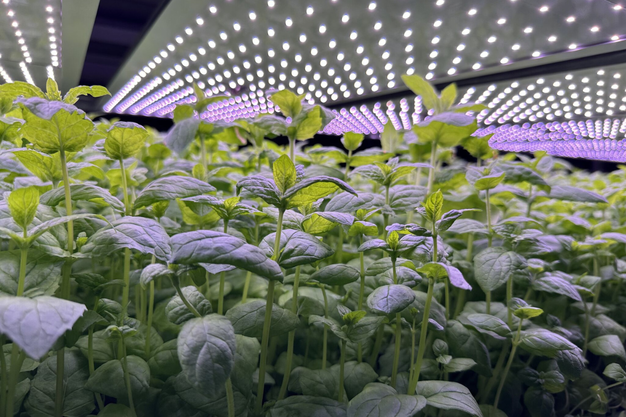 © YesHealth Group
From technology claims to operating discipline
Hansen placed the Riyadh project in a wider industry narrative: a shift away from technology-first storytelling toward operational realism, especially following high-profile failures in the sector. From his perspective, the current correction resembles an earlier cycle in Asia, where large-scale plant factories were built decades ago, with many later failing before the market matured.
"Many indoor farms were built in Asia over 20 years ago," he said. "Around 2010, many of them went bankrupt. Same kind of trajectory we're seeing now in the US and Europe. The idea that technology will solve everything, but neglecting the growing part, and neglecting the cost part."
He says the differentiator now is not a unique or proprietary system, but the daily decisions that keep farms running, aligned with market demand, and controlled on cost. "It's not the technology itself," Hansen said. "The farms that are emerging as winners are the ones with the right people and the right processes."
For more information: 
YesHealth Group
Jesper Hansen, Chief Commercial Officer
[email protected]
www.yeshealthgroup.com/farms/mowreq