Brazil's Minister of Ports and Airports, Silvio Costa Filho, has announced a private investment of R$948 million (US$193.5 million) to expand and modernise the ICTSI Rio Brasil Terminal at the Port of Rio de Janeiro. The project is scheduled to run from 2025 to 2029 and is expected to increase the terminal's annual handling capacity from 440,000 TEUs to 750,000 TEUs, an increase of 70.5%.
According to the ministry, the investment consists of approximately R$414.4 million (US$84.6 million) allocated to infrastructure works and R$533.5 million (US$108.9 million) for new equipment. Planned measures include the expansion and reconfiguration of storage yards, the rearrangement of buildings to improve internal traffic flows, upgrades to electrical and utility systems, and the acquisition of additional container-handling equipment. The project also includes investments in automation, cargo management systems, access control and monitoring, as well as adjustments to meet updated regulatory requirements set by Brazil's Federal Revenue Service.
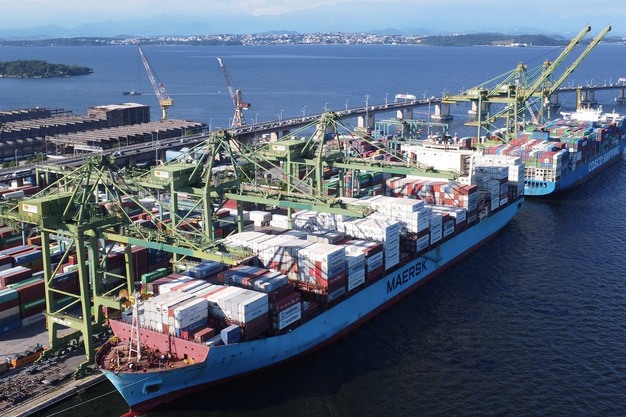 © ICTSI
The terminal operator, International Container Terminal Services Inc. (ICTSI), stated that the expansion will allow the Rio Brasil Terminal to handle larger vessels, including Panamax and post-Panamax ships of up to 366 metres in length and capacities exceeding 13,000 TEUs. Two new ship-to-shore cranes are scheduled to arrive from mid-2026, with specifications suitable for vessels of up to 400 metres.
The Port of Rio de Janeiro has recorded growth in cargo volumes in recent years, driven by increases in containerised trade. According to government data, container throughput at the port has continued to rise since 2023, with further growth projected over the medium term. Without additional capacity, projections indicate that the terminal could reach saturation between 2027 and 2028.
ICTSI indicated that part of the strategy is to redistribute container traffic currently concentrated at the Port of Santos. In addition to the Rio Brasil Terminal project, the company has previously invested more than R$190 million in logistics corridors linking Rio de Janeiro with Minas Gerais and Suzano, with a focus on rail transport.
The expanded terminal is expected to begin offering additional capacity from 2026, with full utilisation projected at around 75% between 2029 and 2030. According to ICTSI, this timeline is intended to support more predictable operations and reduce congestion risks at other Brazilian ports.
ICTSI operates 34 container terminals across 20 countries. In Brazil, the company manages the Rio Brasil Terminal as part of its broader South American port operations.
 © ICTSIFor more information:
Ronnel Javier
ICTSI
Tel: +63 2 8245 4101
Email: [email protected]
www.ictsi.com