On December 8th, the French Minister of Agriculture launched the Conferences on Food Sovereignty at the Rungis MIN, with the aim of defining a national agricultural strategy over the next ten years. But for the French Apple Pear Association (ANPP), "this work cannot be undertaken or have the slightest impact if certain prerequisites are not met."
No projection without knowing what is on offer
"We cannot discuss sovereignty without knowing what we are producing," explains Pierre Venteau, director of ANPP. "This is because, generally speaking, the potential of French apple production remains unknown, and nobody knows how to measure supply, at least on a national scale. The data from the General Agricultural Census (RGA) and the annual Agreste figures differ: the RGA counts areas with little or no production, which can distort the result, according to Pierre Venteau. But the main reason for this discrepancy lies in the accounting method, "which is based on a sampling system at the time of the CAP declaration, in which apples are not clearly identified." The situation is even worse for organic produce, where there is not even any differentiation between table apples and apples for juice. What can be done? According to ANPP, the best assessment would be based on recognition using photo image processing and radar, accompanied by AI, "for which we can have a good level of (interspecific) discrimination. But with a cost of €150,000 [175,392 USD], it is difficult to finance." Another solution would be to make precision compulsory in the CAP declaration.
Authorizing the use of ozone
Ozone is currently banned in the process of apple packaging and storing. The fruit is currently transported to the stations with clear water. However, ozone has been used in France since 1904 to treat drinking water and in municipal swimming pools. Since 2019, following an opinion from ANSES, it has also become an authorized processing aid for bagged salads, known as 4th range salads. Above all, France imports ozone-treated fruit and vegetables from a number of European countries on an almost daily basis (ozone in banana and grapefruit containers, and treatment of Spanish red fruit). ANPP finds this situation incomprehensible and, above all, penalizing for the sector, especially as ozone "would make it possible to combat storage diseases in apples."
Authorizing new techniques for applying plant protection products
The apple and pear sector is also calling for the authorization of new techniques for applying plant protection products, including "two promising methods that combine greater efficacy for the same applied dose and limit the risk of drift. These are the PulVéFix and the tree micro-injection systems." The association is therefore asking to be allowed to use these techniques, which meet the need for improved and more efficient treatment techniques while protecting the orchard environment.
Securing operational programs
"Historically, French orchards have been able to modernize thanks to the effectiveness of operational programs open to members of recognized producer organizations. This system ensures that European funds are mobilized at very significant levels, thanks to the counterparts provided by the producers themselves, in line with their real needs and priorities," explains ANPP. This system has enabled the apple sector to incorporate a number of innovations, including mating disruption, energy-saving irrigation, anti-hail nets, and frost control. But under the European Commission's proposal for the future 2028-2034 CAP, this funding for programs is under threat. "These programs are unique in that they have no ceiling. If we move towards nationalization as the Commission wants, it will be up to the Member States to finance part of them, with limited amounts being allocated," explains Pierre Venteau, who makes no secret of his concern. "This is the only structuring tool dedicated to economic organization that we currently have."
ANPP is therefore asking the French government to commit to preserving the dedicated resources, not just the principle of Operational Programs, but also the annual amount, in order to maintain the only sustainable and effective lever to support investment in orchards.
Polish, Spanish, and Italian apples in private-label compotes
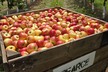
While supermarkets have been listing French apples for fresh produce for nearly 3 years, French distributors are reported to be much "less careful" when it comes to private label compotes. "Consumption of these products is growing, and private labels account for 46% of volumes sold (source: Kantar 2024). Yet, the main retailers are sourcing apples from Italy, Spain, and Poland." As a direct consequence of this early season, French stocks are rotting in fridges, warns ANPP. "At the end of October, we had nearly 2,000 tons of apples waiting to be processed. At the end of last week, we had almost the same quantity," explains Pierre Venteau. "It is a situation that is all the more unbearable for producers, given that distributors often speak out publicly to say how much they support French produce." According to ANPP, retail chains should commit to 100% French sourcing for their private label compotes ahead of the annual negotiations.
ANPP is expecting a reaction from the government and distributors on all those points in the next few days. "We are not refusing to participate, but before we can discuss anything, we need something concrete," concludes the director.
For more information:
Association Nationale Pommes Poires
6 rue de Lyon - 75012 Paris
Phone: +33 (0)1 53 10 27 80
Fax: +33 (0)1 53 10 27 88
[email protected]
www.lapomme.org