Banana handling practices were the focus of a recent technical session led by Sergio and Miguel Escalante of Colombia's Centro Aceros at Du Roi Laboratory's annual banana workshop. Their guidance addressed how both large and small farms can reduce defects such as bruising, latex stains, and crown rot through consistent handling and efficient packhouse design.
Sergio Escalante outlined how cableway systems reduce physical damage during transport from the field to the packhouse. The bunch is hooked in the field and moved directly to the fruit patio, limiting contact points. He noted that Latin American export regions have used cableways for decades to avoid bumpy tractor-trailer movement on dirt roads. He said the system decreases scratches and bruises, lowers fuel and maintenance use, increases planting area by reducing road width, and can improve export quality by 15 to 25 percent. He added that the technology is also suitable for smaller farms because it reduces labour and simplifies the movement of harvested bunches, fertiliser, and field inputs.
Centro Aceros has installed systems in various countries, including South Africa. Miguel Escalante said the equipment is supplied with starter maintenance kits and that standard bearings can be sourced locally. He also noted that theft of trolleys is a consideration in some regions, so growers should plan accordingly.
In the packhouse, Miguel described an assembly line approach with defined operating procedures and trained workers. During handling, workers make straight cuts with curved knives to support latex drainage. Water flumes with underwater jets transport hands to maintain gentle movement and prevent abrasion. Hands are placed crown down to enable latex to drain away from the fingers.
Quality control occurs at the end of the first bath, with rejected fruit diverted before the accepted hands enter a second long bath for 10 to 20 minutes of latex drainage. Insufficient drainage can lead to staining and weaker adhesion of anti-fungal treatment, increasing the risk of crown rot. In cool subtropical winters, higher fruit density can cause bananas to sink; foam spacers or slight increases in water density can be used to maintain buoyancy.
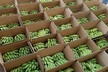
After the second bath, hands are sorted by finger count and weight. Fruit that meets specifications is placed in containers with three compartments for small, medium, and large grades, each compartment weighing 18 kilograms. This stabilises packline rhythm and reduces time lost adjusting carton weights.
Anti-fungal treatment follows in the spray rooms before packing. Packers work between two conveyors, one supplying cartons and lids, and the other supplying pre-weighed containers of bananas. Palletising completes the workflow before load out.
Miguel noted that consistent adherence to these steps can help farms, including smaller operations, work toward achieving high proportions of Class 1 fruit and maintaining reliable supply standards for export markets.
Source: AfricanFarming