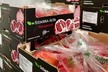
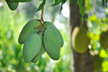
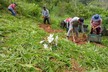
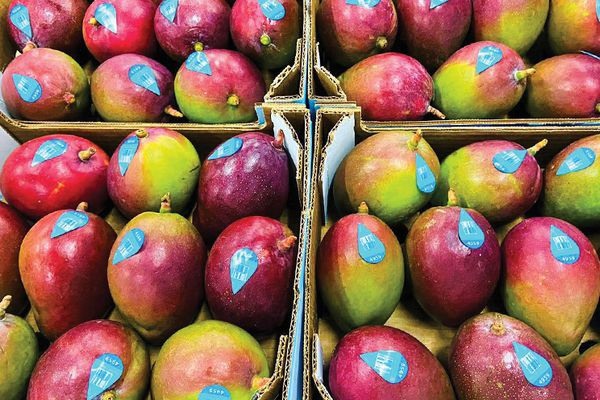
A minimal amount of mango shipments entered the U.S. from Mexico last week, which means the country has officially finished its season. "We now solely rely on Brazil for the supply of mangos," says Albert Perez with Continental Fresh. Brazil's production has started in a small way, but volumes are building up and should be peaking in about three weeks.
While that may sound promising, the expectation is for Brazil to ship barely over one million boxes/week in the next few weeks. "This won't be enough to satisfy the needs of the U.S. market," shared Perez. Up until about three weeks ago, Mexico shipped more than three million boxes/week that easily found a market.
Brazil is anticipated to ship about 10 million boxes of mangos this season, up two million boxes from last year. "While Brazil's volume will be larger this year, we are in a very different situation from last year when Mexico shipped mangos through the end of September, even early October," said Perez. This year's early end of the Mexican season leaves Brazil alone in the market until the end of October. As a result, a tight mango market is expected for the remainder of September as well as October.
 © Continental Fresh
Promotions in November and December
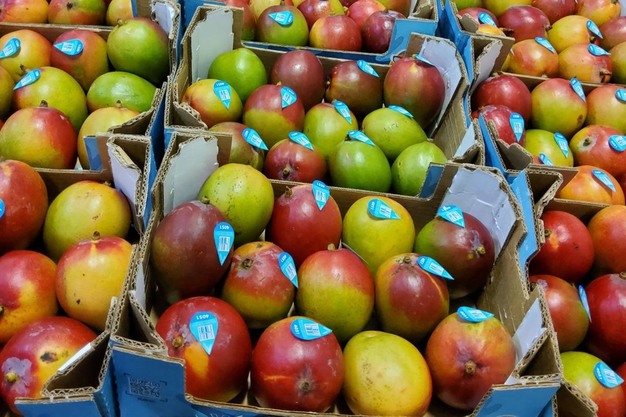
In fact, October will be even tighter than September as Ecuador isn't expected to have good supply of red mangos until week 45, the first week of November. "Once Ecuador starts shipping, we expect a more normal volume and an opportunity for retailers to promote mangos in November and December." The country usually peaks on sizes 10 and 12, which are the most popular.
High prices
The business is largely made up of contracts with a little bit of volume left for the spot market. As a result of limited volume coming in, contract prices are at $10-$12 FOB, which is high. "This also includes a compensation for the 50 percent tariff that Brazil is charged with. It's the highest tariff mangos have ever had." Prices on the spot market are expected to go above $12.
Impact of tariff
Is the 50 percent tariff forcing Brazil to diversify to other markets? "That's not what we are seeing currently," commented Perez. Up until now, mango shipments from Brazil to the U.S. seem to continue as usual. It's important to know that the tariff is not calculated over the U.S. FOB price but based on the commercial value of the product at farm level. The import tariff is not paid on freight, warehousing, customs, etc. Ultimately, it will be more like a 25 percent tariff on the FOB. This is still significant, and it will result in the consumer paying a higher price for their mangos. While Brazil does have the ability to ship to Europe, the continent can only take limited volumes and does not generally accept the Tommy Atkins variety. Therefore, the U.S. remains Brazil's key market. Once Ecuador comes into play, there should be more room for promotions. Not only because of additional volume, but also because the country is faced with a 15 percent import tariff, which is significantly lower than Brazil.
 © Continental Fresh
 For more information:
Albert Perez
Continental Fresh
Tel: +1 (305) 860-9611
[email protected]
www.continentalfresh.com