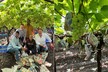
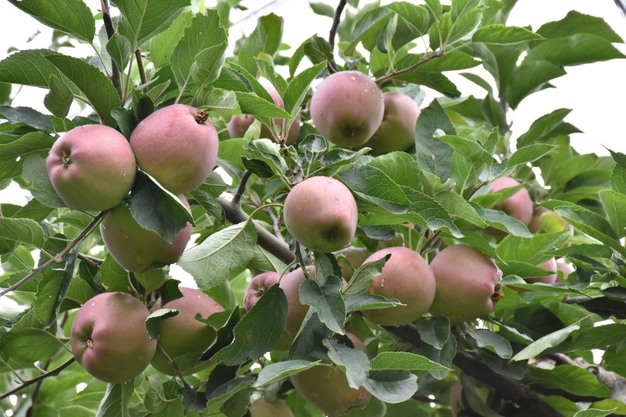
This year, the apple season in the mountainous regions of Imathia also follows the trend of reduced yields observed in the lowland zones. FreshPlaza visited one of the main apple-producing mountain villages of the area, Rodochori, located at an altitude of 600 meters.
 © Kazepidis Fruits
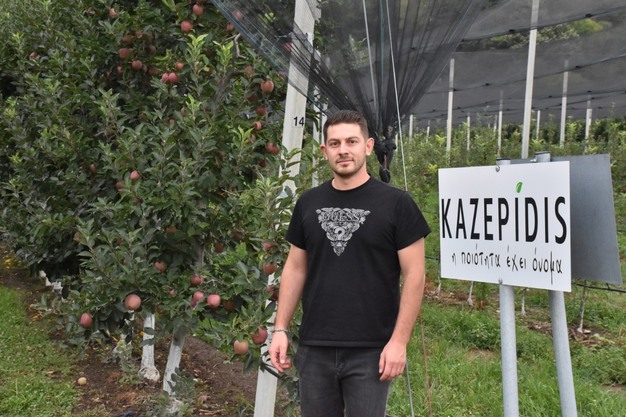
Mr. Kyriakos Kazepidis, owner of the local production and trading company Kazepidis Fruits, states: "This year, production is expected to be down by 30–40%. This is due to last summer's drought and the spring frost. Commercially, we expect a good season with strong demand. There are no stocks left, and it seems that European production will not be abundant. They say that producer prices might be as much as double the 0,35 euros per kilo we saw last year."
 © Kazepidis Fruits
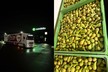
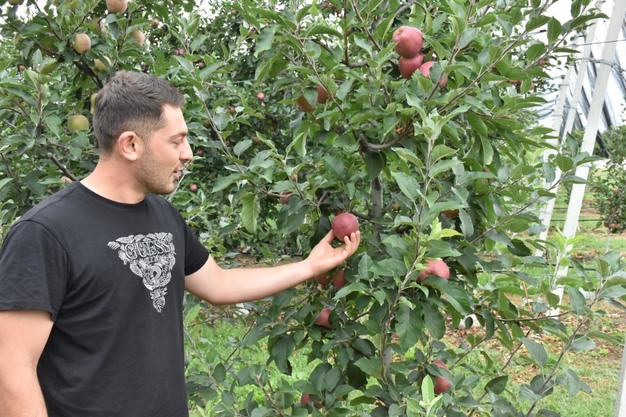
The crop had developed smoothly so far, and weather conditions have led to fruit ripening about a week earlier than usual. Mr. Kazepidis explains: "It hadn't rained for a long time. The rain that came during the first week of August and the cool conditions that followed helped the red varieties develop color within just two days. As a result, they colored earlier than usual, and we expect the first apples from our region to be harvested around September 15 to 20."
 © Kazepidis Fruits
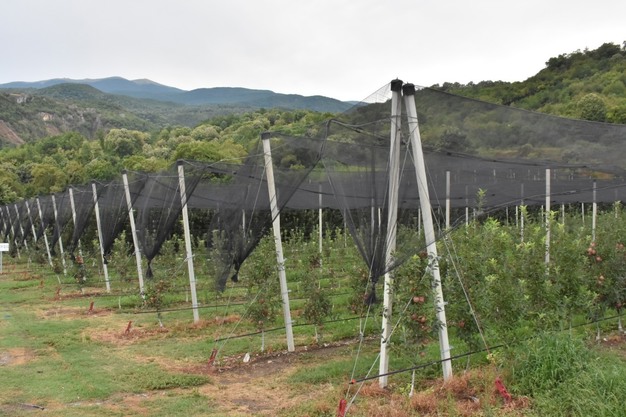
Apple growers in Rodochori and other areas of Imathia are shifting toward spindle trees and linear planting systems—not to increase yields, but to secure production.
 © Kazepidis Fruits
"It hasn't been proven that these systems give higher yields. In our experience, the opposite is true. From traditional tree shapes, we get up to 60 tons per hectare, whereas with the new systems, it's 30. In low-yield years, even just 15 tons per hectare. However, the new systems are easier to protect with anti-hail nets, so the crop is more secure. We also take additional measures to enhance protection. For setting up the nets, we use prestressed concrete poles, which are more stable. They bend but don't break. We do all of this because, 99% of the time, we get destructive hail every year. 'A bird in the hand is worth two in the bush,' as they say," concludes the Greek entrepreneur.
For more information:
Kyriakos Kazepidis
Kazepidis Fruits
Tel: +30 694 020 6077
Email: [email protected]