This year's citrus season in the Southern Hemisphere has been marked by ups and downs, reports Sven Stahmer, specialist citrus importer and managing partner of Rhino Fresh Produce GmbH, based in Stuhr near Bremen. The procurement situation for lemons in particular has been very challenging at times since the beginning of the season, which has driven up prices accordingly. The grapefruit sector, on the other hand, has been more favorable, with a promising product innovation now on the horizon.
Across the entire citrus segment, South African export volumes are roughly on par with or even above last year's levels, Stahmer cites current statistics. "In the case of lemons in particular, there is talk of scarce export volumes, but this is not entirely true. However, there is a relatively large proportion of Class II produce, which reduces the total volume for export to Europe accordingly. Although the original expectations could not quite be met, this year's campaign was quite stable, with no serious price fluctuations." The season began in the northern growing regions of Limpopo, Hoedspruit, Groblersdal, and Marble Hall, which until a few years ago mainly produced goods for the Middle East, followed by the Eastern Cape from July onwards.
 © Rhino Fresh Produce GmbH
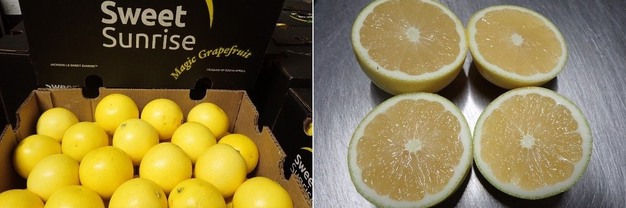
The latest variety innovation in the grapefruit sector is called Jackson.
South African lemons until October?
Due to frost, the Turkish lemon harvest is likely to get off to a late start this year. "It is therefore to be expected that the South African season will be longer this year. Until mid-October, the produce can be unloaded duty-free in the EU, so in the late season, produce from the Western Cape, which is otherwise primarily exported to the US, will certainly also end up on the EU market. I would not rule out the possibility that up to a third of the total harvest volume from the Western Cape will ultimately be sold here."
South African Star Ruby grapefruits traditionally mark the start of the season in May. Stahmer: "We started the season with good prices, but these fell at times later in the season. Nevertheless, we were largely able to meet the price expectations of exporters at the source. After the first half of the season, there is traditionally a significant decline in demand during the school vacations in July, after which we can place more volume again from the second half of August onwards. It is also worth mentioning that demand for grapefruit is generally higher in Eastern European markets, especially in Poland and the Baltic states, which is why the season here usually lasts well into October."
 © Rhino Fresh Produce GmbH
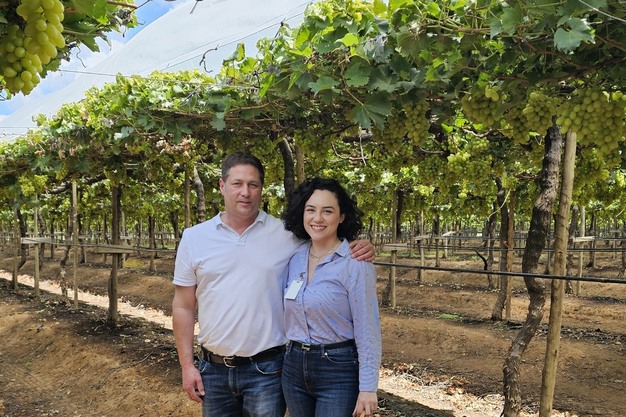
The Rhino Fresh Produce team visiting the grape production facility in Brazil before the season: Hortencia Ferreira da Silva and Sven Stahmer.
Varietal innovation enriches citrus selection
Because of its dominance in global markets, Star Ruby has been by far the most widely grown variety in both the Northern and Southern Hemispheres for many years. With the Jackson variety, Rhino Fresh Produce GmbH is now offering its customers an alternative variety for the premium segment for the second year. "It is a relatively sweet, small-caliber, and easy-to-peel fruit that is particularly suitable for children. We have found that the fruit is particularly popular in the premium segment. It seems to be establishing itself well, especially in Asia, but also in the UK, and in the Baltic states, it has even become a big hit with certain food retail customers. In the German domestic market, however, it is still relatively unknown, although it has already won its first customers in the wholesale sector. In the medium term, however, I also see a lot of potential for this variety in the local food retail sector, as it does not have that bitter taste but is much milder."
"It has smooth skin, light and juicy flesh, few seeds, and can be eaten like a navel orange. The reason the Jackson is more tropical in flavor is that during production, the trees store more moisture and sugar in the fruit than in the roots and branches. Other grapefruit varieties generally forego sugar to preserve their juiciness. The Jackson manages to do both. Anyone who tastes the Jackson for the first time will quickly realize that they are embarking on a journey of flavor. We are delighted to be able to bring something truly new to the citrus section." The export volume of the Jackson is very limited. The marketing window for the Jackson variety initially extends over the summer months of July and August.
Soft citrus: Large calibers predominate
In the soft citrus sector, large calibers and Class II fruits predominate this year. The harvest in the north of the country has already been completed, while the season in the Eastern Cape is now picking up speed. The Nadorcott variety is currently being shipped primarily, flanked by smaller quantities of Orri. Stahmer: "The season started with satsumas, which we sold mainly in Eastern Europe and Finland. Compared to last year, the quality was consistently good. In June and July, we continued with Leandri and Clemenules. However, I fear that there are still high stocks in circulation, which could potentially put pressure on Nadorcott prices. The decisive factor in the soft citrus category is the LEH programs, so that we are not dependent on the spot market."
 © Rhino Fresh Produce GmbH
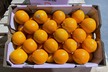
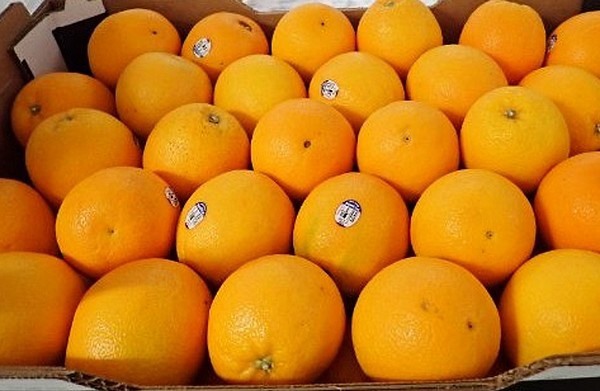
Navel oranges of South African origin
Orange exports from Zimbabwe are gaining in importance
Rhino Fresh Produce GmbH was founded in 2021 and is primarily dedicated to the procurement and marketing of overseas produce worldwide, such as grapes, avocados, stone and berry fruits, exotic fruits, and citrus fruits. Rhino Fresh Produce's nut and dried fruit range is becoming an increasingly important segment of the company. The first products, such as dates, peanuts, and hazelnuts, are already being packaged and marketed under the company's own brand. In South Africa, there are definite synergy effects for Rhino Fresh Produce in its collaboration with producers who do not specialize in just one fruit segment. For example, the company is also involved in the still young kiwi and dragon fruit production there.
The Stuhr-based company now also sells selected local fruit products such as apples, cherries, and strawberries. It serves food retail customers across much of Europe, either directly or through partners. In the orange sector, the seasonal transition from Egypt to South Africa did not take place until the second half of July this year, which is unusually late. "We only traded navels of South African origin for a short time, although the high-quality produce was very well received on the market. Since the beginning of August, we have been focusing primarily on Valencia juice oranges, which we source from both South Africa and Zimbabwe."
"Compared to South Africa, orange cultivation in Zimbabwe is smaller in terms of area. Nevertheless, we have already been able to increase our share to around one-third of the total volume in the first four years, with a slight upward trend. We expect to complete shipments from South Africa in week 38, which means we will have goods arriving in Europe until mid-October. However, there are also packers who are withdrawing from the market a few weeks earlier," he concludes.
For more information:
Sven Stahmer
Rhino Fresh Produce GmbH
Ernst-Abbe-Straße 6
DE - 28816 Stuhr
Tel: +49 42133005990
[email protected]