It's cold in South Africa, and the craving for high-energy comfort food will promote potato sales.
The air fryer environment changed the potato universe, says Willie Jacobs, the CEO of Potatoes South Africa. Everyone who's ever wanted can make their own chips (French fries) now, without the hassle (or dubious health implications) of deep-frying, while feeling pious about their electricity use.
People living in South Africa might not realise it, but the reliable year-round availability of fresh potatoes – potatoes that have not been in any kind of storage - is a luxury not enjoyed by many in the world, Jacobs points out.
 © Potatoes SA
Degree of panic when stock levels dip
"South Africa produces 2.5 million tonnes of potatoes per year: approximately one million tonnes go to the fresh produce markets, where they constitute 70% of the vegetable trade. A further million tonnes will be sold directly to retailers and wholesalers, and the balance of 500,000 tonnes is grown for processing purposes, mostly for crisps and French fries," he says, adding: "It's the other way round in most of the world. South Africa can produce potatoes for twelve months of the year."
'A globally unique environment', he calls it, in which potato storage facilities are limited and growers, traders, and buyers follow a just-in-time procurement model.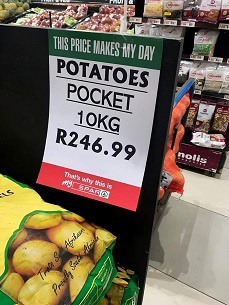 © Potentieel"You see a degree of panic on the markets when buyers notice low stock levels. The moment that the potato price moves beyond certain frameworks, it creates emotional purchases and sales. That escalates the price."
Consumers bore witness to the tremendous volatility of potato prices over the past few years, social media photos circulating of ludicrously expensive potatoes (right, October 2023; 13.88 euros for 10kg potatoes).
People are incredibly fond of potatoes, Jacobs remarks, "and it creates emotions around the vegetable that shouldn't be there. This happens every time there develops an anxiety around the potato supply. A disconnect springs up, and prices that should never have seen the light of day are placed before consumers. It's easy to regard such prices as purely exploitative, but mostly - as a rule, even - this is the result of an overreaction, when the emotions around potatoes override reason."
Jacobs believes more clarity around potato market stock levels and a better flow on the markets would bring more stability to retail prices. Bottlenecks do a lot of damage. More stable market prices would eventually find their way to retailers' potato prices, in turn increasing the demand for potatoes.
Last year, he offers as an example, the impression of a potato shortage was broadcast in the media. "It had an unbelievable effect on price, and not long afterwards, there were shortages as a result of the frost in July 2024. Farmers lifted potatoes that should've been left in the ground to fill that gap and oversupplied the market, once again driving the volatility."
At the moment, for example, there are 500,000 fewer 10kg pockets on the market than this time last year, but it's a blip when you zoom out to the total YTD deliveries of 51.8 million 10kg bags, he says. © PotatoesSA
Potato harvesting in the eastern Free State ran behind schedule due to rains earlier this year, and in trying to catch up, more potatoes were delivered during May, as shown in the graph above.
The current average price of R63 (almost 4 euros) per 10kg bag is roughly R2 per bag higher than last year. Interesting to note is the trend that between the highest quality and the lowest quality and smaller sizes, a pronounced price gap opens: it's the difference between R75 (4.3 euros) per a 10kg bag of prime medium-sized potatoes, and R40 (2.25 euros) for their ordinary counterparts.
Jacobs remarks that when the quality differential between the top 10% and the bottom 10% is closing, as it currently does, it is a positive development.
 © Potatoes SA
Left: South African potatoes in a Malawian store. Right: lifting potatoes in the Sandveld, Western Cape
Export ambitions
South Africa grows potato seed and tubers at a prodigious rate. Its certified seed (with specified disease tolerance levels) planted in Namibia, Botswana, Zimbabwe, Zambia and Mozambique are feeding many in the sub-region. "We don't really export potatoes, it's rather a case that SADC [Southern African Customs Union] countries import our potatoes. The largest buyer remains Mozambique."
There is no need for any imported frozen potato products, Potatoes SA believes. The state provides no financial subsidies to South African potato farmers, but it does agree that they should not have to compete against imported and, crucially, subsidised products.
"We have three years left on the current five-year cycle of protection against the imports of European frozen potato products." The average tariff is 20%, but there is a fair amount of variation between the various importing companies. Within the coming year, they will be applying for a renewal of the import duty. and they are confident the application will be successful.
Potatoes SA would like to see a regular potato trade with Namibia, with whom they're in talks on this topic. "We see an opportunity for collaboration with Botswana and Namibia to enhance potato availability and consumption in the region."
The latter countries want to develop their own potato capacity, and regularly use temporary closures of the border with South Africa to protect domestic production.
Besides trade within Africa, Potatoes SA would like to see more international trade for its members. Attempts to export to Russia have been difficult, but the insights they gain will stand them in good stead, he believes. For more information:
Willie Jacobs
Potatoes SA
Tel: +27 12 349 1906
Email: [email protected]
https://www.potatoes.co.za/