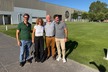
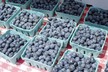
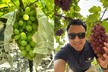
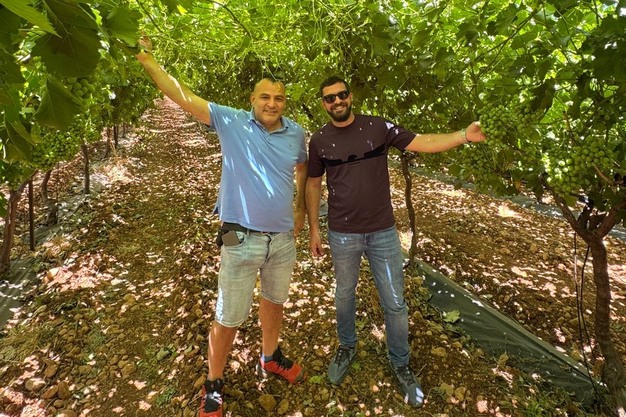
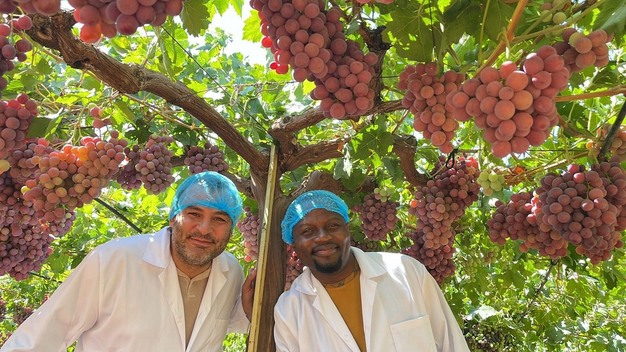
The Lebansese grape season is shaping up to be one of the most promising in recent years, says Mehdi Awdi, owner of Lebanese grape exporter ETS Awdi Enterprise: "While many farmers across the Bekaa Valley are grappling with water shortages, due to minimal winter rainfall and rapidly depleting wells and reservoirs, we've been fortunate. Thanks to our infrastructure and sustainable water management, our wells and irrigation systems remain fully operational. We're optimistic. The vines are thriving, with no dust storms or heat waves to disrupt growth. We're expecting strong yields, excellent sizing, and premium-quality grapes across the board."
 © ETS AWDI ENTERPRISE
According to Awdi, their focus on export markets has changed over the past few years, mostly due to heavy competition from Chinese grapes. "Southeast Asia was once our primary market, but increased competition from Chinese grapes, favored for their proximity and lower prices, has shifted our export strategy. Today, more than 50% of our sales are directed toward markets across the African continent, where demand for Lebanese grapes remains high. We're also working to expand into Russia and grow our presence in European retail. Lebanese grapes performed exceptionally well in major European supermarket chains last year, and we're aiming to build on that success."
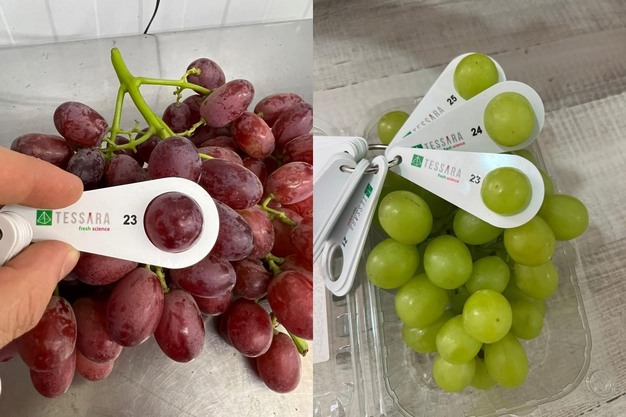
Awdi emphasizes that Lebanese grapes have gained a lot of respect in terms of their quality. The exporter even states other origins are masking their produce as Lebanese to capitalize on this increased reputation: "Lebanese grapes are earning growing international recognition. In fact, some Egyptian producers have started marketing their red seedless grapes as 'Lebanese Crimson' to capitalize on the strong reputation of our varieties, a clear testament to their influence. This season, we're introducing several new varieties, including premium green and black seedless grapes, in response to evolving global market preferences."
 © ETS AWDI ENTERPRISE
"Most Lebanese grapes are grown in the Bekaa Valley, one of the world's oldest and most storied grape-growing regions. The valley is home to the 3,000-year-old Roman Temple of Bacchus, adorned with carvings of vines and grapes that reflect the region's ancient connection to viticulture. The valley's unique climate, with its warm days, cool nights, and a dry growing season, promotes a vibrant color, rich flavor, and extended shelf life. While rain and extreme heat pose challenges to grape growers in many regions, our conditions provide a consistent edge."
The Lebanese grape exporters have not had an easy time recently, and there are still quite a few issues Awdi has to deal with: "Our biggest challenge is regional instability. In 2024, the Israeli–Lebanese conflict prevented us from harvesting, tending, or packing nearly 600 tonnes of grapes, which was an immense loss. Logistics is another large obstacle. Air freight is frequently unreliable, with constant flight cancellations that make advance planning difficult. Sea freight, once a strength, has also become more complicated. Previously, CMA CGM and Maersk offered direct shipping to Southeast Asia in just 16 days from Beirut. Now, with routes rerouted through Egypt, the same journey takes over 33 days. Even so, our grapes continue to arrive in excellent condition."
 © ETS AWDI ENTERPRISE
"Another major hurdle is government inaction. Many global markets remain closed to Lebanese produce due to the lack of active trade or phytosanitary agreements. We're eager to access high-potential markets like Indonesia and South Africa, but without government advocacy to push for bilateral trade deals and regulatory approvals, those opportunities remain out of reach," Awdi concludes.
For more information:
Mehdi Awdi
ETS Awdi Enterprise
Tel: +961 70 878 606
Email: [email protected]