Over the past decade, there has been a global increase in viruses affecting watermelons due to a combination of interrelated factors: climate change, agricultural intensification, globalization and trade, virus evolution, loss of biodiversity, and poor management practices.
Climate change, such as rising temperatures and changes in rainfall patterns, can affect the distribution and abundance of insect vectors that transmit viruses to plants. Warmer climates may favor faster reproductive cycles for these insects, increasing the spread of viruses. Increased international trade also facilitates transmission to new geographic areas. Infected seeds, seedlings, and fruits can be transported from one region to another, introducing viruses or their vectors into previously unaffected ecosystems. Viruses can evolve rapidly, developing new variants that can more easily infect plants or evade their natural defenses.
The reduction of genetic diversity in agricultural crops has been demonstrated to increase the plant's vulnerability to infection. The use of similar varieties limits the ability of plants to resist new viral infections. In addition, in certain areas, a lack of understanding of the most effective disease management practices can contribute to the spread of viruses.
In 2021, two new viruses were found on watermelon in the United States, first in Texas and then in Florida. A similar situation occurred in Italy, where a new emerging virus affecting watermelon was identified for the first time in the Campania region, specifically in Eboli and Battipaglia (province of Salerno). This virus was identified by Giuseppe Parrella, a virologist and researcher at the CNR-IPSP in Portici, Naples.
The virus was identified in samples collected in 2023 through the use of NGS (Next Generation Sequencing), a sophisticated technology that facilitates the identification of all the viromes present in a plant. The virus identified was classified as Watermelon crinkle leaf-associated virus 2 (WCLaV-2), which had never been reported in Europe before this discovery. However, its presence had previously been documented in China, the United States, Brazil, and Australia. This information was provided by Parrella.
"We are concerned about the presence of this virus," says the virologist, "because little is known about it, as it belongs to a recently described and still poorly detailed taxonomic group of viruses: the genus Coguvirus, which belongs to the family Phenuiviridae. While there is evidence that these viruses are transmitted by grafting, it remains to be determined whether a suitable vector exists for their transmission in the wild. It is noteworthy that the incidence of the virus in the field is high, reaching 60-70% in some cases. Consequently, we hypothesize that the widespread presence of these viruses in the field may be due either to the presence of a highly efficient vector or to the transmission by seeds. It should be noted, however, that these are still hypotheses, although they are supported by some preliminary evidence or by the fact that the Phenuiviridae family includes ecologically diverse viruses, some of which are transmitted by arthropods and are capable of infecting not only plants but also humans and various animals. It is also noteworthy that WCLaV-2 is included in the EPPO (European Plant Pathology Organization) alert list, which underscores the need for increased vigilance regarding the presence of this virus in crops. It is important to emphasize that further extensive research is needed to fully understand the biological properties and characteristics of WCLaV-2, particularly with regard to its mode of transmission."
"Another alarming discovery is the fact that this virus has often been found in association with another group of viruses also emerging on cucurbits: the Polerovirus (e.g., Cucurbit aphid-borne yellows virus CABYV). In such instances, the symptomatology observed in the field is complicated by this combination, which is difficult to identify in isolation."
Symptoms of WCLaV-2
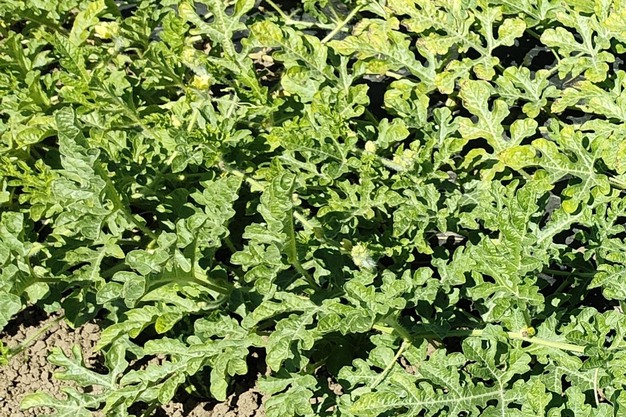
"The viral infection of watermelon plants is characterized by the development of wrinkling and blistering of the leaves, especially those located at the apical meristem. In addition to these symptoms, a yellow mosaic pattern and a yellow mottling pattern have also been observed on the leaves. The stem also shows a reduction in internode length, particularly in the distal section. The overall effect on the plant is stunted growth and reduced vegetative development. Fruit set is often poor or of very poor quality, and deformations and circular lesions are often observed on the fruit. These symptoms are similar to those reported for a second virus: Watermelon crinkle leaf-associated virus 1 (WCLaV-1), which is closely related to WCLaV-2 but has not been detected in our crops, although the potential for introduction exists. In other countries, such as the United States, these two viruses are often found together in watermelon crops."
Symptoms of WCLaV-2 associated with Polerovirus
Given the frequent association of this virus with Polerovirus that causes leaf yellowing, the symptoms described are not well recognized in such cases, as leaf yellowing tends to predominate and mask the characteristic signs of WCLaV-2.
"There is a need to develop a sensitive and specific diagnostic method that allows the control of plant source material (seeds and plants) and the epidemiological study in the field. The formation of a collaborative group of motivated and experienced researchers is crucial to facilitate comprehensive research on this virus.
Finally, it is recommended that all growers and field technicians closely monitor watermelon crops and report any anomalies," Parrella concludes.
This article was previously published in Primeur May 2025. Click here for the link to the entire edition
For more information:
[email protected]