The strawberry season is now reaching its peak. "We now offer around ten different varieties every day, including Elsanta, Sonsation, Falco, Sonata, and Clery. Domestic strawberries account for around 50 per cent of the market share, and we also sell imported produce from neighboring countries such as the Netherlands and Belgium. Demand for Dutch greenhouse produce is generally slightly higher because it is more visually appealing, while domestic field-grown produce is subject to severe weather fluctuations," reports Ogulcan Sariboga, sales manager at Raiffeisen Obst & Gemüse GmbH in Leverkusen.
 © Raiffeisen Obst & Gemüse GmbH
The Raiffeisen O&G GmbH team with branch manager and authorized signatory Johann Bergmann (5th from left) and Ogulcan Sariboga (to his right). The company is recording steady growth in sales and customer numbers, meaning that it has almost outgrown its current location.
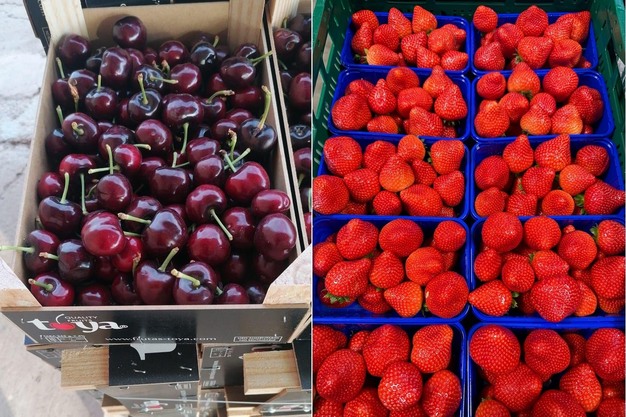
The Sonsation variety in particular is becoming increasingly important, the fruit wholesaler continues. The outstanding quality variety is expected to be available until mid-June, around two weeks longer than last year. Price is less of a factor. "Sonsation, which is mainly sourced from the Netherlands, is priced at around EUR 3/500g, sometimes twice as expensive as German outdoor produce. We have also noticed that most of our customers are pursuing a two- or even three-pronged strategy, so there is something for everyone. Overall, we are very satisfied with how the season has gone so far, both in terms of sales and supply volumes."
 © Raiffeisen Leverkusen
Spanish sweet cherries and Sonsation strawberries
Cherries red, asparagus dead
The asparagus season is now coming to an end. "We mainly rely on regionally produced asparagus, which has been in short supply and expensive for weeks. The shortages are primarily due to significant reductions in acreage on many farms. Asparagus is traditionally very popular at Pentecost, after which we will withdraw from marketing and only offer the product for pre-order", says Sariboga, referring to the early end of the season. First-class German asparagus is currently priced at around EUR 10/kg in wholesale.
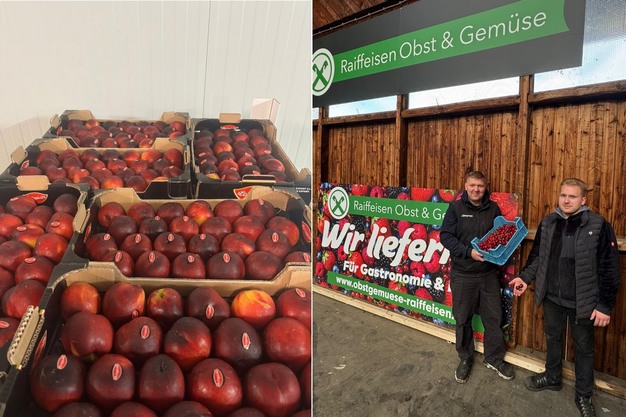
Meanwhile, the first German sweet cherries from the Koblenz area arrived in week 22. This means that the season is getting off to a fairly early start this year. Sariboga: "The saying 'cherries red, asparagus dead' really does apply this year. Large-sized fruit in the 30/32 size range was already available in week 23, whereas normally the season starts with soft, small cherries. However, this is likely to be related to the choice of varieties. In addition to the Burlat variety, the slightly harder Narana is now also being offered in the early season. In the long term, we are seeing that retailers are increasingly turning to cheaper imported produce even during the German season, which means that more domestic cherries tend to end up on the open market."
Spanish imports continue to supplement domestic cherries. Despite weather damage in parts of Spain, the desired sizes of 32+/34+ are available in encouraging quantities. According to Sariboga, the situation is only likely to become more critical as the season progresses. "There has been devastating frost damage in Turkey. I was recently on a tour of producers in the important growing region of Izmir and saw some damaged orchards. In terms of procurement, it will therefore be a very difficult season. I do not rule out that we will have to source produce from Balkan countries such as Moldova, Serbia, or Bulgaria later in the season."
 © Raiffeisen Leverkusen
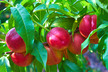
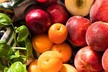
Besides cherries, there have also been apricots, nectarines (left in the picture), and peaches from Spain since mid-May, followed by Paraguayos in calendar week 21. Although prices are slightly above last year's level, demand is consistently satisfactory. Right: Employees of Raiffeisen Obst & Gemüse GmbH show off the first Koblenz cherries of the year.
For more information:
Ogulcan Sariboga
Raiffeisen Obst & Gemüse GmbH
Robert-Koch-Straße 25-27
51379 Leverkusen
Tel: +49 1515 3856819
[email protected]
www.obstgemuese-raiffeisen.de