Washington State University (WSU) is on track to release its first new cherry cultivars in almost two decades. The R3 and R19 varieties are nearing the end of Phase 3 trials, and if they perform well this season, they'll be approved for release by fall, said Per McCord, WSU's cherry breeder.
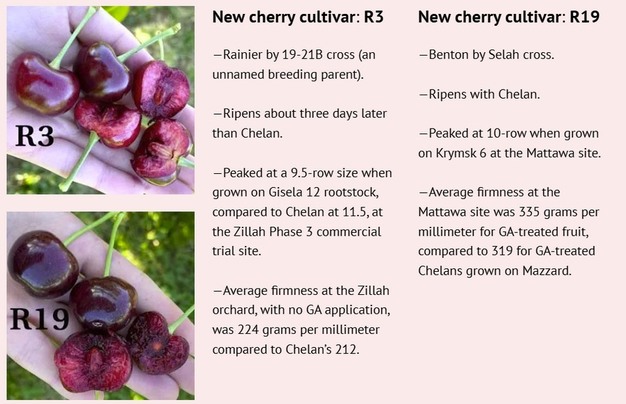
The R3 is a cross between Rainier and an unnamed selection (19-21B), while R19 combines Benton and Selah. Both ripen early—R19 with Chelan, and R3 slightly later—and trial data shows they produce cherries that are larger, firmer, and sweeter than Chelan, the current early-season standard.
At the Zillah trial site, R3 peaked at a 9.5-row size and firmness of 224 grams per millimeter on Gisela 12 rootstock, compared to Chelan's 11.5-row and 212 firmness. R19, grown on Krymsk 6 in Mattawa, achieved 10-row size and a firmness of 335 grams per millimeter, outperforming GA-treated Chelans on Mazzard at 319.
 © WSU
© WSU
R29 remains two years behind in trials, and about a dozen other selections are in Phase 2. While prepping for release, McCord's team is filing intellectual property applications and documenting traits like bloom structure and petal color. Trade names and royalties are also being set.
WSU plans to continue research on rootstocks and growing systems even after the cultivars are released. The university urges growers to run their own trials once trees become available, which could take at least two years.
Rob Blakey of Stemilt Growers, which hosts the Mattawa trial, supports the move. He sees value in early-season diversification and believes both cultivars align well with industry needs. The new varieties are expected to speed up the availability of premium cherries at the start of the season.
The release of R3 won't be delayed by the presence of Cherry Virus A (CVA), a benign and common virus. The Washington State Department of Agriculture plans to drop CVA from its virus screening program this year, clearing the way for the cultivar's certification.
Growers, including Megan Thompson of Cascade Cherry Growers in Oregon, are eager to test the market. Thompson, a member of the advisory and licensing committees, believes both cultivars are clear improvements over Chelan and is optimistic about their commercial potential.
With high interest and strong early results, WSU's cherry program is poised for a major step forward, bringing new life to its breeding efforts after nearly 20 years.
Source: GoodFruit