The German cherry harvest has now officially begun. Similar to previous years, the first Bellise sweet cherries were picked and delivered from the Obsthof Hochhaus in the heart of the early growing region of Rheinhessen in the last week of May. The season is proceeding similarly to previous years, reports owner Björn Hochhaus on request. "We are seeing encouraging fruit on the trees and are now expecting a good cherry harvest after last year's extremely wet weather. We are also starting the new marketing season with high expectations, as Turkey in particular is expected to struggle with massive weather damage and corresponding delivery problems according to the latest forecasts. As a result, our early cherries will already be entering a receptive market."
Cherry growers are also feeling the impact of increased production costs, particularly the rise in the minimum wage. According to Hochhaus, a producer partner of Landfrisch AG, a price increase of around ten percent compared to last year is necessary to remain economically viable. However, he adds that a distinction must be made: "Early cherries require a certain amount of care, so the picking yield per hour is around a quarter lower than for later varieties. Accordingly, the slightly higher labor costs must always be considered in the early season."
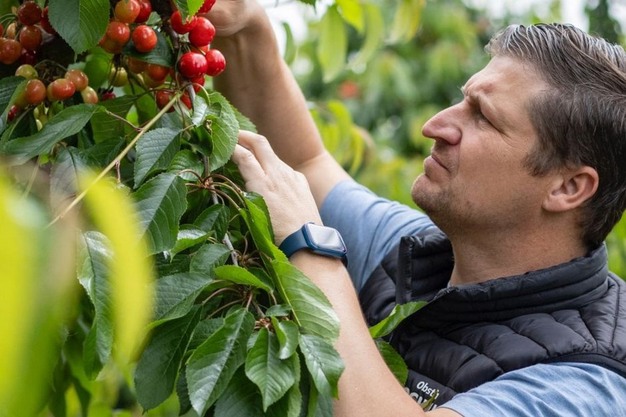 © Obsthof Hochhaus
Fruit grower Björn Hochhaus inspects the first early cherries of the year of the Bellise variety. Together with the Nimba variety, Bellise marks the start of the season at the Mainz fruit farm. Rheinhessen, together with Baden, is one of the earliest growing regions in Germany.
The Mainz fruit farm's subsequent varieties include Samba, Satin, Early Korvik, and the commercially available Kordia and Regina. Hochhaus: "A few years ago, we added the very late variety Final 12.1 to our range. This decision has proven its worth, as we have now extended our harvest window by a good week and can therefore deliver until calendar week 28. We used to have a short break of one to two weeks before the start of the plum harvest. We have closed this gap with Final 12.1, so that after the cherry season is over, we can continue seamlessly with the first early plums."
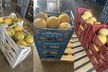
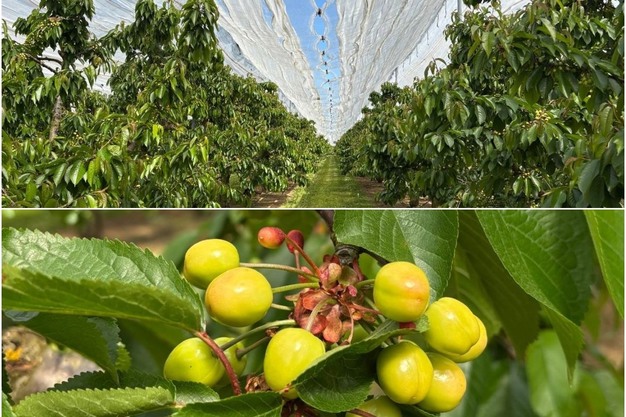 © Obsthof Hochhaus
A look at the cherry orchards shortly before harvest. Around 20 percent of the total cherry cultivation capacity is now covered.
Large stone fruits to increase efficiency
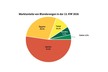
Plums account for around two-thirds of the fruit farm's total stone fruit cultivation capacity, followed by cherries (17 percent), mirabelle plums (3 percent), and apricots (2 percent). "Even though apricots are only a niche product, we are seeing demand from retailers increase every year. This indicates that apricots from domestic cultivation are becoming increasingly established." Meanwhile, plum cultivation has been massively expanded, increasing its share of total stone fruit production from around 40 to 65 percent, Hochhaus adds.
Part of the extensive investment was also a restructuring of the plum variety range. "In the early season, the Julika variety now marks the start of the season, while in the late season, we have added the Baronesse variety. As a result, we have been able to extend the harvest window by several weeks so that we can now offer regional plums from July to around mid-October." In general, the fruit grower sees a gradual trend toward larger fruits, whether berries or stone fruits. "With strawberries, there is a shift towards annual crops and larger fruits. The same applies to cherries and plums: the Baronesse variety, for example, is much larger than the tried-and-tested Hauszwetschge. This development is also ultimately due to the increase in the minimum wage: the larger the fruit, the faster and more efficient the harvest, and the lower the labor costs."
For more information:
Björn Hochhaus
Obsthof Hochhaus 
Am Finther Wald 1
55126 Mainz
Telephone: 06131 / 950 33 66
Email: [email protected]
www.obsthof-hochhaus.de