Spring 2025 was marked by significant frost in Greece (and Turkey), which affected summer fruit production. Italy, France, and Spain did not experience widespread frost, but weather conditions were unfavorable during flowering, with heavy and frequent rainfall, which somewhat affected the production potential. Additionally, there have been violent hailstorms in recent weeks in Spain (Catalonia, Aragon, and the Murcia region). Estimates of the losses caused by these hailstorms are currently being calculated and cannot be fully taken into account in the harvest forecasts revealed in mid-May.
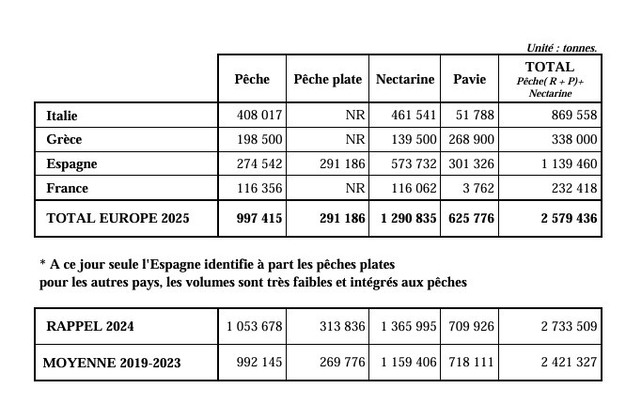
With just under 2.6 million tons of peaches and nectarines, the European harvest forecast for 2025 is 6% below the 2024 harvest and 7% above the 2019/2023 average. Greece is the country most affected by this decline. France and Italy are forecasting production below optimal potential but stable compared to 2024. Forecasts for Spain, which are slightly down compared to 2024, are likely to be revised downwards when the data is updated at the end of June, and estimates of losses due to hailstorms can be taken into account.
The situation, basin by basin:
 © medFEL - capture d'écran
On May 20th, the nectarine harvest forecasts were unveiled in a webinar (medFEL). Hosted by Eric Hostalnou, Chamber of Agriculture of the Pyrénées Orientales, with Elisa MACCHI from CSO Ferrara for Italy, Santiago VAZQUEZ from the Federation of Spanish Cooperatives & Manel SIMON from AFRUCAT (Catalonia), Georges KANTZIOS from the ASEPOP Cooperative for Greece, and Raphaël Martinez from the French Peach and Apricot producers' association.
France: Forecasts revised slightly downwards
2024 was a "crazy year," recalls Raphaël Martinez. With potential volumes of 230,000 tons, the first part of the season was very difficult to manage. This was initially due to the exceptionally early harvest (40% of volumes were available in June), but also to a series of events such as unfavorable weather until mid-July, the dissolution of the French National Assembly, the economic context and, of course, the Olympic Games (euphoria in the second half of the season). Production volumes were normal in 2024, with a very early season that disrupted the market, followed by a large supply at the end of June. The market then stabilized, allowing for smooth sales in the second half of the season.
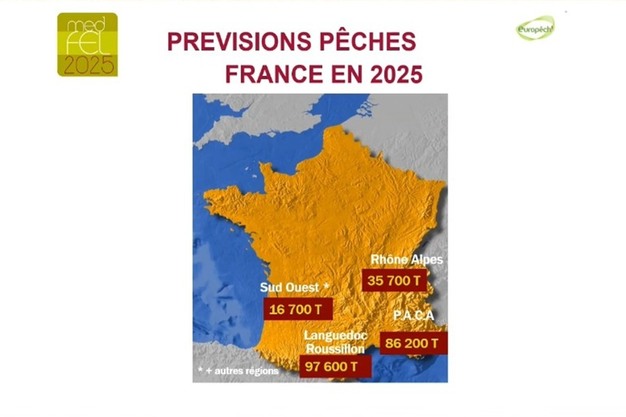
For 2025, there are no major climatic incidents to report, and the forecasts made two weeks ago predicted normal production. However, Raphaël Martinez warns that some corrections need to be made. "The weather conditions during flowering and fruit set were very poor, leading to fruit drop, so we will certainly not reach the theoretical potential of 230,000 tons. We will be closer to 80% or maybe 90% of potential, at around 200,000 tons.
This year, the season is starting later, with the very first nectarines expected to appear in early June, and "the Roussillon region will see its first significant harvest in about two weeks."
With this slight decline, the trend will be towards larger sizes. "We will be under pressure on the smaller sizes," explains Raphaël Martinez, director of Peaches and Apricots of France. But above all, this season marks the return of plastic trays, following the cancellation of the Agec law (cardboard trays were one of the reasons for the difficult 2024 season), on entry-level prices, and therefore "undoubtedly with significant demand from less affluent households."
 © medFEL - capture d'écran
In the Rhône-Alpes region, production is expected to be stable over the year. In the PACA region, production potential is there if no climatic accidents occur between now and harvest, and in the Languedoc-Roussillon region harvest potential is expected to be normal thanks to abundant rainfall at the end of the year and in the spring. Although the level of deep groundwater remains a cause for concern, the situation of surface water and shallow quaternary aquifers has improved significantly.
Greece: Frost cuts production by 22%
In 2024, Greece had a good harvest, with normal levels, after several years of decline due to adverse weather conditions. The 2024 season was marked by a 10 to 15-day early start. September saw some adverse weather conditions, which reduced the total production.
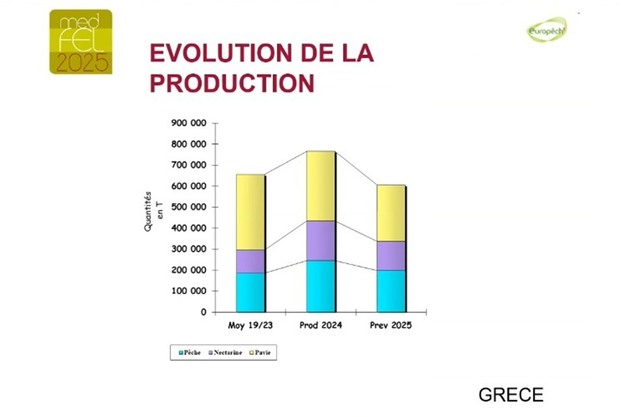
However, "Greece suffered a severe frost in March (during full bloom) with temperatures dropping to -8°C, followed by a second frost in early April (although to a lesser extent)," explains Georges Kantzios. The result is that production is down by 22% compared to 2024 for nectarines (338,000 tons in 2025) and 19% for peaches (270,000 tons in 2025). Overall, Greek production this year is barely above 600,000 tons.
While the previous season was characterized by early ripening, the bad weather this year, from the end of April until last week, will cause a delay of approximately ten days.
 © medFEL - capture d'écran
Italy: Production similar to 2024
As a reminder, 2024 marked a return to normal for Italian production (with 920,000 tons, up by 40% from 2023 - 870,000 tons of peaches and nectarines and 57,000 tons of nectarines), particularly in the north of the country after a poor 2023 season due to frost.
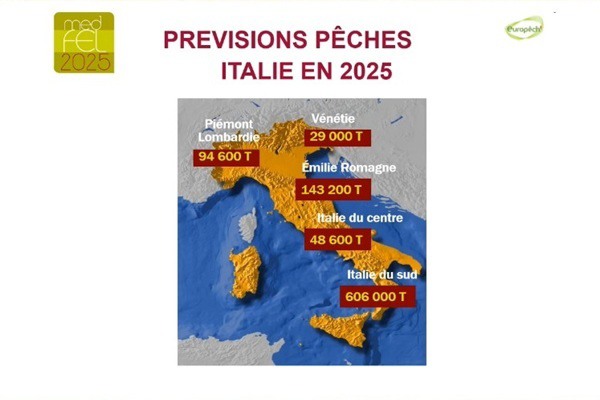
In 2025, peach, nectarine, and flat peach production is therefore expected to be similar to that of 2024, at 920,000 tons. There will be a slight decline in the center-north, offset by a recovery in quantities in the southern regions. "Despite the frost episode on March 20th, the damage to nectarines is not significant. No major incidents have been reported to date, with flowering and fruit set progressing well," explains Elisa Macchi. Compared to the 2019/2023 average, production is down by 3% for peaches, up by 2% for nectarines, and down by 22% for flat peaches. Harvest times are close to those of 2024 in the south, and slightly delayed in the north, varying by area by up to 7 days. The first fruits were harvested in the south more than 2 weeks ago.
Acreage continues to decline, down by 3% nationally compared to 2024, with a more pronounced reduction in the northern part of the country, mainly for peaches. In the south, however, the declines are smaller and in some cases a recovery in planting is observed.
 © medFEL - capture d'écran
Spain: Recent hailstorms make estimates difficult
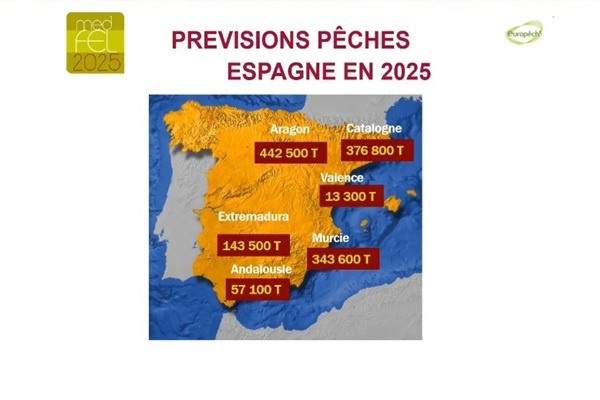
In Spain, 2024 marked the end of a drought that had lasted since 2022, particularly in the Ebro Valley. For the 2024 season, Santiago Vazquez reports a positive outcome, although "the best figures of some previous years were not achieved." With normal potential slightly higher than in 2023, initial forecasts for nectarines in 2025 are for 1,140,000 tons of peaches, flat peaches, and nectarines. Spanish production is expected to be 5% below last year's level and 8% above the 2019-2023 average. For flat peaches, the decline compared to 2024 is also estimated at 5%, and production is expected to remain stable compared to the 2019/2023 average, with a forecast of 300,000 tons.
These forecasts should be treated with caution and will need to be reviewed in the coming weeks in light of the hailstorms that have hit several areas of the country in recent days. "Estimates are difficult. Flowering took place without any major climatic incidents, but there has been a succession of hailstorms since the end of March until recently in Catalonia, Aragon, Extremadura, and the Murcia region in particular."
 © medFEL - capture d'écran
In Catalonia, 40,000 hectares of farmland were severely affected. Fruit trees were the main crop affected, with around 10,000 hectares damaged. The impact was very heterogeneous, depending on the area and farm, and also on the species, being most severe for apricots (13%). In the case of nectarines, losses were estimated at 4%. (At the time of the forecast, hail damage in Catalonia had not been fully assessed, so data may change in the June update.)
Several thunderstorms accompanied by heavy hail also took place in the first half of May, affecting several regions of Murcia (Jumilla, Yecla, Mula...), the Valencia region to some extent, and the province of Albacete, Aragon and Catalonia. In Murcia, hailstorms caused severe damage that has yet to be assessed.
 © medFEL - capture d'écran