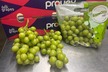
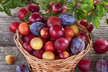
COT International was present at Macfrut last week to showcase its new varieties of apricots, cherries and plums. It was also an opportunity to reiterate the company's objectives in terms of varietal selection, based on research into productivity for producers and taste for consumers.
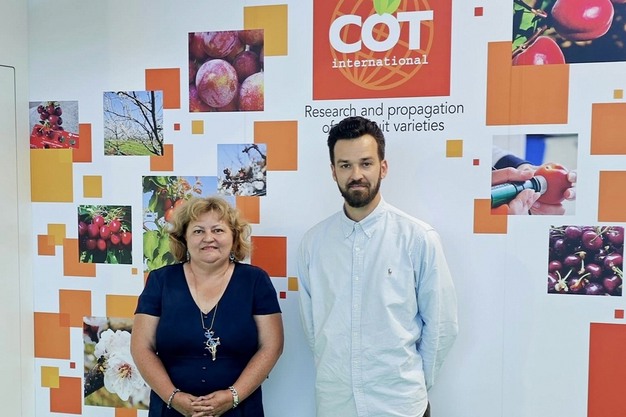 © FreshPlaza Marie-Laure Eteve and Pascal Bassols Pot at Macfrut 2025
Having fruit that is consistent throughout the season in terms of taste and appearance
COT International wants to expand its range of varieties while maintaining the same objective: to offer tasty fruit from the start of the season. "The first variety is harvested in mid-April in Murcia, and the last one usually finishes at the end of August in France (St-Gilles). For cherries, we focus mainly on early varieties, but not exclusively. We are particularly well known for the Nimba, Pacific Red, and Frisco varieties, and we are now trying to expand our range after the Summit variety in order to produce a little later in the season. As for plums, we are mainly working on selecting varieties for July and August, but we also have new selections for the end of June and a few September varieties. The aim is to be able to offer producers fruit with the same appearance and taste quality throughout the season," explains Pascal Bassols Pot, technical and sales manager at COT International.
Focusing on taste
For apricots, cherries, and plums, the focus is on taste. "All our apricot varieties are self-fertile. More than 70% are also resistant to sharka, which remains a major problem for many producers around the world. We have also developed many new self-fertile cherry varieties. As for American-Japanese plums, although self-fertility is not yet possible, we are doing our best to combine productivity and taste quality."
Developing a range of apricot varieties for colder regions
Another objective for the Gard-based breeding company is to develop a new range of apricots called WINTERCOT®. "This range is starting to be planted in the United Kingdom, particularly in Kent. These are varieties with high cold requirements, flowering after all other existing commercial varieties. These varieties are particularly interesting for regions prone to spring frosts. We have already started planting some trees in Kent, as well as in Switzerland."
However, the company has not forgotten the regions that face milder winters and are the most affected by global warming. "In 2015, we opened a new facility in the Murcia region of Spain, in an area where the number of cold hours is around 200, which is relatively low. The initial aim was to focus on apricots, but now we are also starting to develop plums and cherries in these areas with milder winters."
Growth in the export market
In addition to this development in England, the company is opening up new markets around the world. "We recently signed an agreement to develop the southern hemisphere with the company ETERNAL FRESH, and plantations in Australia, New Zealand, South Africa, and Chile. Last March, I travelled to the United States, specifically to California and Washington State, to try to open up new markets and promote our varieties. In Asia, we are in discussions with India. I feel that every country is now looking for fruit with good taste. Productivity is important for producers, but for consumers, taste quality remains the key factor. We are therefore constantly highlighting our ability to develop our varieties for better taste quality.
Dividing production areas according to cold hours
Pascal Bassols Pot spoke during the symposium at Macfrut on variety diversity, highlighting the company's work on varietal adaptation. "We are currently the only ones using different methods to understand the cold requirements of varieties. We divide production areas according to their cold hour requirements, from the lowest to the highest. We do this in order to provide each producer with the variety best suited to their region. For example, we are starting new plantations in Norway. We also apply this approach to cherries. The aim is to guarantee producers maximum security in terms of the sustainability of their orchards, so that the chosen variety can produce for not 5 but approximately 15 years in the context of climate change. We are committed to adapting our selection program to the requirements of each region in order to offer producers the best possible recommendations."
For more information:
Pascal Bassols
COT International
Mas de la Condamine, Chemin de l'abricot
30230 Bouillargues
[email protected]
www.cot-international.eu