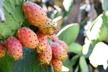
On the farm Jan Harmsgat, in the foothills of the Langeberge of the Western Cape, the pomegranate harvest was about 15% lower than last year. "This was mainly due to older orchards whose production is beginning to decline," explains Kowie Smit. "However, the quality of the fruit was excellent, as reflected in better packout results compared to previous years."
He continues: "We currently farm only with the Wonderful variety of pomegranate, with our oldest orchards being 18 years old and the youngest just one year. We are also exploring new varieties to extend the season."
Until now, Jan Harmsgat has focused on the processing market, supplying Blue Skies locally and in Egypt, with arils sold in the United Kingdom and Europe. "Our youngest orchards are not yet in production, but we expect to begin exporting more class 1 pomegranates in the near future."
To prepare for this, a test run of Class 1 pomegranates was packed in their new packhouse, equipped with a sorter and a sizer, features that the previous pack shed did not have.
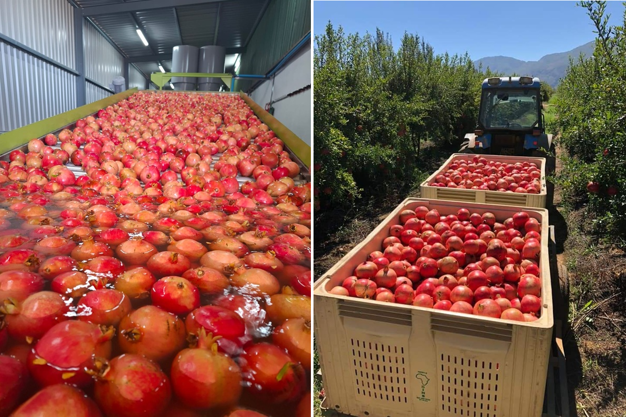 © Jan Harmsgat
Only late-harvest pomegranates for juice
"At Jan Harmsgat, we manage the production, packaging, cooling, and marketing of our fruit in-house to ensure that customers receive only the highest quality. Nothing goes to waste; any fruit not packed due to sunburn, light cracks, or being too small is pressed into juice."
Jan Harmsgat's pomegranate juice has earned a loyal following for its balanced flavour. On the farm—established in 1723—the fruit is juiced, packaged, and warehoused for distribution across South Africa.
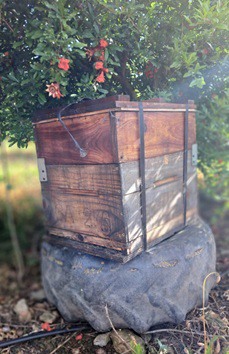 © Jan HarmsgatOnly late-season pomegranates with a high sugar content are used, explains Smit. The slow juicing process allows the juice to flow out gently, and the juice is left unfiltered to preserve a natural sediment that appeals to health-conscious consumers.
Right: a beehive brought into the flowering orchard
"We attract new clients every day," says Smit. "A quality product is truly the best form of marketing—and by that, I mean quality at every stage, from production through to the service we provide."
Initially, they produced 100% pomegranate juice in three packaging options: a 2-liter bag-in-box, a 1-liter bottle, and a 250 ml bottle. "Two years ago, we introduced a sparkling canned drink made with 50% pomegranate and 50% grape juice. This was followed by a slimmer sparkling lemon drink with 20% lemon juice and 80% water, as well as a lemonade with 20% lemon juice and 80% grape juice. We also produce a 100% zesty lemon juice, primarily used in cooking."
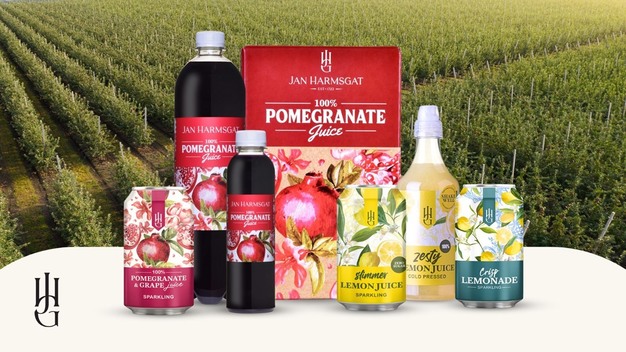 © Jan Harmsgat
Their products are stocked in various stores across South Africa, including their farm shop and online stores.
"In addition to pomegranates," Smit adds, "we farm with wine grapes, pecan nuts, and seedless watermelons. We also produce our own exclusive wine range, which includes Chenin Blanc, Sauvignon Blanc, Chardonnay, Shiraz, Cabernet Sauvignon, Pinotage, and Pinot Noir. The wine is exclusive and mainly sold directly from the farm." For more information:
Kowie Smit
Jan Harmsgat
Email: [email protected]
https://janharmsgat.com