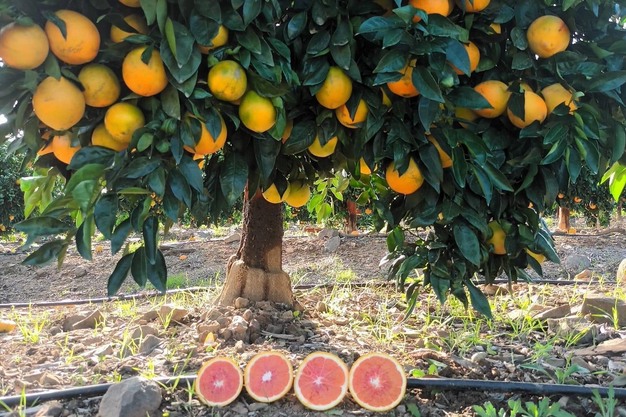
Consumer interest in pigmented citrus fruits has been growing in recent years, and their consumption is expected to increase in the future, especially if evidence is found of outstanding health benefits in the case of pink citrus fruits due to their lycopene content. Could the development of new varieties providing organoleptic and nutritional value give a boost to the declining consumption of oranges?
 © CitrusRosso
"While there has been a great revolution in protected mandarin varieties for the second half of the season, as well as some innovations in seedless lemons and grapefruit free of furanocoumarins, among others, hardly anything groundbreaking has emerged in the orange market in the last 30 years," says Ernesto Machancoses, of Citrus Rosso. "In fact, orange consumption has dropped to worrying levels."
Born in 2015 from the union of a group of Spanish growers aiming to respond to the unsatisfied demand for pigmented citrus from the markets, Citrus Rosso has been focusing its efforts on developing new pink orange varieties for their lycopene content.
"In recent years, it has become clear that consumers have a sensitivity to the color red. For this reason, breeders and growers have been working on the recovery of traditional blood orange varieties with anthocyanins. However, we believe that these varieties aren't exactly what the market is demanding, so we decided to go for new varieties that are pink due to the presence of lycopene, given their nutritional properties and health benefits. This is the case of the protected variety Red Lina (managed by the CVVP), the earliest pigmented orange on the market and already grown on over 200 hectares in Spain," says Ernesto Machancoses.
 © Joel Pitarch | FreshPlaza.com
Ernesto Machancoses.
"In 2018, biochemical analyses showed that lycopene-pigmented oranges didn't just have a novel appearance, but offered all the nutritional benefits of conventional oranges and also contained high levels of carotenoids, especially phytoene and phytofluene, which could have a very positive impact on people's health; something we were able to confirm in a second phase of research," says Machancoses.
"In a third phase, supervised by a medical scientific committee, we underwent the slow procedures of an ethical scientific committee to be able to test it on people by introducing these fruits in the diet of hospital patients in pediatric units. We are now compiling the analyses of more than three years of tests, which we hope to publish in early 2026, with fascinating results, as the high content of these antioxidants is able to pass in the stomach to the microbiota and from there into the bloodstream, and the high presence of lipophilic particles helps reduce fat," he says.
 © CitrusRosso
Citrus Rosso's agronomic project has around 1,000 hectares with different varieties of pigmented citrus available to partners and associates. "One of our objectives is to have pigmented varieties covering the whole calendar, so that they can be available all year round, something we hope to achieve in 2 or 3 years' time. At the moment, we can offer them for 8-9 months of the year. We already have some important partners in South Africa, where more than a million Red Lina trees are already being grown, and some growers in South America, among other countries," says Machancoses.
According to the expert, there is undoubtedly a demand for pigmented citrus that needs to be met. "A lot is being planted in Asia, given the cultural significance of the color red. In the United States, pigmented varieties have gone from representing only 2% of the orange supply in 2020 to more than 25% today. Europe is, perhaps, where we are seeing the greatest delay when it comes to the supply of these varieties, but it's also where there is the greatest growth potential. In fact, we have recently finished the pink-orange season without being able to meet all the demand. We expect significant growth in the consumption of pigmented oranges," says Ernesto Machancoses.
For more information:
Ernesto Machancoses
Citrus Rosso
[email protected]