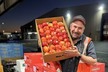
The start of the season for South African stone fruit has been extremely difficult this year. "The winter in the origin was very wet, which meant that the dams were all full, but the following spring was mostly too cold, which is why loading could only start 10-12 days late. Unfortunately, this meant that availability in December was very low, which is why we completely missed the Christmas business. If we hadn't already canceled some major programs early on, the start of the season would have been a total disaster," says Christian Hencke, specialized stone fruit importer and managing director of FFC Fresh Fruit Company GmbH. Up to calendar week 48, up to 40 or 50 per cent fewer goods than usual were loaded in the entire stone fruit category.
In contrast to the current season, the supply situation in the same period last year was much more encouraging, Hencke recalls. "In the 2023/24 season, there was already plenty of product available at Christmas thanks to the relatively warm spring in the country of origin. However, the positive side of the low availability is that current prices are relatively high and stable. Overall, prices are 10 to 15 per cent higher than last year. There is also little competition at the moment: Chile is not expected to start loading the first nectarines onto the market until calendar week 4/5. In terms of variety, South Africa has always had a competitive advantage in recent years, at least in the local markets, especially for nectarines and plums. In two to three years at the latest, however, Chile will also be entering the market with larger quantities of these new, popular varieties."
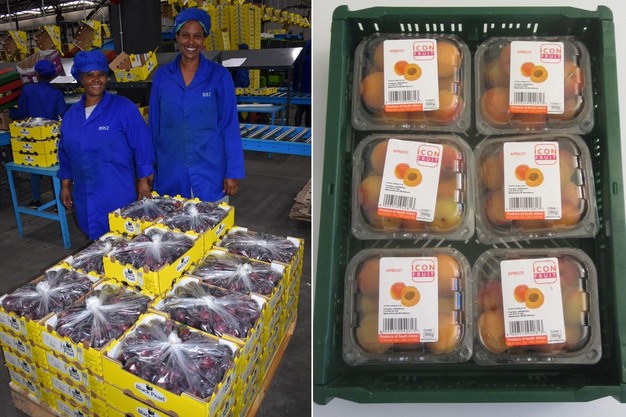
 Last season, FFC Fresh Fruit Company GmbH handled around 1,000 packing orders for stone fruit. Hencke: "Without our service partner Europe Retail Packing in Poeldijk, with whom we are now in our second year of cooperation, this would not have been possible at all."
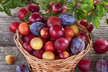
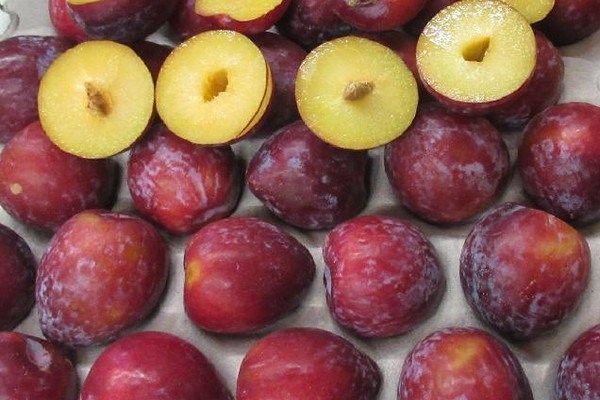
Despite the delayed start to the season, the outlook for the rest of the season is now looking good, says Hencke, referring to the overall favorable volume forecasts. "For plums, we expect an export volume of 13.7 million boxes, which is a slight increase over the previous year (13.2 million). However, this will be a rather small volume. Forecasts for nectarines also indicate an increase in volume. Here, we expect the first promotions in food retailing from calendar week 4, as soon as additional quantities from Chile are available. Peaches have caught up strongly in the past two years, with fairly stable production volumes, which is why prices are currently more stable than for nectarines. Apricots round off the stone fruit program: here we are seeing that the traditional varieties tend to be shipped more to the Middle East, while the so-called Carmingo varieties are attracting more attention in local markets." The start of the season for apricots was also rather difficult, while prices are roughly in line with last year's level, according to Hencke.
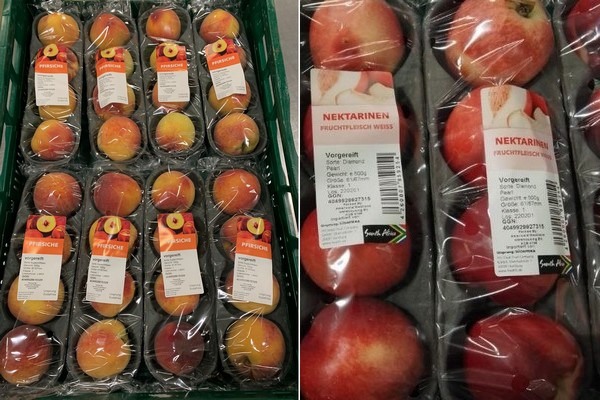 Compared to other European countries, the German market is quite conservative. "Unlike other countries, until a few years ago the German food retail industry did not accept any white-fleshed nectarines, but only the traditional yellow-fleshed varieties."
Improved logistics situation
A crucial factor continues to be the logistics in the area of sea freight. Hencke: "On Christmas Day, containers were loaded for the first time at the port of Cape Town. In addition, there have been weekly departures of conventional reefer ships from Cape Town since this season, which could not be guaranteed last year. In this respect, we are currently quite positive about the logistics situation, even though logistics costs have risen again compared to last year. Transport in conventional ships is 15-20% pricier than in containers." Average transit times are back to normal at 20-22 days, he adds.
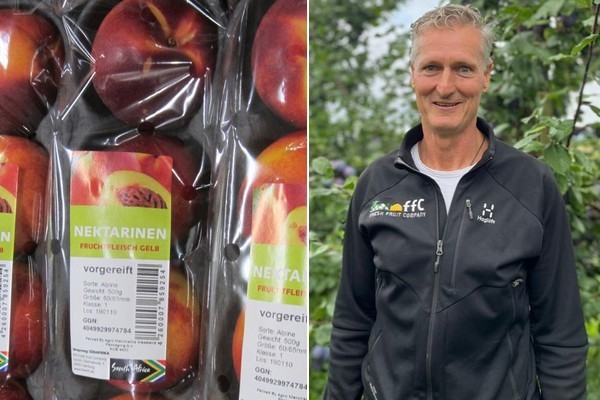 Christian Hencke has been at the helm of FFC Fresh Fruit Company GmbH for two decades now. In addition to the German domestic market, the company mainly supplies customers in Austria, Switzerland, and Poland with South African fruit.
Although FFC Fresh Fruit Company GmbH has specialized in stone fruit over the years, it also focuses on the procurement, service, and marketing of other fruits of South African origin, including grapes, citrus fruits, and top fruit. "The grape season is now picking up speed. Due to the early end of the season in Italy, there was a supply gap and extremely high prices for Peruvian and Brazilian goods from November and December. The past citrus season in South Africa was challenging overall due to the blackspot problem. At the beginning of October, the orange market collapsed because a large number of goods hit the market at once. In the top fruit segment, we are now starting to load the first early pears. After an extremely difficult season last year, there are cuts across the board in the programs, and we have decided to focus only on colored pears instead of green pears."
Photo credit: FFC Fresh Fruit Company GmbH
For more information:
Christian Hencke
FFC Fresh Fruit Company GmbH
Oberhafenstraße 1
Fruchthof, 2nd floor
D - 20097 Hamburg
Phone: +49 40/32 52 97 - 28 / - 29
Fax: +49 40/32 52 97 31
e-mail: [email protected]
www.freshfc.de