The Spanish artichoke season is proving tough, as has been the case in recent years. Prices are good and artichoke sales are going well, "but production volumes, which go hand in hand with field and labor costs, are becoming smaller and smaller, so the market is gradually falling into the hands of specialists in this vegetable," says Iván Arenas, from Eurofruits Levante.
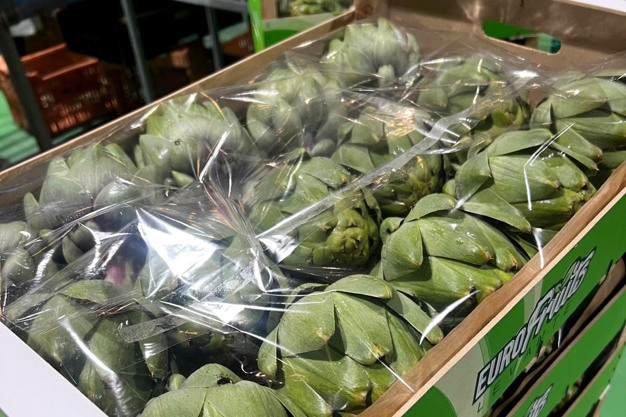
"Regarding artichoke cultivation itself, growers are increasingly abandoning the Blanca de Tudela, the original variety from Campo de Cartagena, and adopting the Green Queen hybrid artichoke, which arrives a little later, so the peak in the supply is also being reached a little later than usual," he says.
"This year, in fact, for reasons we don't know, the Blanca de Tudela artichoke has been generally affected by germination problems in the plantations. Little by little, the plantations appear to be losing homogeneity, and their yields are dropping from 20,000 kilos per hectare just a few years ago to 14,000-15,000 kilos on average nowadays, and we believe that this could be linked to a degeneration of the cuttings."
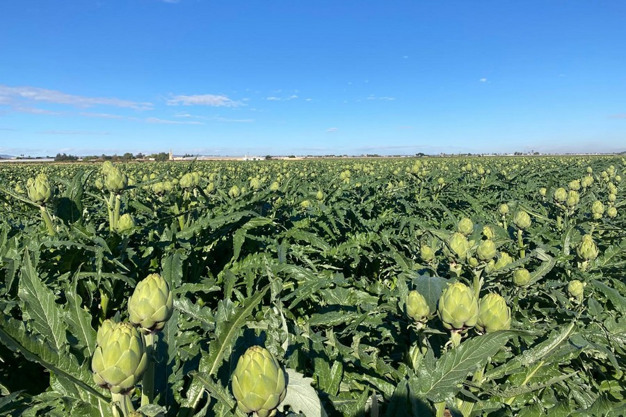
"New Blanca de Tudela artichoke plants can be obtained by selecting cuttings from the growers' own plantations in order to multiply them. What has historically been done to try looking after the variety is to combine cuttings from artichoke plantations in Tudela, in Navarre, with those in our area, to ensure the variety's genetic renewal and prevent the plants from becoming unproductive, while also rotating the cultivation areas. However, despite us doing all this, we are not obtaining the same yields as in the past," says Iván Arenas.
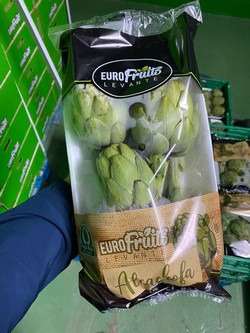
"Meanwhile, hybrid artichokes, which grow from seeds, haven't experienced any drop in production, and their growth is much more homogeneous, as is their germination. That's why producers are investing in growing this variety, which achieves very good sales on the fresh market, even though there are some issues with their industrial processing because their morphology isn't as well suited as we would like to the processing machines for the canning industry," he says.
As far as prices are concerned, Iván says that they are at a good level, at around one euro per kilo at source and above two euros per kilo at the warehouse. "These are acceptable levels, bearing in mind the production and selection costs required for the product that goes to the fresh market, and the competition that exists."
"There are third countries supplying their artichokes to Europe, and they end up competing with us in both the fresh and processed markets. We have seen cheap fresh artichokes from North Africa reaching Italy, which has been a good market for Spanish artichokes, and from there they can be supplied to France, which is another big market," he says.
"Nonetheless, artichokes cannot withstand long transit times when fresh, so even if imported volumes increase, I am confident that the market will continue to appreciate the excellent quality and freshness guaranteed by Spanish artichokes."
 For more information:
Eurofruits Levante
Calle Constitución, 53
03170 Rojales, Spain
Tel.: +34 638 729 509
[email protected]
https://eurofruitslevante.com/