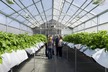
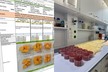
At the 41st Strawberry Day in December 2024, Tobias Linnemannstöns, Head of Supply Chain at Frutania, spoke about the 'Production Possibilities for Continuing to Produce Berries in Morocco and Southern Europe despite Heat, Drought, and Water Shortages'. He focused mainly on the two growing regions of Huelva in Spain and Agadir in Morocco on the Strait of Gibraltar.
Agricultural production in Morocco is of great economic importance, accounting for 12 per cent of GDP. For Germany, this figure stands at under 1 per cent and for Spain at 2.3 per cent, explained Linnemannstöns at the beginning of his presentation. The marketing structure in Morocco and Spain is very export-oriented. "In fact, production and export take place during the winter months or in the non-northern European season. Part of the harvest is sold on local markets."
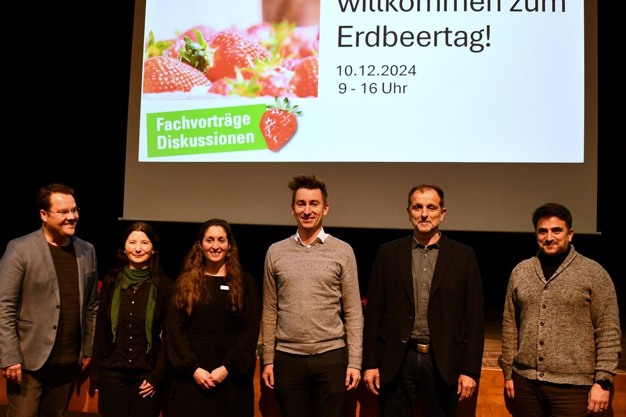 © VSSE
Tobias Linnemannstöns (m) was one of the speakers at last year's Strawberry Day.
Development of the berry production in Spain and Morocco
Regarding the development of Spanish strawberry production in recent years, "we see a relatively constant percentage area - approx. 7,200 ha. And since 2015, we have also seen a relatively constant production volume of approx. 330,000 tonnes of strawberries. By way of comparison, in 2023 Germany had approx. 11,300 ha of land under cultivation for strawberry production, with a production volume of approx. 130,000 tonnes. The open-field area has fallen below 10,000 to 9,000 ha," continued Linnemannstöns. "It is very, very export-oriented. The main market for Spanish strawberries is Germany. Other markets are France and England, and others like the Netherlands. From here, some of it is then exported again."
As another example, he pointed to the raspberry production in Morocco. "Basically, we have seen a massive increase and investment in the production of raspberries since 2014, with a total production of around 30,000 tonnes, which is then in fact exported to Northern Europe. By way of comparison, raspberries are produced in Germany on 873 hectares, with 6,664 tonnes." A similar picture emerges for the Moroccan blueberry production, an important product that continues to be invested in, according to Linnemannstöns. "Here we have a production volume in 2020 of approx. 35,000 tonnes of blueberries. This continues to be a growth market. By way of comparison, in 2023 there were 3,469 ha and 15,322 tonnes in Germany."
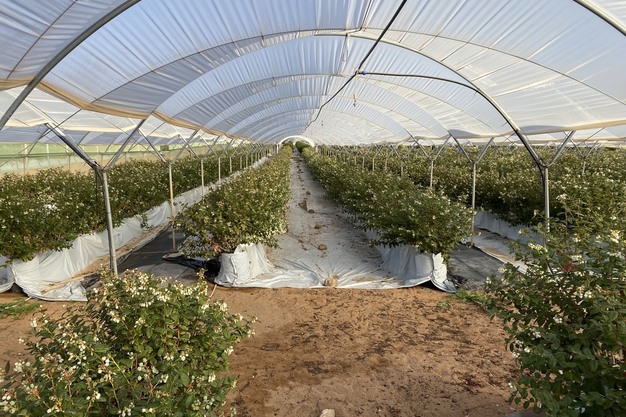
Blueberry cultivation in Morocco
Impressions of the production in Spain
Strawberry production takes place in "relatively simple tunnel systems" and mostly in the ground, reported Linnemannstöns. "Usually with five dams in the tunnel as a double row. Normally, planting takes place in September/October, and then, depending on the variety, production or harvesting starts in January. Then we have a continuous production process until well into May, although of course we also have fluctuations depending on the weather." The tunnel systems are predominantly relatively short systems of a maximum of 70 m. "This is certainly also related to the higher temperatures in summer since the ventilation behavior is somewhat more optimal and certainly also from the intralogistics perspective, so that the distances in the field remain shorter." There is a very high proportion of protected production in Southern Europe. "Almost everything is cultivated under cover. Another standard practice is to level the land to create relatively flat surfaces."
Most raspberries are still grown in the ground in Spain, using a "simple system of the same tunnel type". For blueberries, there is a certain unit with two rows in the tunnel. The cultivation of strawberries, blueberries, and raspberries is very similar. Often there are also two rows with greenery for a better climate in the houses. This also has the advantage that the company can establish open breeding of beneficial insects to prevent lice.
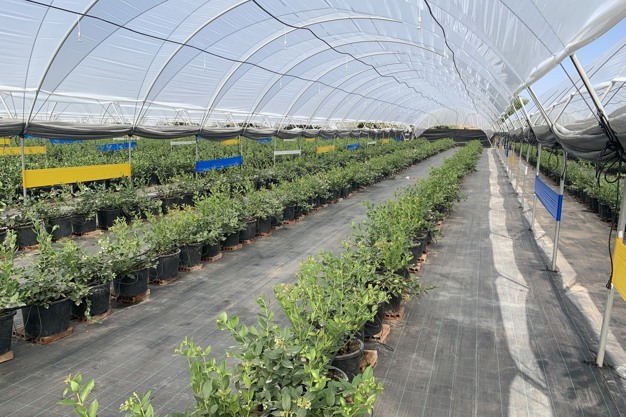
Moroccan blueberries as a pot culture
Berry production in Morocco's Canarian Houses
According to Linnemannstöns, the tunnel houses in Morocco look a little different. "These are so-called Canarian Houses - relatively simple constructions with wooden beams or metal." For blueberries, more modern protected systems are used. "They usually try to counteract the weather or the high temperatures with a little spray mist for cooling," explained Linnemannstöns. "For strawberries, for example, crown irrigators are installed after planting. In Spain, it is also standard practice to irrigate using crowns after planting." These tunnels are also specially shaded, for example at the delivery point, to make work more pleasant.
The measures taken include shading nets, for example for blueberry plants, but also a basic irrigation system and white foils to reduce the warming of the soil. Of course, rain is also a problem. "With heavy rain and rain events, simple gutter systems between the tunnels are increasingly being used or at least started to be used to collect and drain rainwater."
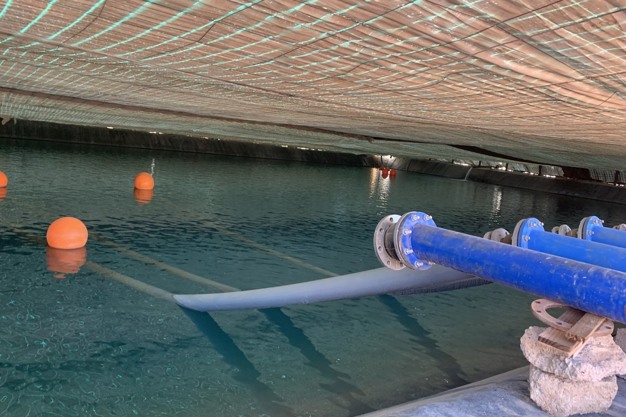
Water basin with evaporation protection.
State-of-the-art water technology in Morocco
In Morocco, modern infrastructure and water technology such as an osmosis plant are used to process water, Linnemannstöns continued. Importance is also placed on evaporation protection to save water. "To spread the risk, attempts are being made to work with different sources. Groundwater, reservoirs in mountainous regions and desalination plants can therefore be publicly owned, especially in Morocco. The companies also operate their own reservoirs and infrastructure to ensure that they have sufficient water for their crops," Linnemannstöns reported.
In Morocco, there is a political will to continue production, and investments in water infrastructure are therefore being made by the government. "In the Agadir region, there is a state-sponsored desalination plant that is intended to be available for agriculture, but also for tourism and local people. The plant is in operation and is supposed to supply 15,000 ha of agriculture with water."
Water costs in particular vary greatly from country to country, with a wide range in the costs per cubic metre. "You would think that in water-scarce regions, water for agriculture would actually be pricier; that is not the case. Nevertheless, there are certain restrictions depending on the annual precipitation and the availability of water locally. In Spain, for example, water use was reduced for fruit-growing businesses last year, which we have not seen to this extent in our country so far."
"Perhaps we will also have to think more about investing in our own water storage, reservoirs, etc. to be able to cultivate safely in the future if the number of consecutive dry days increases in the future," said Linnemannstöns in conclusion.
Visit the company at Fruit Logistica: Hall 27 | D-32
Photo credit: VSSE / Frutania GmbH
For more information:
Tobias Linnemannstöns
Frutania GmbH
Heinrich-Lanz-Str. 3
D-53501 Grafschaft-Ringen
T +49(0)2641-9111-0
F +49(0)2641-9111-199
[email protected]
http://www.frutania.de