Orange X-Press, a subsidiary of Llombart Handels- und Treuhandgesellschaft mbH, has been manufacturing juice machines since 1998 and enjoys steady growth. "Sales have increased this year. Volumes of machines have also increased disproportionately due to strategic partnerships. This is also related to the fact that we cooperate with Hepro GmbH, which maintains good contacts with food retailers. We entered into this partnership because our machine fits very well with Hepro's overall product range, which was still missing an orange juicer," says Account Manager Stephan Große-Rohde. Tech Supporter and Product Engineer Raphael Llombart joined the family business in 2020 after studying mechanical engineering.
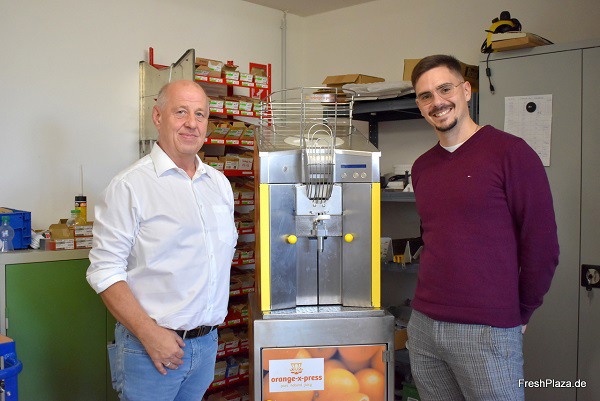
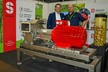
Stephan Große-Rohde and Raphael Llombart at the previous location in Herbolzheim. At the end of October, Orange-X-Press production will move one location away, bringing the production and service area to 220 square meters.
Continuous growth of 20 percent per year
"It all started in Germany, which also allowed us to exploit our home advantage in terms of production, etc. In the meantime, we are also represented in the Czech Republic by a large retail chain that also operates in Germany. In addition, we are holding initial talks with a retail chain in France as well as another large group in the Czech Republic," says Große-Rohde. "In recent years, we have had continuous growth of 20 percent per year. However, profits have slumped somewhat in view of the crises in recent years. In particular, the interrupted supply chain made things difficult for us, with a lack of electronic parts and other raw materials and spare parts."
Although production in Germany has its advantages, especially in terms of distance and quality, production costs have also risen to over 20 percent in return, he said. "However, the focus on the region is also part of our corporate philosophy. After all, the short distances allow us to react much faster and ensure the highest quality standards. This is among our top priorities."
 Launch of the new machine
Currently, the company is tinkering with the changeover of some drives and a smaller machine. "We are now in the final phase and will soon present a prototype that can also be tested in the field. In the future, the machine will take up only half the space. The dimensions of the current machine are due to the high throughput. Smaller operations, such as cafés, bars and bakeries with a smaller throughput, have correspondingly limited space available. To-go products are increasing, which is why we also want to enter this market," explains Llombart.
"Cleaning the machine can be done in under ten minutes. It works via a clamping system and is fixed with wire springs. All the individual parts that are in the machine can be washed in industrial dishwashers, while the machine itself can simply be wiped out and rinsed," says Llombart. "Basically, there are two variations: One machine is designed to be self-service, allowing people to fill their own bottles, while the other standard machine runs a predefined number of oranges through it. The discharge is adjustable according to the size of each container." The standard caliber of the oranges here should be 6 or 7 to be able to produce an adequate amount of juice. "However, there are also customers who have ordered sets of smaller rounds and stars for smaller citrus."
Daily production of 130 to 140 liters of juice
"Since we only work with stainless steel and high-quality raw materials, the prices are correspondingly high," says Große-Rohde. "This has made us rather unattractive to smaller businesses, such as bakeries and the food service industry. With the smaller machine, we are therefore offering a solution that also specifically addresses this customer segment," explains Große-Rohde.
"Our customers also include a large amusement park nearby, where one of our machines has been in operation for three to four years. Certainly, wear parts need to be replaced, such as cleaning brushes and fruit pushers. Otherwise, the machine is robust. The customer has always been able to produce between 130 and 140 liters of orange juice a day. This confirms to us that our machines have a high level of stability and quality. The customer has conveyed to us that other machines he used were no longer usable after a short time."
Stability of twelve years
"With proper care and maintenance, our machines last well over five years," adds Llombart. "I recently personally serviced a machine that had been in operation for over twelve years at that point. We roughly estimated how many oranges must have been pressed over the machine and came to a result of 50 truckloads. Particularly in terms of sustainability, our machine represents an interesting product. Of course, it is a product with a lot of metal, which also costs energy. But in return, the product lasts a very long time. Competitors' machines, which have an equally high metal density, may not last as long." Machines sold to food retailers also show a high utilization rate and have sometimes been in use for at least ten years.
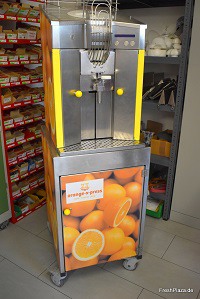
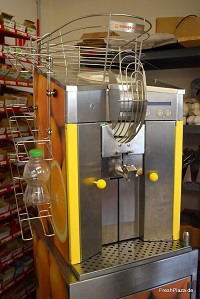 Among other things, the machine can be supplemented with a bottle holder, but also with a bracket at the outlet where bottles can be hung, allowing the machine to be individually foiled on the outside (see right). "We have developed a legally protected pressing principle in which the skins are not pressed along, which also means that no essential oils, bitter substances or potential treatment substances can escape. This means that not only organic oranges but also conventional produce can be used, which is a huge part for year-round supply. This also gives us a huge sales advantage. The bottle holder can be attached without taking up much space. A new addition is the anti-fruit fly system, which we have developed in cooperation with Hepro. There is air circulation in the machine, which prevents fruit flies from entering the press housing," says Große-Rohde.
For more information:
Stephan Große-Rohde und Raphael Llombart Orange-X-PRESS Handels- und Vertriebsgesellschaft mbH
Industriehof 4
77933 Lahr
Tel.: +49 (0) 7821 / 9397608
E-Mail: [email protected]
Webseite: https://www.orange-x-press.de