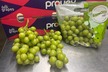
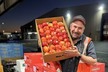
As the mid-season of the Sicilian grape campaign reaches its peak, we took stock of the situation with Salvatore Novello, an entrepreneur specializing in the production and marketing of this reference. A year, that of 2023, which in some ways has been anomalous especially with regard to the production, causing a delay of about 2 weeks compared to the usual timeframe that starts in May with early greenhouse crops and ends in December with late varieties.
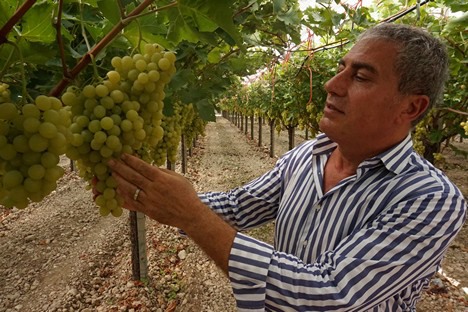 Salvatore Novello
"The production of Sicilian grapes is halfway between early and medium-late crops," says Novello. "So far, the campaign has shown a drop in production of at least 30 percent, an estimate that is certainly by default, when compared to the same period last year, and we think the trend will be the same for the other varieties. If last year was a loaded year, with not excellent production quality, this, on the contrary, is a year of physiological rest for the plants that, worn out by 2 years of drought and high temperatures, have generated less fruit. In addition, some plots, especially those not covered, suffered from the attack of Downy mildew, caused by rainfall in May and June. This resulted in additional shortages of produce."

"The market saw losses in the first phase due to poor judgment on the part of operators," the entrepreneur continues, "who, expected to harvest too early, which affected the value of the product. Later on, as the lack of product on the plants took shape, the market also rebalanced in price. The current season is showing much better quotations than the previous year, which saw prices below production costs. Instead, this year the average production prices, finally in line with the steady increases of recent years, have been between €1.00 - €1.10 per kg and, in some cases, even more."
"Consumption, however, has been modest so far," points out Novello. "This has luckily been compensated for by the lack of product, keeping prices in balance. Demand and consumption could improve with subsequent production, and we hope that the market trend remains this way for the rest of the campaign, also because the drop in production seems to be profiling to be similar for the late varieties as well. We have also not been affected by competition from other producing regions, partly because the weather dynamics have been similar throughout the production area; unlike us, however, they have not been affected by the two-week delay at the beginning of the 2023 season. It looks like we won't even have much competition later in fall coming from the southern hemisphere, and we will probably struggle to make it to the end of the year with the produce."
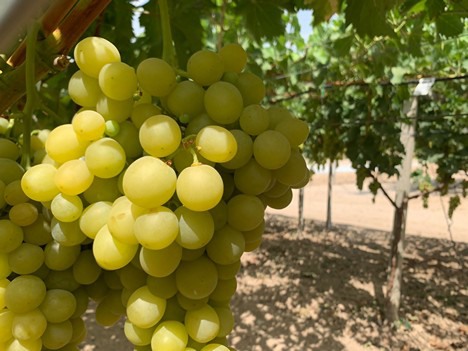
"Obviously," remarks the expert, "forecasts are always very random and should be taken with due caution. In the future, however, we should think about the need to adapt production to consumption. There is no point in producing a large amount if the product doesn't sell. It would perhaps be appropriate to produce less, but with high quality. Unfortunately, there is a lack of direction in this regard, just as there is a lack of a productive/varietal registry to serve as a reference point for the sector."
"The medium-late campaign will begin shortly with the Italia variety as early as next week, but also with seedless ones. For the latter, prices this year are aligned with seeded grapes. This shows that when the production quality is good, and the quantities are in line with consumption, price differences are reduced. Of course, the diversification process of varieties toward seedless ones is underway and there will be no reversal, for a variety of reasons, but here again we need to think about the quantitative balance according to harvest seasons, production methods and varietal selections, seeded or seedless," concluded Novello.
For more information: 
Novello & C. Srl
Mazzarrone (CT) - Italy
https://www.novelloec.com/