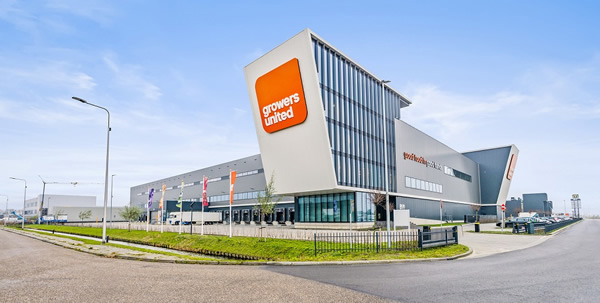
The Dutch Growers United Cooperative began ten years ago with 35 growers who, together, had 270 hectares. Today, it has 32 growers with 650 hectares. Over the last decade, the cooperative has evolved into a joint stock cooperative and launched two new packaging companies. In this interview, Managing Director Jan Opschoor reflects on the season's start, the main future trends, and the cooperative social contact.
"In the last 18 months, the energy crisis caused a stir within the Dutch horticultural sector. Many lights were turned off. That happened to us, too, though we agreed with our members to keep serving some customers during the winter. That was mainly thanks to using LED lighting," begins Jan.
"Because of that, everyone was concerned about the start of the season. They were afraid everything would arrive on the market at once. With bell peppers and eggplants - of which there is usually little available in winter - we're already used to that. But tomato and cucumber growers were particularly worried."
Start of Dutch season delayed
"The dark spring and later planting considerably delayed mainly tomato and bell peppers productions, so their pricing is fair to good. Less product coming in from southern Europe and North Africa at the Spanish and Moroccan seasons' tail ends contributed to that. That was due to drought and water shortages as well as pest and disease pressure in those growing areas. Bell peppers prices have, so far, been great," says Jan.
"And, this spring, eggplant prices were good too, with low yields per m2 until recently. The current high productions are putting pressure on pricing. Tomato prices have been fair to good, with some differences by segment. Higher prices, by no means, always compensate for lower per m2 production. I'm, thus, curious to see how the rest of the season will develop when there's more production."
"Cucumber volumes were limited at the start of that season, and prices were good. Volumes, however, increased sharply, which led to some market oversupply. Several auctions have even had throughput in recent weeks," Jan explains. Tomato growers switching to cucumber cultivation also created additional supply on the market. Some Growers United tomato growers also switched.
"Larger companies try to find market opportunities from a risk-spreading perspective and see those in cucumber cultivation. We've helped our growers by installing a sorting and sealing system at the packaging company, so growers don't have to invest in that themselves."
'Younger growers guarantee continuity
How have cultivation companies developed the most over the last ten years? They have primarily increased in strength, answers Jan, saying, "There have been several mergers within the cooperative. As a result, companies get stronger. Scaling up isn't a goal in itself. Yet, with mergers, companies gain more financial clout, the management team becomes stronger, there's room for specialists, and there are also more chances to become, say, internationally active. Some growers have also chosen to sell based on their strengths."
"I think that can be an excellent strategy. Forced sales haven't been an issue with us. I'm proud of our many young members. Business succession is a broad problem issue within the agricultural sector. We have a large group of young, 'under forty' entrepreneurs. That's extremely important for continuity. Besides the knowledge meetings we facilitate especially for them, these young business people encourage and seek each other out, which has indirectly even led to mergers," Opschoor says.
"We've invested in market data and retail know-how, thus becoming more market-orientated. Along with our service providers, we're professional suppliers and discussion partners for retailers. Our customers haven't changed much; we've just grown closer to them. Europe is by far our largest market, but we've also further developed our sales in Eastern European countries over the past ten years."
Jan identifies internationalization, further sustainability, and digitization as the top future developments. "A good example is the Horti Footprint, which gives us a picture of all our cultivation locations' data. We also use this to anticipate sustainability reports according to CSRD guidelines that will become mandatory within a few years," he says.

Social bridge
According to Jan, they give social contact its due attention too. "As a sector, we've recently become much more customer-oriented, yet haven't sufficiently succeeded in bridging the society/NGO gap. We're working on this vital aspect within the Federatie Vruchtgroente Organisaties (FVO) context."
"We can supply our healthy fruit vegetables to many consumers in a technically high-quality manner, but we must make the production method even more sustainable," the MD continues. "We'll have to clearly explain to people what we're doing and where we must still take steps, like in fossil fuel and chemical reduction use."
The developments around Growers United member bundling have not stood still either. "Further sales bundling to strengthen growers' positions would benefit the sector. There's some movement among growers who aren't members of producer organizations joining cooperatives, whether GMO-driven or not. It's vital for our sector that some sufficiently-sized producer organizations remain. They must create the correct dialogue for other chain parties and invest in things like further sustainability," Jan concludes.
 For more information:
Jan Opschoor
Growers United
899 Honderdland, 2676 LV
Maasdijk, the Netherlands
Email: [email protected]
www.growersunited.nl