Climate change has the world firmly in its grip, Germany included. Drought and high temperatures in the summer months have been a growing problem for German crops for years and require new strategies to adapt to changes in the environment.
One company that is trying to make positive use of the difficult circumstances in production together with its growers, and thus to gain something positive from the supposedly negative change in production conditions, is Fruvital Fruchthandelsgesellschaft, based in Willich (NRW), which cultivates melons and watermelons in cooperation with seed supplier Hazera and various producers in southern Germany. In an interview, Thomas Hinkelmann, producer management Fruvital, spoke about the successful project.
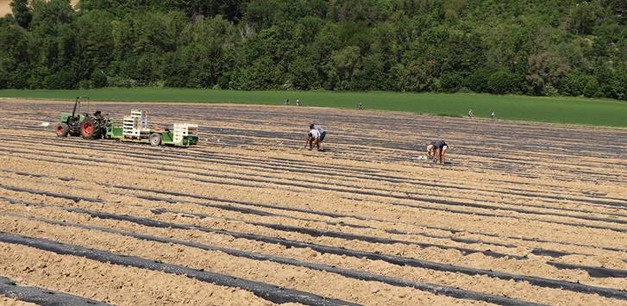
"As an innovative company, we are constantly on the lookout for the best ways to extend seasonal seasons or - where it makes sense - to supplement foreign production with domestic production. For some years now, we have therefore been intensively examining whether there is a possibility of producing tasty watermelons in Germany as well". The German season starts after the season has peaked in Spain. This period is normally covered by imported goods from other countries (e.g. Hungary).
The gap in the seasonal calendar after the Spanish peak season can thus be filled more ecologically than would be possible with imported goods: "Cultivation in southern Germany, especially in Baden-Württemberg, has enormous advantages over international trade in terms of sustainability. This plays a very important role for us."
As is well known, the weather plays a particularly important role in the sale of melons and watermelons - in addition to the selection of varieties. Through domestic German production, the needs of the food retail trade can be met more spontaneously and precisely. If, for example, the weather is unexpectedly warm or the weather changes completely, we can be extremely flexible due to the proximity of production to the customer. We can react at short notice - this means sustainability for us; on the one hand, it saves transport costs compared to importing goods from Spain or other countries. On the other hand, there is less need to speculate about the required quantity days in advance - due to the enormous transport distances. This results in less food waste or excess quantities, and transport distances are shortened enormously. In the end, the fruit is simply fresher and harvested when it is most aromatic."
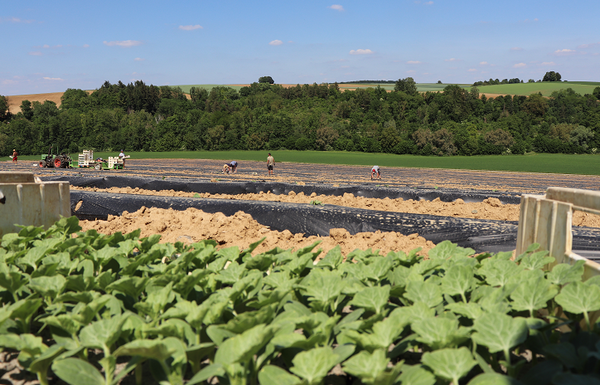
This means that cultivation is ecologically and economically sustainable: "By adding innovative products that were not normally native to our production areas, we help producers to deal with climate change in the best possible way, while at the same time preventing shortages and oversupply and avoiding unnecessary transportation."
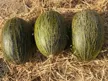
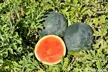
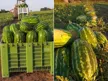
The project is being carried out in close cooperation with seed producer Hazera. "It has been a long process. We travelled to Spain, among other places, to look at varieties directly on site, started field trials and have now found varieties that work really well in Germany. After many sleepless nights, we can now offer Charentais, Honeydew, watermelons and mini-watermelons from German producers - and the demand is growing steadily."
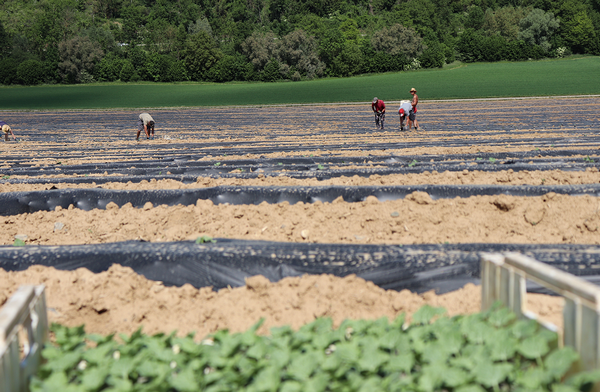
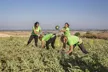
The German consumer has very special preferences when it comes to melons. Large calibres are less popular; hence the decision to go for mini or dessert watermelons, which were tested in Tobias Holderrieth's fields. The producer has found his passion in melons. "A few years ago he started with one hectare and now he harvests the fruit on six hectares. It hasn't always been easy, but now we are proud to be able to bring a regional, unique product of super quality to the market."
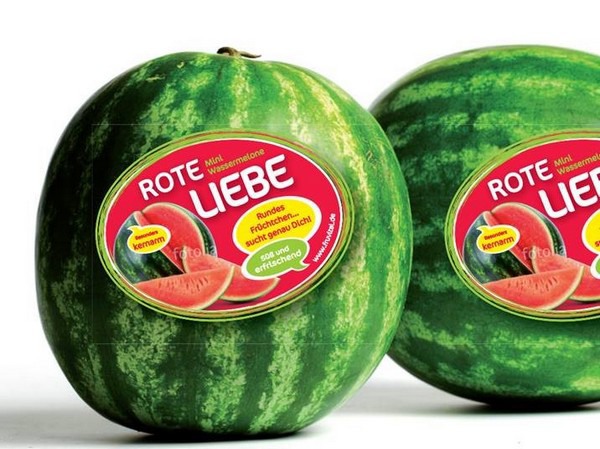
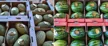
The watermelons are marketed under the name "Rote Liebe" in the German retail trade. "With this brand name we wanted to show that this is a German, regionally produced, premium product. We do not want to be simply interchangeable and convey the exclusivity of our cooperation: Hazera takes care of the selection of varieties and seeds, the producers are responsible for the right quantities and quality, and Fruvital takes care of distribution. In this context, all parties involved are of great importance and everyone sees themselves as responsible for working at the highest level. We are extremely happy with the cooperation and the fruits it bears."
For more information:
Thomas Hinkelmann
Fruvital Fruchthandelsgesellschaft mbH
Hanns-Martin-Schleyer-Str. 35
47877 Willich
Tel.: +49 2154 / 884 29-17
E-Mail: [email protected]