The Nielsen Institute has revealed that France is now ahead of the United Kingdom in the food e-commerce market.
With more than 5,100 drive sites and sales up 7%, France is at the top of the list of countries most interested in online shopping. Having appeared in 2010, they are attracting more and more consumers despite the current major crisis in the retail sector.
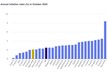
France is the European champion, just ahead of the United Kingdom (6.3%), and well ahead of Germany (1.4%), Spain (1%) and Italy (1.6%). Globally, France is in third place, far behind South Korea (20%) and China (18%), much further ahead in terms of e-commerce. On the other hand, the United States and its 5.6% market share in e-commerce are behind the French.
The share of e-commerce in the FMCG market (Fast Moving Consumer Goods) is expected to continue to grow in the coming years worldwide, reaching a value of $400 billion by 2022.
While online commerce in the world is largely dominated by home delivery services, France is dominated by drive. In France, home delivery represents only 1.4% of FMCG's sales. For the drive, the proportion of households using this concept is 26.7%, or more than a quarter of the population.
The study notes that households use the drive about once a month. This corresponds to their large monthly runs. This underlines the routine nature of the drive, and therefore a greater loyalty between the drive location and the household.
This French specificity also has an impact on the profile of households that are keen on e-commerce: while home delivery users are generally young and childless, the drive appeals above all to families, especially those with young children. This could be noted by the type of products purchased (diapers, baby jars, etc.).
Purchases in e-commerce are only very rare for fresh products and give much more priority to products with long shelf life.
To keep up with the trend, the drive has recently taken on local stores (74% of stores with a new withdrawal point are therefore stores of less than 1000 m²). The "pedestrian drive" is also developing. Thus, supermarkets are trying to seduce an audience that has gradually abandoned them, namely young people and urbanites.
Source: lefigaro.fr