If you ask Ricardo Garrón what keeps Melones del Sol alive in the European market, he won't talk about marketing or expansion. He'll talk about the certainty of being where you say you'll be, when you say you'll be there, and with the right quality.
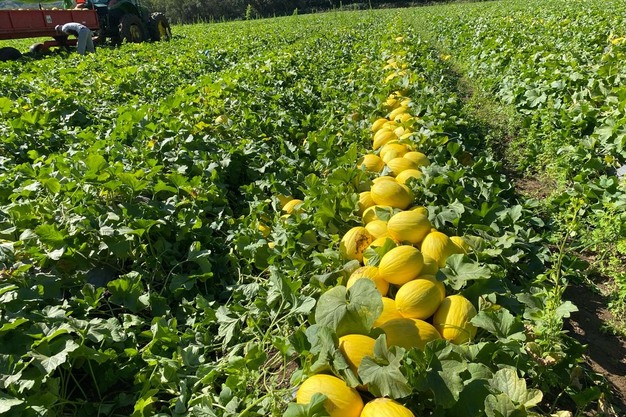
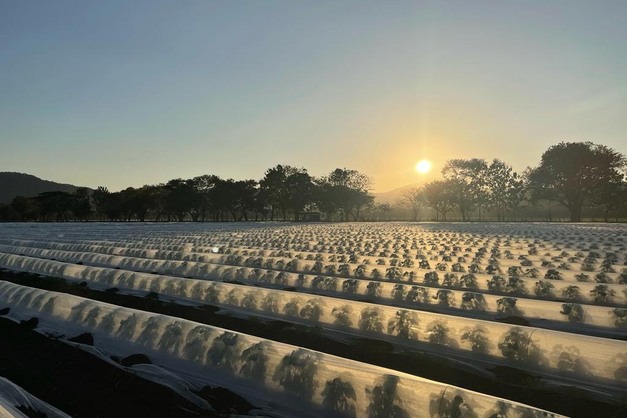
The family business operates from Santa Rita, in Guanacaste, on the Pacific coast of Costa Rica. With 170 hectares under cultivation and its own packing facility, it produces around 240 containers per season, typically between weeks 5 and 16 of the year. A window that opens just as Brazil begins to withdraw and before Spain enters the picture.
 © Melones del Sol
"We are very precise and reliable within our window," says Garrón. "That's why Costa Rica is still in the market. Otherwise, Brazil would have pushed us out years ago." A competitive position built not on price or volume, but on predictability.
Climate change: An unexpected ally
Here is a paradox few would expect to find on the Pacific coast of Costa Rica: climate change, at least for now, is proving beneficial for the business. "So far, the climate disruptions have worked in our favour. Brazil and Spain are dealing with far greater problems," says Garrón.
 © FreshPlaza
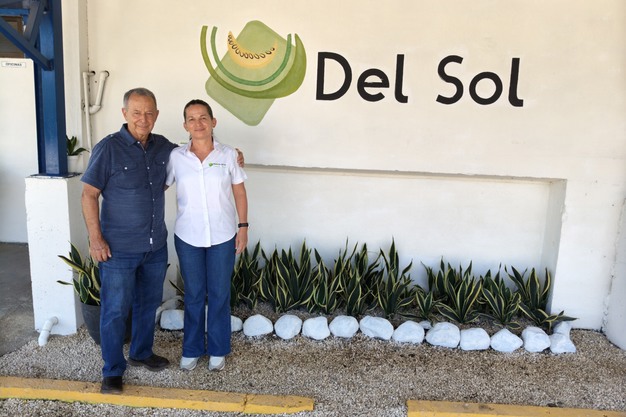
Ricardo Garrón and his wife, Marbeth Venegas, founders of Melones del Sol.
Disruptions to Brazilian supply slightly extended the seasonal window last year, and Spain started its season later than usual, allowing Melones del Sol to keep exporting until week 16. Morocco, for its part, suffered significant rainfall problems. Though Garrón is careful not to present this as a structural advantage: "It's a series of circumstances that, for the moment, have played in our favour."
Melons or watermelons? The market decides
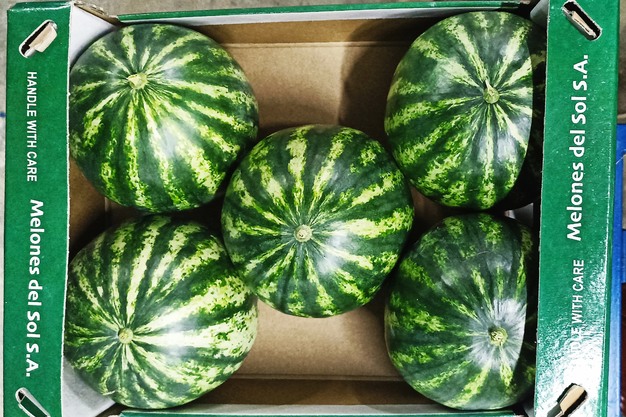
One of the most significant shifts Garrón describes has nothing to do with climate or geopolitics: it's happening on the supermarket shelf. European consumer preferences are moving away from yellow Honeydew melon and strongly towards watermelon — seeded, seedless, and in mini format. "What used to be a 70/30 split in favour of melon has now reversed: 60% is watermelon and 40% melon, and all signs point to the trend continuing," he says.
His assessment is clear: "I think it's pure consumer preference. It's happening everywhere." At the same time, Galia and Cantaloupe varieties — which Melones del Sol does not grow — are seeing a modest recovery, further eroding yellow Honeydew's market share.
Garrón doesn't view these shifts as irreversible. "The market goes up and down. You have to be ready to follow it." That's why he always attends the annual Madrid trade fair each October, which he uses as a sector barometer: "It's the place where you can really feel the trend — where is this heading? You can visit all your clients, talk to them, and get a sense of how the market is evolving."
 © Melones del Sol
There is a certain irony in the numbers: yellow Honeydew is slightly cheaper for Melones del Sol to grow, thanks to years of optimised production and high yields. "We'd rather grow melons," he admits with a slight shrug. "But you have to adapt to the market."
Insects, biology, and staying ahead of Brussels
Melones del Sol has its own laboratory for developing and breeding biological pest control agents: insects and microorganisms that do the work previously handled by chemical products. A long-term investment that has quietly become one of the company's most important competitive assets.
"We've been moving in this direction for many years, so we have plenty of alternatives to replace certain chemical products that are now being banned in Europe," explains Garrón. When new EU phytosanitary restrictions come into force, competitors scramble to comply. Melones del Sol already meets them in advance.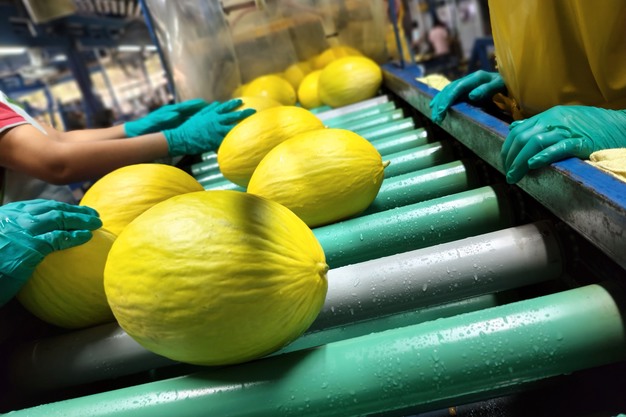 © FreshPlaza
Last season offered a telling example: thrips — small but devastating insects — caused serious damage across farms throughout the region. At Melones del Sol, the problem was far less severe, with the outbreak controlled primarily through biological methods.
The company holds GlobalG.A.P., SMETA, and LEAF certifications, the latter being particularly relevant for the British market. Retail giant Tesco represents a significant share of Melones del Sol's annual sales. "Right now, they're our most important client."
Cultivated area remains stable
"The total melon-growing area in Costa Rica is holding steady. Producers come and go, but the overall volume balances out with what the market absorbs," says Garrón. "Guatemala, for example, has largely stepped back from European trade, pushed towards the US market, which is far less regulated. Costa Rica, historically aligned with Europe's strict phytosanitary standards, doesn't face that conflict."
 © FreshPlaza
According to Faostat data, Costa Rica's melon-growing area remained fairly stable between 2021 and 2024, at around 2,300 hectares, with exports fluctuating between 50,000 and 57,000 tonnes. Watermelon area, by contrast, grew from around 1,850 ha to approximately 2,550 ha, and exports — after an initial dip from 56,000 tonnes to an average of 52,000 tonnes in 2022 and 2023 — rebounded strongly to exceed 65,000 tonnes in 2024.
Labour, rice, and a tightening job market
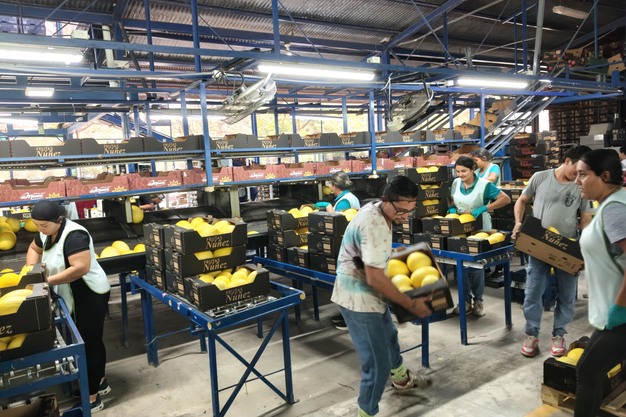
During the season, around 170 workers keep the operation running — roughly one per hectare — spread across field work, packing, and administration. A significant number come from Nicaragua and have been returning to the farm for up to fifteen years. "We know them all by name," says Garrón. "They're excellent workers, no issue there."
However, the labour market in Guanacaste is tightening. The boom in tourism, hospitality, and construction along the Pacific coast is drawing in workers who might otherwise be picking melons. "Now we have to bring more people from Nicaragua. It's a structural problem for the agricultural sector," he acknowledges.
 © Melones del Sol
A second blow came from an unexpected direction: government trade policy. Costa Rica decided to liberalise rice imports, removing the tariff protection that had made domestic production viable. Melones del Sol used to grow rice out of season, which allowed it to keep more workers employed year-round. That option has largely disappeared.
Growing, cautiously
The company has tried to diversify, without much success. Guanacaste's climate — six months of heavy rain followed by a harsh dry season — is excellent for melon but poorly suited to other commercially viable crops. Papaya was trialled with good quality results, but irrigation costs made it unworkable. "Europe and the US produce a lot of fruit and vegetables during our rainy season — a period in which we could also do so here — so it has been very difficult to find another product to diversify into," admits Garrón.
On the question of growth, Garrón is cautious but candid. The farm and the packing facility are sized for one another and for the current client portfolio. Any expansion would require investment in additional packing capacity — something that only makes sense with a stable broadening of the market to justify it. "It's all a chain. If we had an expanding market, we'd like to grow. We're always open to new clients, but it's not easy."
On which type of market suits Melones del Sol best, he has no doubt: the Netherlands, with its spot-market culture and price-driven mindset, is not its natural territory. Their place is in direct relationships with quality-oriented distributors and retail chains. "We're not the cheapest. We're very reliable, and that comes at a price."
About the company
Founded in 1998, Melones del Sol initially sold its entire production to Dole. When Dole withdrew from the Costa Rican melon three years later — transferring its clients to Honduras and Guatemala — the company sought new partners, including Del Monte and Fyffes, for several years. As those relationships also wound down, Melones del Sol began building its own presence in the European market. Using the Netherlands as a springboard, it gradually moved up the supply chain until it was supplying supermarkets and distributors directly. Today, it exports exclusively to Europe, with the United Kingdom accounting for roughly half of its total volume.
 For more information:
Ricardo Garrón
Melones del Sol
Costa Rica
Tel.: +506 8827 8215
[email protected]
www.melonesdelsol.com