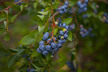
The importance of organic farming and its role in production was at the center of the 7 March 2026 conference held at the Montelupo Hall in Domagnano, Republic of San Marino, Italy. The conference focused on improving every step from production to consumption. Entitled "From Farm to Table: Innovating Processes and Products in a Responsible and Sustainable Way for Healthy, Good, Clean, and Fair Food," and was organized by OSLA-GLAAS. The event received the patronage of the Italian Secretariat of State for Agriculture.
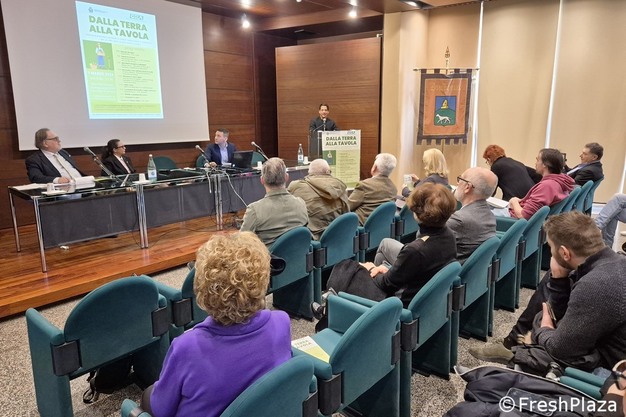 © Cristiano Riciputi | FreshPlaza.comA moment of the conference with Italy's Secretary of State for Agriculture Matteo Ciacci
Michele Andreini, director of OSLA San Marino Entrepreneurs' Organization, opened the proceedings. Then, Mario Tamanti, director of AOP Vi.Va., addressed the audience: "We must disengage from the dynamics of driving prices downwards and recognize the fair value of growers' products. It is not easy, but one way to achieve this is through aggregation."
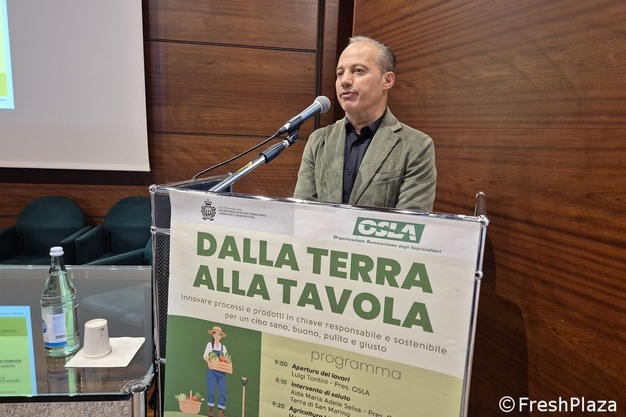 © Cristiano Riciputi | FreshPlaza.comDirector of AOP Vi.VA. Mario Tamanti
Then, Fabio Brescacin took the floor. He is a key figure in the sector and the president of Naturasì, a company that has produced organic and biodynamic products for over 40 years, and has 350 specialty stores throughout Italy. "There is a lot of talk nowadays about environmental sustainability, but few mention that only agriculture can clean the atmosphere by absorbing CO2," said Brescacin. Not to mention, carbon dioxide is a valuable resource for the soil, and plants can only perform photosynthesis with the help of chlorophyll and atmospheric carbon dioxide."
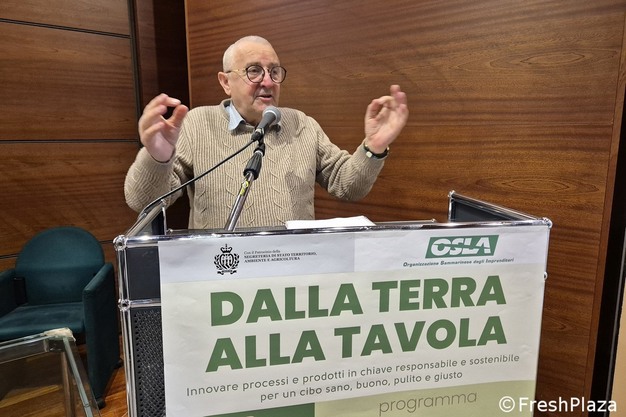 © Cristiano Riciputi | FreshPlaza.comPresident of Naturasì Fabio Brescacin
Organic farming is less affected by the dynamics we see nowadays. "For example, the price of chemically synthesized fertilizers is soaring. In organic farming, however, we use compost, which is unaffected by oil prices," the president continued. Unfortunately, Italy has lost part of its production capacity and is experiencing a serious food deficit. While organic farming costs producers more, it benefits society as a whole, including economically.
 © Cristiano Riciputi | FreshPlaza.com
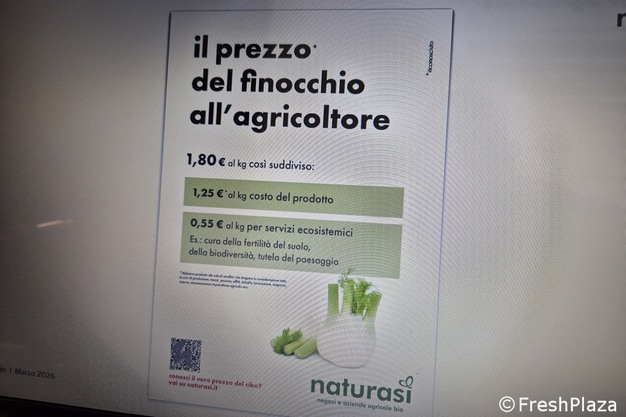
Brescacin used Naturasì's transparent pricing in its stores as an example: "We highlight the final price, as well as how much goes to the producer. Last year, for instance, we sold fennel for €3.98/kg. All 350 of our sales outlets displayed signs stating that €1.80 went to the producer, €0.80 went toward technical services, quality control, and logistics, €1.23 went to the sales outlet, and €0.15 went toward VAT. This makes the supply chain completely transparent, so consumers know where each portion of the price goes."
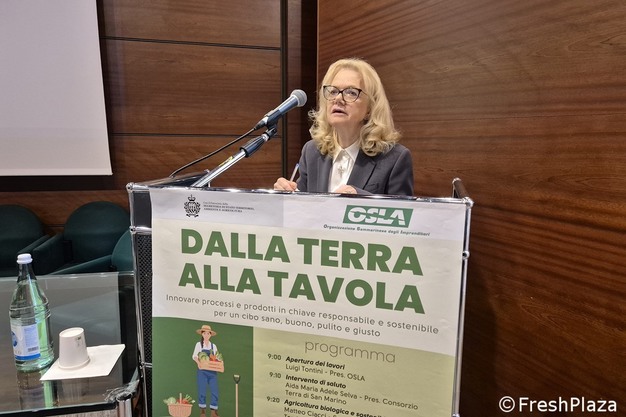 © Cristiano Riciputi | FreshPlaza.comPresident of the Terra di San Marino Consortium, Aida Maria Adele Selva
In San Marino, there is a group that promotes the territory and good agricultural practices. Aida Selva, the president of the Terra di San Marino Consortium: "Ours is a consortium born from the ground up. San Marino is a small, productive agricultural region, so we could only focus on quality, specifically organic farming. We made this choice in 2016, and it is a long-term commitment. The results will be seen over time. The important thing is to be consistent and continue along this path."
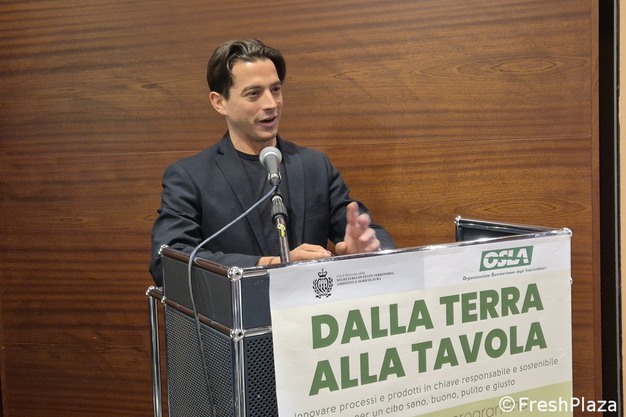 © Cristiano Riciputi | FreshPlaza.comItaly's Secretary of State for Territory, Environment, and Agriculture Matteo Ciacci
Matteo Selleri, the president of USGI, moderated the debate and recognized the contributions of Matteo Ciacci, Italy's Secretary of State for Territory, Environment, and Agriculture. "The farmer is the glue that holds everything together. They combine food production with protecting the territory's hydrology and caring for the landscape. As Secretary of State, I am pushing more and more for organic farming. We support the conversion to organic farming as much as possible," Ciacci said.
Clinical nutrition specialist Dr. Simona Casadei discussed the advantages of a healthy, plant-based diet and how organic food can improve health compared to conventional food.
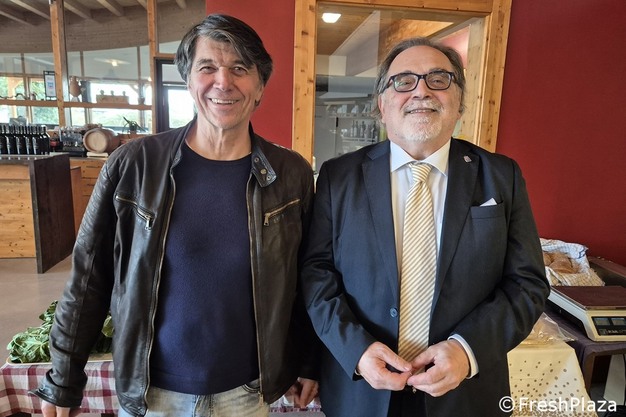 © Cristiano Riciputi | FreshPlaza.comStefano Valentini of Podere Lesignano and Matteo Selleri
Loris Casali, a statistician at UGRAA, recalled that over 30 percent of San Marino's land is used for organic farming. This percentage increases when land in the process of conversion is also considered. But how can this percentage be increased by involving more producers? It is not easy. In San Marino, there are many amateur farmers who are not interested in or convinced of the value of dealing with the bureaucratic aspects of organic farming or the major difficulties of cultivation.
Ciacci emphasized the importance of strengthening relations with hotels, restaurants, and catering channels to better valorize local production and complete the supply chain. Brescacin emphasized that organic farming must be a choice and an opportunity, not a constraint or a way to make more money.
 © Cristiano Riciputi | FreshPlaza.comThe conference concluded with a lunch offering at Podere Lesignano, an agritourism facility where all of the food is locally sourced
"Agriculture, especially organic agriculture, requires invested resources to generate ecosystem services," Brescacin reiterated. "At NaturaSì, we support producers and have a network of technicians who work with them. Then, we collect and sell their products directly to consumers."
Matteo Selleri concluded the conference by pointing out that organic agriculture is part of the larger field of ecology. Reducing food waste is also essential. Public authorities must support producers, especially organic ones, to promote overall economic growth and protect the territory."