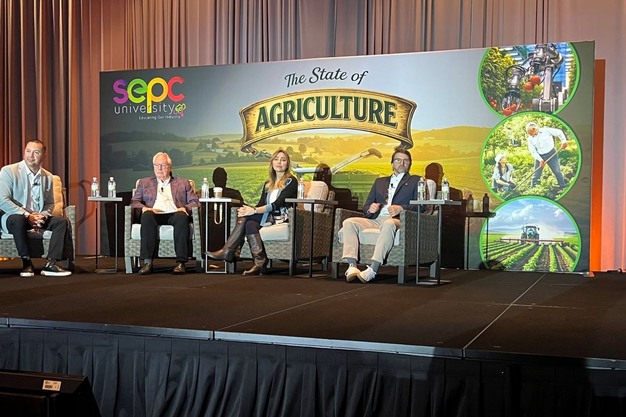
Usually, 8:30 am educational sessions can be quiet, but the room was filled for "The State of Agriculture" session during SEPC's Southern Exposure event. Three industry leaders offered insights on the most pressing agricultural challenges and opportunities in a panel moderated by Robby Cruz, vice president of produce and floral for Target.
Headwinds
"Farmers are forever optimists, but the headwinds of the past 12-18 months have been tough," said Ashley Rawl, VP of Sales, Marketing & Product Development at WP Rawl, one of the panelists. He used the word shop vise to describe the current state of agriculture with the farmer being caught between market volatility and government regulation. The industry is impacted by weather, disease pressure, labor costs, and high land values on the one hand. On the other side, there is the rigidity of specs, audits and government regulations. "Farmers work hard to let this country eat, but shop vise is the overall theme right now," he added.
"On the West Coast, labor, food safety, and water are the main issues," commented Steve Church, Chairman of Church Brothers Farms. With the amount of rainfall California received in the past few months, water has been taken care of for now. "The labor landscape in Salinas and Yuma, AZ however, has significantly changed and it becomes increasingly challenging to find people to harvest the crops." Nationwide, the fresh produce industry is short about 80,000 drivers, which is a major threat.
The third panelist, Sarah Frey, Founder and CEO of Frey Farms, shared that while their operations are east of the Mississippi, they share a lot of the same challenges as growers on the west coast do. "To overcome these challenges, strengthening partnerships with major retailers is a requirement," she said. Rawl added they would like to collaborate with retailers and discuss how to lower the cost of food.
Doing more with less
Church goes on to say that disease pressure has been a challenge for growers. Back in 2022, the Impatiens necrotic spot virus (INSV) had a devastating effect and resulted in a crop loss of about 30 percent in the Salinas area. Prices went up to $90 for a box of lettuce, which is unheard of. Last fall, warm rains resulted in the return of INSV. It is a difficult situation, and growers are looking at solutions. "One company tried growing iceberg lettuce in Idaho, but they failed. There are only a few places in the world where iceberg lettuce can be grown," he said.
Frey mentioned that unlike Church Brothers, they are growing in many different states, and each geographic location is very different, bringing its challenges. "Since we are in a commodity business, we always look at ways to maximize profit and no matter where we grow, we focus on doing more with less."
 © Marieke Hemmes | FreshPlaza.com
From left to right: Robby Cruz, Steve Church, Sarah Frey, and Ashley Rawl.
Retail partnerships
Frey also says partnerships are key to the future of the fresh produce industry and the best partners are the ones that pro-actively want to do business. "We sometimes need to have brutally honest conversations with our partners, but it's important that we understand each other. As a grower and shipper, we also need to know what our buyers go through."
Church adds that the best customers are the ones you don't pro-rate.
Innovation and technology
The shortage of labor is one of the challenges the sector is faced with, and Church mentioned the need to harvest crops like iceberg lettuce and Romaine lettuce with fewer people. One of the innovations is flow wrap for Romaine Hearts. This automated, high-speed packaging saves on labor and also creates a protective seal around the product, reducing bruising. For Rawl, technology also offers potential. They've been using laser weeders equipped with AI to run constantly to achieve the return on investment.
Frey Farms has been able to innovate in an attempt to reduce waste. "On the small farm where I grew up, nothing ever went to waste," she said. "It was shocking to witness the sheer amount of waste at the farm and retail level, which has forced us to become creative on how to handle food waste." Back in the day, melons that saw a bit too much sun were sold as sun kissed. Today, these melons don't meet the specs and to prevent them from going to waste, Frey started a juice company. "It is the right thing for our farm, the consumers, and the planet," she said.
Advice from panelists
Before the session closes, Cruz is asking the panelists for one last piece of advice. Church said the secret to success is to work your ass off and don't take things personal. Just be honest and be a great communicator.
Frey added that watching her kids and nieces and nephews grow shows there is optimism for the future of the industry. "I am incredible optimistic about our future, but I do have a piece of advice for all the young people entering our industry. All of us have worked the fields and if you want to have a successful career in produce, make sure you've worked the fields, even if only for a short amount of time."
Rawl finishes by saying how critical the domestic produce industry in the U.S. is. "A strong domestic food supply is a matter of national security."