The conflict in Iran is creating disruptions across the Gulf fertilizer production and export corridor, raising cost risks for growers as the Northern Hemisphere application season approaches.
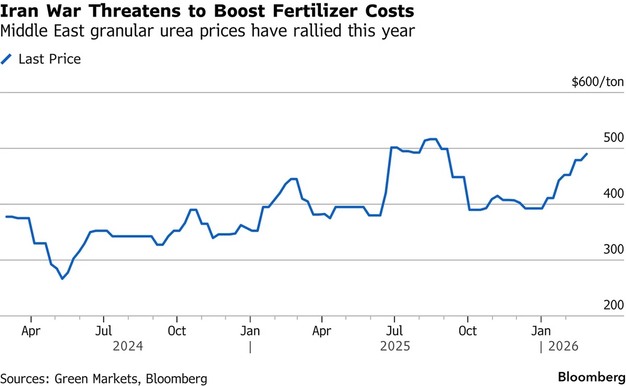
The Gulf region hosts major fertilizer plants, and the Strait of Hormuz facilitates roughly one-third of global fertilizer nutrient trade. Prices were elevated before the latest escalation, and tensions are increasing pressure on nitrogen-based inputs ahead of field applications.
"The timing of the conflict 'literally could not be worse' for the industry," said Josh Linville, vice president for fertilizers at brokerage StoneX Group. "There is never a good time for war, but this couldn't be much worse."
 © Bloomberg
Market effects are already visible. Qatar shut down liquefied natural gas production at its largest export facility following an Iranian drone attack. Natural gas is a primary input for nitrogen fertilizer production. Qatar accounts for about 11 per cent of global urea exports, while approximately 45 per cent of global urea shipments originate from facilities across the Persian Gulf, according to Bloomberg Intelligence.
Granular urea prices in Egypt have increased by US$60 per metric ton since the effective closure of the Strait of Hormuz. Buyers are seeking alternative supplies from North Africa and Southeast Asia. In New Orleans, March barge prices for urea were US$60 to US$80 per ton higher compared with the previous week, with "potentially hundreds of dollars per ton increases in the coming days," according to a fertilizer trader at Andersons Inc.
Urea supply was already constrained prior to the conflict. Drone damage to a Russian nitrogen facility had tightened sentiment in the market. Russia and Qatar are the two largest urea suppliers to the United States. While direct imports from Iran are limited, product flows from other Middle Eastern countries transit through the Strait of Hormuz.
According to StoneX, three of the world's ten largest ammonia exporters and one in five major phosphate suppliers rely on this waterway. Even if cargo continues to move, freight insurance costs could become "economically unviable," according to Scotiabank.
Iran controls between 10 per cent and 12 per cent of the global urea trade. Israel's state of emergency status may disrupt gas supplies to Egypt, affecting fertilizer production.
Yara stated that although it has "limited exposure to the region," the Strait of Hormuz is a "critical chokepoint." The company added, "Disruptions of this scale will affect fertilizer and food prices, but it is still too early to assess the magnitude or duration. We know that many farmers are already under cost pressure. They play a crucial role in global food security."
Source: FarmProgress