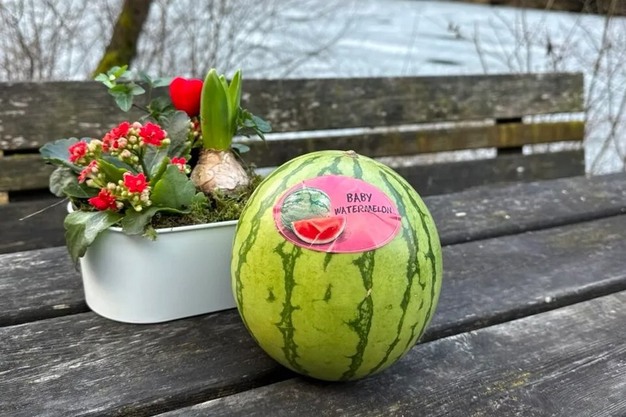
In winter 2026, European supermarket shelves are increasingly stocked with watermelons and mini watermelons from Brazil. While watermelon is traditionally linked to summer consumption, trade flows reflect counter-seasonal supply dynamics, according to EastFruit.
European production remains concentrated in Spain, Italy, and France, peaking in the summer. Outside the season, from approximately October to April, the region relies on imports to meet demand. Despite an annual production of around 3 million tons, Europe depends on third-country suppliers during the winter months.
"The main competitive advantage of Brazil is the opposite seasonality. Harvesting takes place approximately from August to March, which almost perfectly matches the period of product shortages in Europe," explains Kateryna Zvierieva, Development Director of the Ukrainian Horticulture Association.
 © EastFruit
Brazil exports more than 200,000 tons of melons to Europe annually. In 2025, total exports of melons and watermelons reached about 470,000 tons. Watermelons accounted for roughly 40 per cent of that volume, with up to 93 per cent destined for Europe. Primary entry points include the Netherlands, the United Kingdom, Spain, and Germany, which function as redistribution hubs within the EU.
Seedless mini watermelon exports recorded higher volumes at the start of 2025. According to Comex Stat, more than 24,000 tons were exported in January, 9 per cent above December and 88 per cent above January 2024. Export revenue exceeded US$14 million FOB in the month, 68 per cent higher year on year. This represented the strongest January performance since Comex Stat began tracking in 1997.
Growth was supported by reduced production in Costa Rica, Honduras, and Panama due to weather conditions and lower planted area. By the end of the 2024 to 2025 export season from August to January, shipment volumes were 35 per cent higher than the previous cycle.
Brazil competes in the EU market with Morocco, Turkey, and Costa Rica, which together account for about 77 per cent of external watermelon supplies to the bloc. Nonetheless, Brazil maintains its position through counter-seasonal availability and established logistics chains.
"Today's global supply model is relatively predictable and largely driven by seasonality. During the summer, the European market is predominantly supplied by domestic production. However, with the arrival of winter, the focus shifts to suppliers from South America, Africa, and the Middle East. In practice, this seasonal rotation of sourcing regions has already become a stable standard for the fresh fruit and vegetable market. Counter-seasonal production, large export volumes, and optimized maritime logistics make it possible to maintain stable supplies and competitive prices even in the context of intercontinental trade," concludes Kateryna Zvierieva.
Source: EastFruit