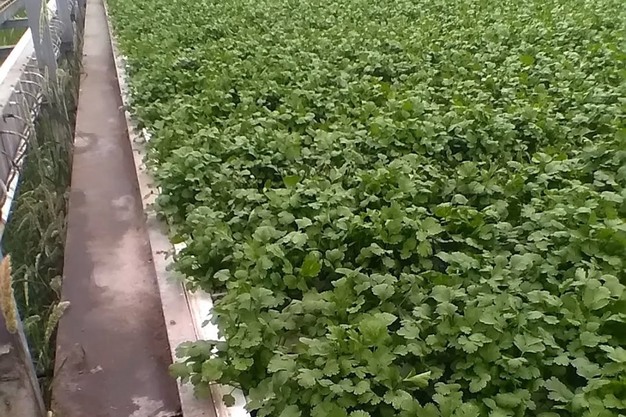
The recent heatwaves have wreaked havoc in the market for coriander in South Australia and Victoria, with supermarkets there reporting shortages. But it hasn't been all bad news for one family-owned grower on South Australia's Limestone Coast. Holla-Fresh, which grows a full range of culinary herbs, including coriander.
Holla-Fresh proprietor Ian Lines says that it missed the worst of the heat. "I'm from the far south of South Australia, and whilst we had some heat, we didn't have the same level of heat that other areas did, so personally, no, we did not.
 © Holla_fresh
"That's obviously been better for me because I've been supplying when other people have not been able to. We all need to be valuable to our customers."
The cooler weather is a double-edged sword, though, with costs rising in the winter as Holla-Fresh faces a much higher need for heating in its greenhouses.
"It is colder in winter," Lines says. "Coriander doesn't mind cooler weather — it's just slower growing — but something like basil won't grow in winter unless you put external heating in. You've got to have temperatures around 23 or 24 degrees in the greenhouse."
That increases costs in the winter, which is painful for a business that is offered steady prices year-round. He notes, "Probably of the 100 per cent of energy I put into heating, they only put in 25 per cent, and in New South Wales and Queensland, most don't put heat in at all because winter temperatures are already around 22 to 24 degrees."
Costs are a big issue for herb growers, with mechanisation difficult for their product lines. While other crops have increasingly been heavily automated, demands for perfect products mean that herbs have to be closely picked over to avoid blemished leaves.
 © Holla_Fresh
"My production time per unit has doubled in five-to-six years because of extra quality standards," says Lines. And that doubling of time brings an increase in labour costs, squeezing returns for growers. Some are really feeling the pinch in South Australia.
"It's really hard work at the moment. There's no profit, and we're struggling to pay maintenance bills," says Lines. "We have growers going out of business. In the herb industry, two suppliers in the supermarket space have gone broke in the last 18 months, and a number are looking to leave the industry."
As in many areas, growers might like to relieve the pressure with exports, but herbs present their challenges, with short shelf lives meaning that only high-cost alternatives are viable for shipping overseas.
He says, "If packaged correctly, herbs travel well, but fresh culinary herbs have a narrow shelf life, seven-to-ten days. To export them, you'd have to fly them, and then you're only competitive in very high-end markets like Singapore."
Lines is not downhearted, though. Despite the challenges, he loves growing herbs, and he does see the way forward despite the tough road ahead. He's quick to identify one advantage: "Australia has some of the best and most efficient farmers in the world."
For more information:
Ian Lines
Holla-Fresh
Tel: +61 (0) 407 399 014
Email: [email protected]
www.holla-fresh.com.au