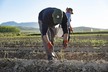
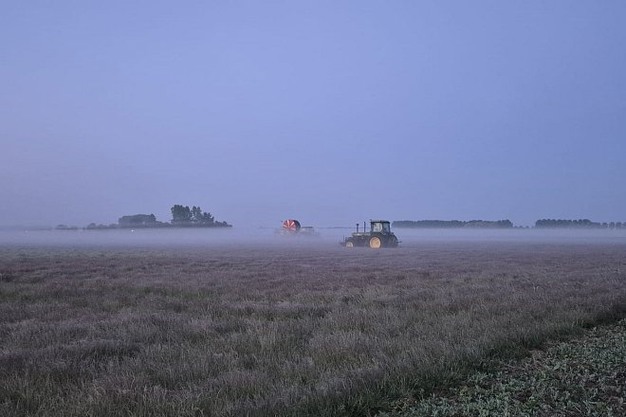
Anyone talking to Rien Veraart quickly realizes he considers himself, first and foremost, a grower. "I'm out there in the field myself, boots in the clay. That's where you see where the problems lie," he says. That combination of crop cultivation and 30 years of experience in the international industrial vegetables trade shapes the down-to-earth approach of Veraart Agri in the Netherlands.
 © Veraart Agri
With a four-strong team, the company operates in an undeniable niche: the supplementary market between large contract suppliers and processors with acute shortages. Veraart Agri supplies canning factories, cold stores, and drying facilities throughout Europe, focusing on Central and Western Europe. "We're not a volume trader. We step in when there are gaps."
Staying small to switch quickly
Rien founded his business in 1994 and, a year later, established a branch in the Czech Republic, which is still a hub within the organization. Despite its international presence, the company has deliberately remained small. "The big players will only start with large volumes. They have no interest in a truck or two. That's exactly where we add value," he says.
The job is volatile and highly seasonal. "You're either running around or standing still." In the summer, the company mainly focuses on gherkins and peppers; in the winter, trade often halts because of factory maintenance.
Market fluctuates per product
Their range consists mainly of carrots, parsnips, rutabagas, and celeriac, but the market situation varies considerably per product. Parsnips are relatively stable, and carrots are currently in abundant supply but may become scarce later in the season. Celeriac is in a tight spot. "About 20% more has been planted, resulting in low prices," explains Rien. Consumer behavior also plays a role: "Younger generations are buying less."
Rien sees Eastern European diets changing, too. "Ten years ago, most people ate local, seasonal produce. Now, everything has to be available year-round. That has major consequences for cultivation and trade," he says.
Link in the chain
Veraart Agri acts as a link between surplus and shortages. "Growers call when they have a surplus, processors when there's a shortage. Sometimes a batch has to reach the right place within 14 hours." Here, quality is paramount. "Appearance, less so, but freshness and flavor, all the more," says Veraart.
He adds that success depends on speed, reliability, and fair trade. The growers' position is critical to Rien. "There's plenty of money circulating, but too little remains with growers." He tries to work differently by taking advantage of opportunities in times of scarcity and passing that on to growers.
Rien cultivates produce like blackberries, potatoes, onions, and celeriac on about 60 hectares. That diversity is deliberate. "You must continually balance yield, price, and risk," he explains.
According to Rien, there are no simple solutions to the structural problems. "Complex issues don't have simple answers." One thing he knows for sure. "Without fair prices for growers, the entire chain ultimately comes under pressure," Veraart concludes. (JG)
For more information:
Veraart Agri
Langeweg 3
4698 PM Oud Vossemeer
Tel: +31 (0) 166 605040
[email protected]
www.veraartagri.eu