Low-pressure system "Elli" has arrived. In Lower Saxony, snow chaos reigns on the A2 near Hanover, and the lane toward Dortmund is closed after an accident. The German Weather Service (DWD) expects up to 20 centimeters of new snow. In Berlin and North Rhine-Westphalia, however, people can breathe a sigh of relief for now. The severe weather warnings have been lifted here. Only in the higher elevations of North Rhine-Westphalia, in the Sauerland and East Westphalia, do they remain in place.
 © Se-Sa GmbH
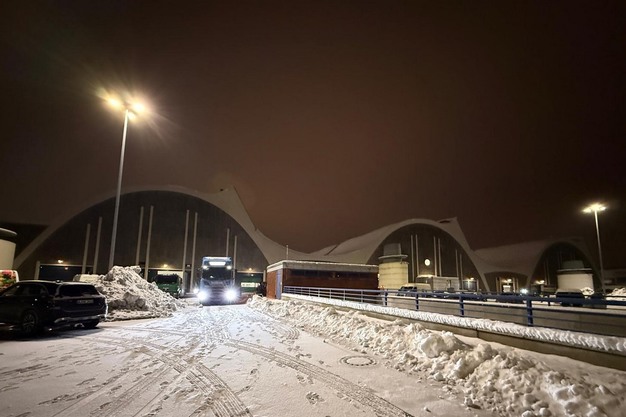
View of the Hamburg wholesale market hall in the snow
Cold snap follows sluggish Christmas business
The winter weather is not exactly favorable for the fruit and vegetable trade, according to the Berlin wholesale market. "Temperatures here can drop to as low as -10 degrees during the day. This has a corresponding impact on our sector: restaurants are less frequented, weekly markets are only held to a limited extent, and people are buying less in stores in this weather," reports a local retailer, referring to the already disappointing Christmas business.
The snowy weather is also having an impact on business at the Hamburg wholesale market. "Regional weekly markets are still taking place, but are significantly less frequented. Many orders are being canceled at the last minute, which is very detrimental to us," says a fruit wholesaler based there. The cold front is also posing major challenges for the sector at the procurement level. Problems in seaports with ship and truck delays are the order of the day. "In the case of Egyptian spring onions, for example, we have been facing bottlenecks and corresponding price increases for about a week."
 © Fruit Security GmbH
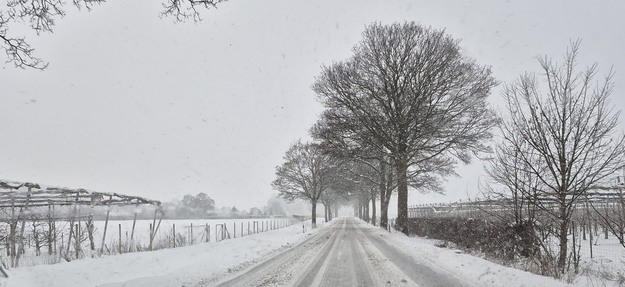
Snowed-in fruit orchards in the Altes Land region
Extreme weather complicates fruit logistics
The current weather situation is also posing major challenges at the logistics level in some cases. "Our customers are located throughout Germany, and we deliver to many of them with our own trucks. With this weather, we have to factor in additional travel time of up to 30 minutes per 100 km. On the other hand, we also have to take additional resources into account, as we have to heat our trucks accordingly, which has a significant impact on costs given today's energy prices," explains mushroom wholesaler Ramazan Gülnar from Paris Direkt GmbH, based in Münster-Roxel.
 © Wehenpohl Obst- und Gemüsebau
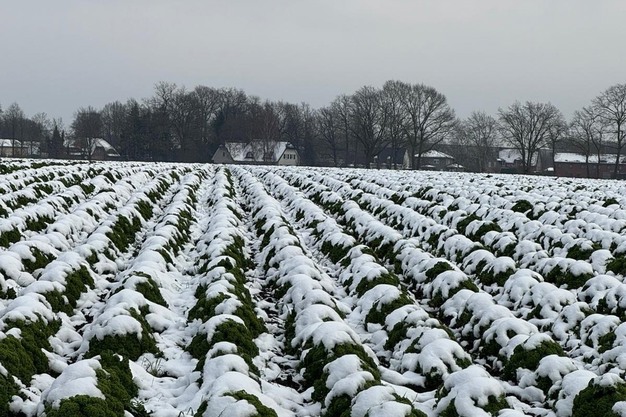
View of a kale field in the Oldenburger Münsterland region
Excessive snowfall jeopardizes kale harvest
In Oldenburg Münsterland – the kale stronghold of northern Germany – the current snowfall is delaying harvesting work, as some fields are inaccessible to harvesting machines. "There is currently up to 10 cm of snow on the crops, and it is difficult to say what the kale will look like when the frost is over. Since the end of November, the crops have deteriorated significantly, meaning that yields are no longer adequate. Some areas in the surrounding area have already been abandoned and cannot be harvested at all. We only have a few hectares left, and I hope to be able to harvest something there," reports a kale producer on request.