New research has found that rising temperatures and traffic congestion cause only limited losses in California's processing tomato supply chain, offering potential insights for Australia's agricultural sectors.
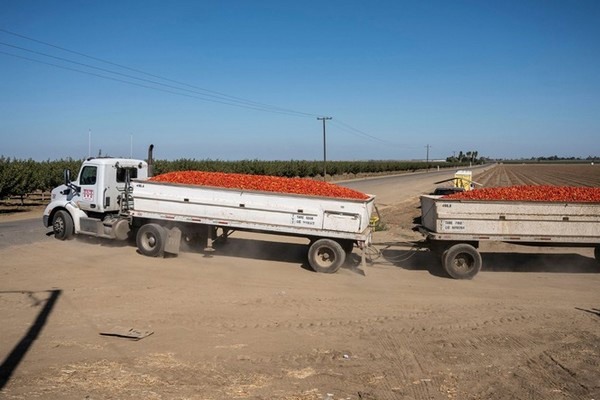
The study, published in the American Journal of Agricultural Economics, examined 1.4 million truckloads of tomatoes transported from fields to processing facilities between 2011 and 2020. The analysis was conducted by Dr Sarah Whitnall from The University of Western Australia's School of Agriculture and Environment during her postdoctoral research at the University of California, Davis.
 © The University of Western Australia
According to the findings, the tomato supply chain's high level of coordination helped minimise losses linked to heat and congestion. While higher temperatures increased damage, the rise was relatively small. Losses were lowest when cooler temperatures coincided with lighter traffic, and even under hotter, congested conditions, the share of damaged tomatoes increased only from about one per cent to two per cent.
Dr Whitnall said the results are relevant for Australia, where long-distance transport and rising temperatures are ongoing challenges across agricultural supply chains. She noted that improving coordination and efficiency in transport and logistics could help reduce food loss and strengthen resilience as temperatures increase.
She said similar studies could support industries such as horticulture and viticulture in understanding climate-related pressures throughout their logistics networks.
The research was supported by the US Department of Agriculture's Agriculture and Food Research Initiative.
For more information:
Ana Mendigutxia Balil
The University of Western Australia
Tel: +61 (0) 8 6488 1650
Email: [email protected]
www.uwa.edu.au