Agrivoltaics, a technique developed in the 1980s, combines agriculture with photovoltaic solar energy by using the same land for both purposes. This method maximizes land use without reducing productivity. It has shown promising results with horticultural and small-scale crops, but there is limited experience with woody crops, especially citrus, partly due to the height of the required structures and the initial installation costs.
The Agrivoltaica Chair at Polytechnic University of Valencia has launched the first pilot plant in the Valencia Region at a citrus farm to study the interactions between photovoltaics and agriculture. Started last year, the project measures parameters including irradiance, harvest quality, energy use, crop productivity, and agricultural challenges across multiple seasons.
 © Universitat Politècnica de València
The initiative involves EMIN ENERGY, Elecnor Foundation, VAO Sistemas, GSFI Energía, Gestión y Administración Técnica Agraria, and the Comunidad de Regantes de Llíria, all part of a collaboration agreement to promote applied research.
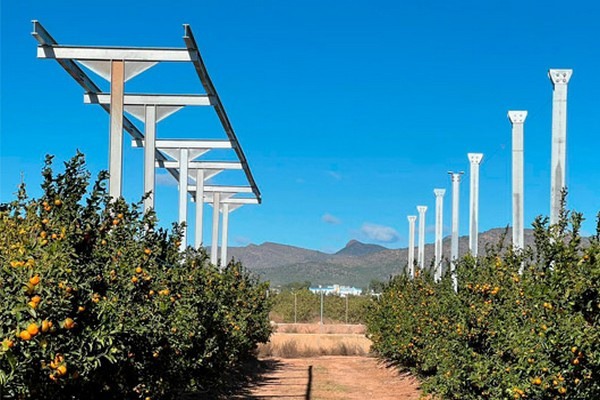
The pilot plant is located in Llíria (Valencia) on a 4-year-old Tango Gold mandarin farm and has a power capacity of 30 kWp. The specially designed structure for this farm is 5.5 meters tall to avoid interfering with the existing trees, and it is divided into two sections: one with a fixed setup and the other with a tracker (agritracker).
Over the coming months, an advanced sensor system will be installed to gather data on microclimatic and energy variables. This information, combined with measurements of agronomic variables, will enable comparisons among the three experimental blocks: the control area, the fixed-structure area, and the mobile-structure area.
Besides the agronomic part, the installation also serves as a self-consumption plant, which will help us determine whether photovoltaic production improves the farm's energy efficiency and reduces irrigation and farm management costs.
"This project aims to gather reliable data that can be applied across the entire industry. Agrivoltaics presents real opportunities to enhance farm competitiveness, though its implementation involves challenges like designing systems suited to specific crops and climates," stated Zulema Sousa, a researcher at the UPV Agrivoltaics Chair and Emin Energy member. "The research we are conducting with the UPV will help us develop expertise tailored to the conditions of our citrus crops," she added.
The installation will become fully operational in the coming weeks, and the research team anticipates obtaining initial results this season.
For more information:
Polytechnic University of Valencia
www.upv.es