Newheat and Les Tomates d'Auïtou, based in the Corrèze department, have just commissioned the largest solar thermal power plant ever dedicated to vegetable production in heated greenhouses in France. This pioneering facility marks a new era in a sector that is more self-sufficient, more competitive and resolutely carbon-free.
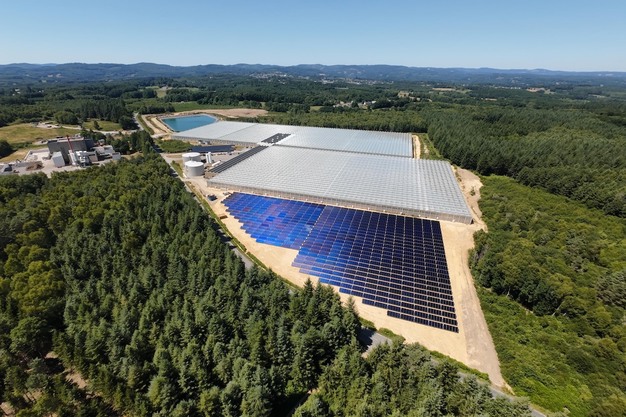 © Newheat et Les Tomates d’Auïtou
A strategic choice to improve environmental performance
Since its creation, Les Tomates d'Auïtou has built its business model around self-sufficiency and low energy consumption. Already supplied for the most part by waste heat, the farm wanted to go one step further and completely eliminate its reliance on propane. "We designed our farm with a view to achieve excellence in terms of environmental performance and resilience," explains Geoffrey Goutoule, the farm's manager. "After connecting up to the energy recovery plant, we looked for a way to offset the residual propane consumption in an efficient and competitive way. Solar thermal energy with storage was the perfect answer.
The facility was also built on landfill, an area that had previously been undeveloped.
Precise control increases yields
The farm in Correze, awarded the Zero Pesticide Residue label and a member of the Rougeline union of cooperatives, grows 100,000 tomato plants in 8 hectares of greenhouses. Developed by Newheat, the plant uses 7,091 m² of thermal solar collectors, a capacity of 5.6 MWp and storage of 1,500 m³, to provide 5,400 MWh of useful heat every year - the equivalent of 14% of the site's annual requirements.
While the impact of solar thermal energy is primarily energy-related, it also plays a role in crop performance. "The installation provides finer, more stable temperature control, which is essential to guarantee overall agronomic performance." Thanks to this more precise control, yields could rise from 40 kg/m² to 45-50 kg/m².
A model that can easily be replicated
The project was completed in a record time of just 3 months. This replicable model paves the way for other farmers wishing to reduce their dependence on fossil fuels, especially as no adaptation of farming practices is required. "Generally speaking, the construction of a solar thermal power plant has no direct impact on the operation of the site," explains Thibault Perrigault, industry development manager at Newheat. "It is an installation that fits any structure that needs pre-heating or direct heating at less than 100°C, and wants to both decarbonize its heat supply and ensure the stability of its energy costs in the long term. The only constraint is the availability of land nearby (max. 2 km depending on the size of the requirements).
For farms or sites processing agricultural products, identifying and securing land is generally less of a constraint than in other sectors. These sites often have larger or more easily mobilized areas, which makes it easier to set up a solar thermal power plant. We also install solar thermal power plants to heat district heating networks in towns and cities, where land is a major constraint."
Two solar thermal power plants have already been installed on heated greenhouses this year, including another at the Rougeline cooperative. Newheat has also announced advanced discussions with several farmers, and will be present at SIVAL to support this dynamic.
Towards a new image for heated greenhouses?
With this new solar thermal power station, the farm claims to be exceptionally self-sufficient: 100% in water, 71% in electricity and 98% in heat. It is a message that could help rehabilitate the image of greenhouses in the eyes of the general public, as long as it is communicated collectively. "Our greenhouses are only heated to 17°-19° (compared with 20°-25° in a conventional system). Now, with this solar thermal power station, we will be able to slightly increase the set temperature in the greenhouses if the solar resource is significant and we have a surplus of temperature energy," explains Geoffrey Goutoule. "It is clearly possible to produce greenhouses in a virtuous way. But the topic remains sensitive, and the message needs to be relayed throughout the sector."
For Thibault Perrigault, the example of the Correze region proves that solar thermal energy is relevant everywhere, even in the coldest regions. "Our biggest power plant is in Verdun, and Denmark is the most advanced country in the world in terms of solar thermal energy. Greenhouses at altitude or in harsh regions are therefore fully covered."
A solution supported by the public sector
The project represents a total investment of more than €3.7m [4.3 million USD], and has received financial support from ADEME (almost €1.9m [2.2 million USD] under the Funds for Heat- Large-Scale Solar Installation Projects. "This installation meets ADEME's ambitions for the development of solar thermal energy and solar heat. France's integrated national energy-climate plan, published on July 10th 2024, calls for decarbonized energies to account for 58% of final energy consumption by 2030, rising to 71% by 2035. This increase means that efforts will have to be made across all renewable heat sources, including solar thermal, which has a target of 6 TWh by 2030 and 10 TWh by 2035. The development of large-scale solar installations will be a key factor in achieving these targets," according to ADEME.
The project is also supported by the European Union (ERDF) and the Nouvelle-Aquitaine region.
For more information:
Clémence Rebours
Nouvelles Graines
[email protected]