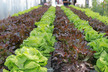
The transition of the brassica and leafy vegetable season from northern Europe to Spain hasn't been fully completed yet due to the influence of warmer-than-usual weather. The area planted with cauliflower has been reduced due to the difficulty in producing it and the market's demand. The same applies to the area planted with kale, with production limited to the mid-winter months. Meanwhile, the number of hectares devoted to broccoli is similar to last year's.
"We are already exporting, but we are not fully there yet. Europe's productions in the last few weeks are overlapping with the imports from Spain. Bearing in mind that the Christmas season is practically ready, we are already seeing a positive development, and growth will continue in the coming weeks," says Sebastián Aguilar, Sales Director of Campo de Lorca, which produces brassicas all year round under the Cricket brand.

"It is true that production has been brought forward by up to two weeks due to the unusually high temperatures recorded in September and October. Thanks to our planning, we have a strong commercial presence in the domestic market, both in the retail and in the free market, and this has made it much easier for us to sell our products," he says.
"Moreover, local productions in Europe have continued for longer; firstly, because growers planted later due to the impact of drought in the United Kingdom and the Netherlands, especially from March onwards, and secondly, because the generally good weather has resulted in very good yields. For these reasons, they are still currently harvesting their own crops, but already combining that with imports. Thanks to the domestic market, we didn't suffer too much, but we did have to accept some promotions that shaped our position at destination," says Aguilar.
This year's cauliflower acreage is said to be reduced by around 15-20%. "Cauliflower has become a product for specialists. Free plantings outside of programs are usually done for rotation after lettuce, but it's a more difficult product to grow, so it's preferable to use broccoli for this purpose," says Aguilar.
"The market has also become more demanding, asking for a snow white product. In this regard, our company has spent five years testing varieties, and today we are working with 15 of them. These are the ones consistently allowing us to meet the market demands and deliver the volumes required. That's the reason why our cauliflower acreage remains stable," says the Campo de Lorca Sales Director.
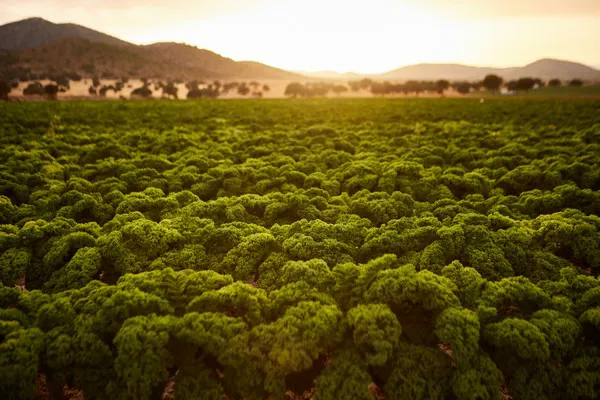
As far as broccoli is concerned, Aguilar says that there have been no significant changes. "However, in the case of kale, due to the restrictions imposed to combat the white fly, the product has gone from being one with a high market penetration to becoming risky. This is forcing us to have the season restricted to the pure winter periods, when the fly cycle has stopped, which will cause distortions in the market, not just in the retail, but also in the industry, foodservice, etc."
The use of effective phytosanitary products to fight pests is going to be a significant challenge this season. "Grower associations are lobbying in Europe to find a solution," says Aguilar.
The other big challenge will be having access to enough water, given the recent measures to reduce underground aquifers in Murcia from 2028 onwards. "By halving the water transfer and the aquifers, we expect the sector to struggle. Because one thing is clear, after 2028, we must continue to supply our customers. We know that Murcia's regional government is well aware of this situation and we will back any measures they deem appropriate to take," says Sebastian Aguilar. For more information:
Sebastián Aguilar
Cricket
Tel.: +34 968465960
[email protected]
www.campodelorca.com