Agriculture has long ceased to be a simple business and is becoming increasingly more technical. Demand for smart sorting machines, high-quality cameras, and automated packaging is on the rise, also to facilitate working with smaller fruits and vegetables.
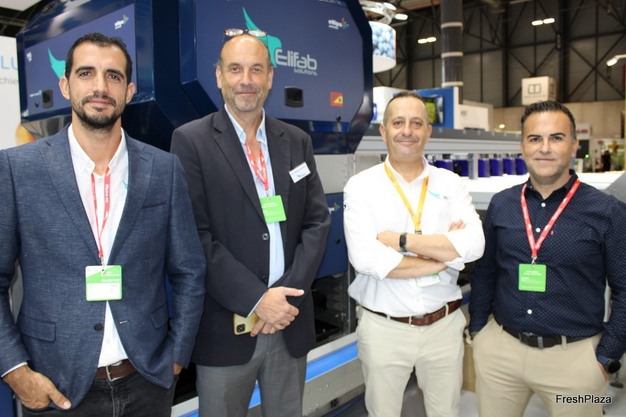
"We started in 2016 and have specialized in the sorting of blueberries, cherries, plums, and cherry tomatoes. Today we are present in 20 countries. We have about 110 machines installed in Chile, Peru, Mexico, the U.S., Canada, Australia, Morocco, South Africa, Russia, Ukraine, and Bulgaria," says Fabricio Santos, manager of Elifab.
 © Fresh Plaza
When it comes to small fruit sorting, "we are seeing particularly strong growth in Peru with blueberries, also in Morocco and the U.S. Another important market is Spain, where we have just installed the largest cherry sorter in Europe, and perhaps in the world, with 48 lanes, featuring Ellips True-AI, automated box packing from Mat Exakta and automatic bin tipping robots from Palm Systems. It is, perhaps, the most important project of my career so far. Some companies are reluctant to install revolutionary machinery like ours, but once they start to see the results, they usually go for new and bigger machines," says Santos.
"We prefer to work with blueberries or cherries, which are delicate. The precision is far superior to other technologies. For example, in blueberries, our machine can handle 45 fruits per second per lane; the others, in apples, can handle 12 fruits. Small fruit requires more advanced technology, and few brands are willing to invest in R&D," says the manager.
"We are growing with a focus on sustainability, rather than speed. All the engineering is in-house; everything is developed and manufactured in Murcia. Even our suppliers are just a few minutes away from the factory. That gives us a cost advantage over others," says Santos.
"Ellips is our partner and also our technology supplier. They are providing us with the best vision systems in the world. They bet on AI long before the rest.
To give an idea of savings, Santos says: "In a cherry plantation, rain can cause 30% production losses and the appearance of rotten or damaged fruit. It would be very difficult to remove those cherries with manual labor. Many workers would be needed, and the cost would be so high that selling the fruit wouldn't make up for it. Our technology can remove up to 98% of defective cherries at a constant speed, which gives you some guarantee in difficult seasons and can mean the difference between going bankrupt or not," says the manager.
For more information:
Fabricio Santos
Elifab
Tel.: +34 600 69 84 93
Tel.: +34 968 11 28 27
[email protected]
www.elifab.com
https://insights.ellips.com/customers/how-vidrio-fruits-delivers-for-the-worlds-most-demanding-cherry-markets