Agriculture is Florida's second largest economic powerhouse, trailing only tourism. With more than 133,000 jobs riding on its success, farming fuels communities across the Sunshine State. However farmers face numerous challenges: pests, diseases, labor, rising costs and more.
To protect crop yields and the environment, the University of Florida Institute of Food and Agricultural Sciences (UF/IFAS) is leveraging tools such as technology driven by artificial intelligence (AI).
To expedite the development of AI-driven technology, UF/IFAS is set to build a 40,000-square-foot AI hub at the Gulf Coast Research and Education Center (GCREC) in Balm, about 25 miles southeast of Tampa. The Center for Applied Artificial Intelligence in Agriculture will serve as a world-class research, Extension and development facility.
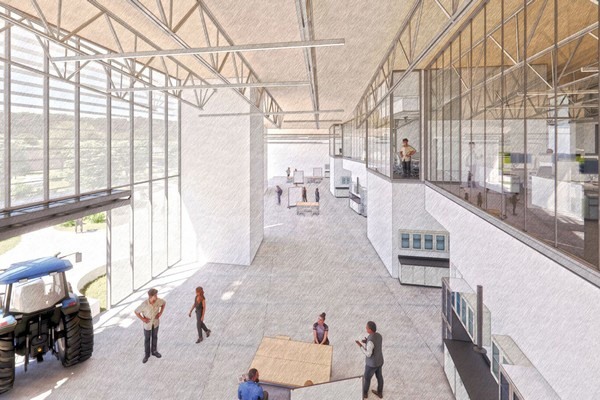 © UF/IFAS
Five years of planning will start coming to fruition Nov. 7 as UF officials and other dignitaries break ground on the AI center. The groundbreaking will be part of the 100th anniversary celebration of GCREC.
"This will be the cradle for the next technological leaps forward made possible by a 150-year-old land-grant model of academia-industry-government partnership," said Scott Angle, UF's senior vice president for agriculture and natural resources and leader of UF/IFAS.
AI and robotics can autonomously accomplish many tasks that traditionally require manual labor. By developing these technologies, AI can increase the number of technology-driven, competitive-paying jobs on the farm.
Another advantage: applying AI to challenging problems often leads to start-up companies that could benefit Florida's economy.
At the hub, AI scientists will work with researchers throughout UF/IFAS to study ways to breed plants that resist pests and disease, thus boosting crop yields for farmers. These AI scientists also will work to help ensure growers use fewer chemicals to grow their crops.
"We envision faculty at the AI center will use new technology to solve growers' problems with more speed and efficiency than ever before," said GCREC director Jack Rechcigl said.
Plans call for a state-of-the art research shop, equipped with everything needed to design and build robotic technologies for agriculture.
The hub also will include office space, as well as areas designed to encourage conversations to build teams for AI research and Extension. Those discussions are critical. While the center will be based in Balm, center-based faculty will develop technologies for many Floridians, whether they work in agriculture or other economic sectors.
Hundreds of UF/IFAS faculty leverage AI in their research. Specifically, in the past five years, the institute has hired 16 faculty who specialize in developing ways to utilize AI to help improve technology for agriculture and natural resources. UF also has HiPerGator, the fastest AI computer in U.S. academia, and a gift from NVIDIA.
 For more information:
Brad Buck
UF/IFAS
Tel: +1 (656) 347-8422
[email protected]
www.ifas.ufl.edu