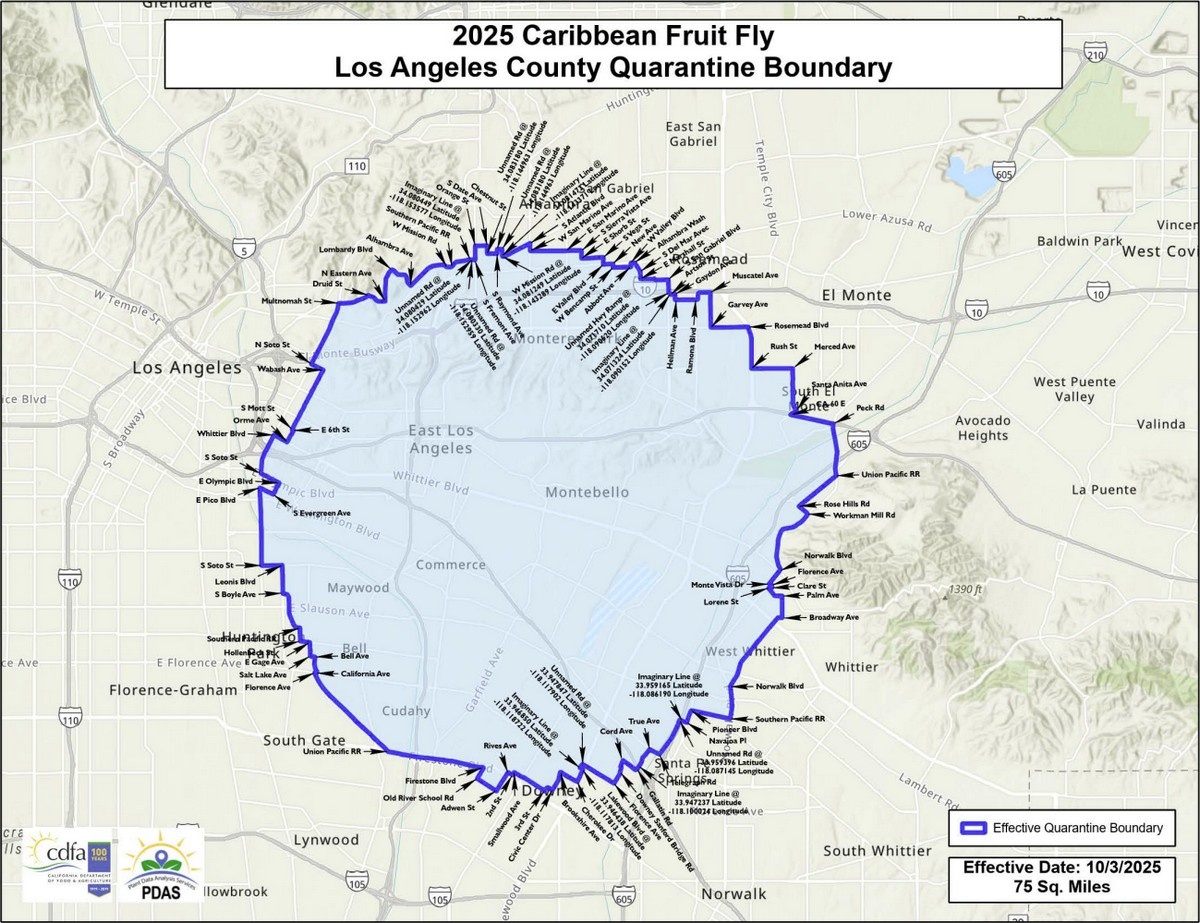
A section of Los Angeles County has been placed under quarantine following the detection of two adult Caribbean fruit flies (CFF) in and around the city of Montebello. The regulated area covers approximately 75 square miles, bordered by Alhambra to the north, Downey to the south, Huntington Park to the west, and South El Monte to the east. The California Department of Food and Agriculture (CDFA) has published a quarantine map available here.
The Caribbean fruit fly poses a risk to California's agricultural and natural resources due to its wide host range, which includes avocados, figs, citrus, peaches, pears, and tomatoes.
Movement restrictions and disposal guidelines
Residents within the quarantine zone are advised not to move homegrown fruits or vegetables off their properties to prevent the pest's spread. Produce can be consumed or processed on-site through juicing, cooking, freezing, or disposal via garbage grinders. Unused produce should be double-bagged in plastic and placed in regular garbage bins for collection.
Control measures and treatment plan
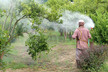
In collaboration with the Los Angeles County Agricultural Commissioner, CDFA will implement an Integrated Pest Management (IPM) program designed to contain and eliminate the pest. As part of the response, officials will remove host fruits and vegetables within 100 meters of the detection sites to eliminate eggs and larvae. Within 200 meters, inspectors will cut host fruits to check for larvae presence. Properties within 400 meters will be treated with Spinosad, an organically approved material used to control adult fruit flies and reduce population density.
Fruit fly infestations occur when female flies lay eggs inside host fruit. The resulting larvae feed on the fruit's interior, rendering it unsuitable for consumption.
Preventing future introductions
Authorities note that most invasive pest introductions occur when infested fruits or vegetables are transported into California by travelers or mailed from other states and countries. Residents are reminded not to bring or ship fresh produce, plants, or soil into the state unless inspected and cleared by agricultural authorities.
More information on how to prevent pest introductions is available at www.dontpackapest.com.
State, federal, and county officials continue year-round surveillance and containment programs to reduce the risk of invasive pest introductions and protect California's agricultural production and biodiversity.
 © CDFAFor more information:
California Department of Food and Agriculture
Tel: +1 916 654 0462
www.pressreleases.cdfa.ca.gov