Plant protection, bureaucracy, and production costs—these are just a few of the issues that are currently preoccupying the special crops sector. Under the motto "Querbeet—a refreshing evening with local fruit, vegetables, mushrooms, and potatoes," the first Parliamentary Evening for Special Crops took place in Berlin on October 14, 2025, to discuss current challenges and the need for political action with numerous members of the German Bundestag, representatives of authorities, associations, and member companies. The event was hosted by the Bundesvereinigung der Erzeugerorganisationen Obst und Gemüse e.V. (BVEO), the Union der Deutschen Kartoffelwirtschaft e.V. (UNIKA) and the Deutscher Kartoffelhandelsverband e.V. (DKHV).
Parliamentary State Secretary Silvia Breher was the keynote speaker and emphasized the importance of German specialty crop production in her welcoming address. She noted that there are numerous exemplary companies in the country that supply consumers with high-quality food. Enabling their valuable work with reliable framework conditions is a priority for the Federal Ministry of Agriculture, Food, and Rural Affairs (BMLEH). The ministry and its departments are always available for constructive dialogue.
Risk protection and bureaucracy reduction
In his opening speech, Olaf Feuerborn, CEO of UNIKA, emphasized that the industry needs a well-stocked toolbox to be future-proof. "Plant protection products are indispensable for risk protection in production. It is imperative that their approval procedures be streamlined, unbureaucratic, and responsive," said Feuerborn. He therefore welcomed the fact that the goal of improved approval procedures had been included in the coalition agreement and said he wanted to constructively support the path taken by the government.
Thomas Herkenrath, president of the DKHV, pointed out the danger of excessive regulation in his speech. "It is becoming increasingly difficult for many European companies to remain competitive in global trade. In particular, high production costs, driven by excessive bureaucracy, overregulation, documentation requirements, and certification mania, are putting increasing pressure on the economy," warned Herkenrath. The much-promised reduction of bureaucracy – together with deregulation and harmonization of certification systems – must now be implemented politically as quickly as possible, demanded the DKHV president.
Fair and equal conditions are necessary
The chairman of the BVEO, Johannes Bliestle, called on politicians to create reliable framework conditions to enable the industry to plan for the long term and drive its own development. Only then can "domestic production be an insurance policy against crises, supply bottlenecks, and political turmoil." Bliestle also had strong words for the competitive inequality in the European single market: "A free market needs fair and equal conditions. If a company in Spain or Poland can produce at a labor cost level that is often only a third to half of what we have here, then it is clear that we are under competitive pressure," said the BVEO chairman.
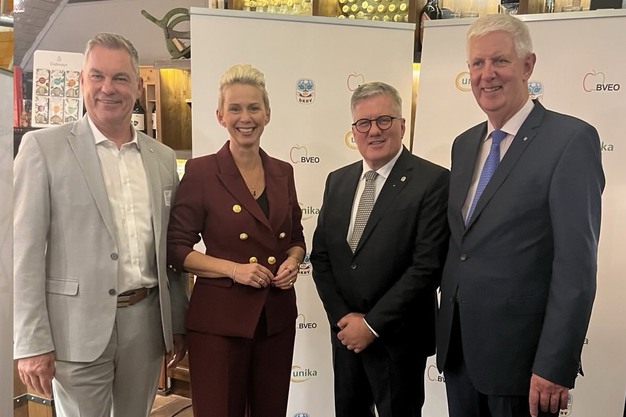 © BVEOFrom left: Johannes Bliestle (Chairman, BVEO), Silvia Breher (Parliamentary State Secretary BMLEH), Thomas Herkenrath (President, DKHV), and Olaf Feuerborn (Chairman, UNIKA).
For more information:
www.bveo.de
www.unika-ev.de/
www.dkhv.org/