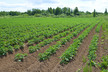
The area under potato cultivation is expanding in the Baglung district as local authorities promote the crop as a reliable income source for farmers. The Agricultural Knowledge Center Baglung has been working over the past three years to increase production across all 10 local levels in the district.
High-altitude regions such as Nisikhola, Tamankhola, Tarakhola Rural Municipality, and the municipalities of Dhorpatan, Galkot, and Jaimini have been identified as productive areas for potato farming. According to Rajeshwor Silwal, Chief of the Agricultural Knowledge Center, expansion is being supported by low production costs and rising demand.
Since fiscal year 2080/81, investments have been allocated to expand cultivation: Rs 26 million (US$195,000) in FY 2080/81, Rs 15.9 million (US$119,000) in FY 2081/82, and Rs 5.9 million (US$44,000) so far in the current fiscal year. The program includes the introduction of new farming technologies, improved fertilizer management, irrigation upgrades, and the distribution of high-yield seed varieties.
"This year, our goal is to expand the area of potato farming by an additional 43 hectares," Silwal said. "Potato cultivation in Baglung is thriving, and farmers are increasingly enthusiastic. This initiative will support them in earning a stable livelihood."
Currently, potatoes are cultivated on about 3,700 hectares in the district. Last year, production reached 56,240 metric tons. Supplies are distributed to urban markets, including Baglung, Pokhara, Butwal, Chitwan, and other cities. Farmers have not had to import potatoes so far this year.
Krishnalal Kandel, a farmer from Dhorpatan Municipality–5, said yields are improving with better access to irrigation and fertilizers. "Since I started growing potatoes, my harvest has improved every year," he said.
To further support staple crop production, the Agricultural Knowledge Center has allocated Rs 3.7 million (US$28,000) this fiscal year under its food crop promotion program. The initiative is being carried out through local cooperatives and farmer groups, with the objective that each group cultivates at least one crop on 100 ropanis (5 hectares) of land.
Source: Khabarhub