At the beginning of week 39, the first Moldovan damson plums of the Stanley variety arrived at Macoo GmbH's incoming goods department. "It is true that we start the season a little later, as there were still last shipments from Macedonia. The quality of the first arrivals is fantastic: the fruit is hard, firm and beautifully colored. It is definitely better than at the beginning of last year's season. I would almost say that there have never been such beautiful damson plums from Moldova before," reports Macoo boss Marco Henschke when asked.
Depending on quality and volume, the goods will be traded until week 47-48. "We are planning a total quota of about 850,000 kg of damson plums since we will not be able to get by 650,000 kg with the originally planned quantity. What will affect this year's market a bit is the higher transportation costs. All in all, however, we are starting the season with confidence and have already been able to conclude good contracts," says Henschke, referring to the assured volume offtake.
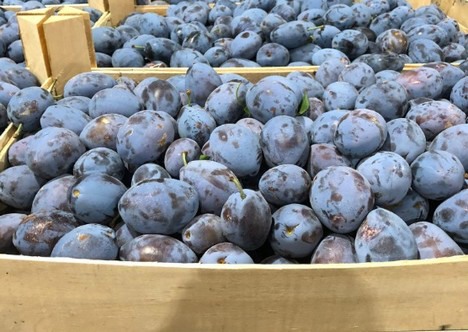 © Macoo GmbH
High demand on the German market
A few years ago, Macoo GmbH was one of the first large-scale importers of Moldovan damson plums in Germany. "We had to do some convincing at the beginning because people simply didn't know the product. In the meantime, the product has become well established throughout Germany, and we share the market with OGA-OGV and some suppliers in Munich. All of them are now also explicitly asking for goods from Moldova now that the German plum campaign is over."
In terms of volume, the first weeks of sales are traditionally the strongest, the Dresden-based importer continues. "Towards the end of early mid-November, demand weakens somewhat. Currently, almost only Moldovan damson plums can be found on the German wholesale markets. This is because German goods are now only offered sporadically and fruit from Poland and the Balkan countries now also play only a supplementary role. The German market is also particularly lucrative from the grower's point of view."
Further marketing potential exists
I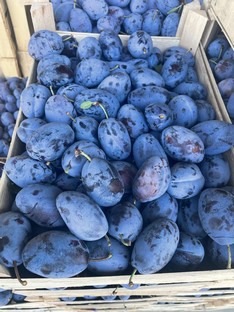 n line with the high demand in the export market, Moldovan growers are mainly dedicated to the cultivation of the commercial variety Stanley. "This variety is the bakery plum par excellence. Although we sell it exclusively on the fresh market, it would also be suitable for pitting. In the future, it might be possible to supply this market segment as well. Another factor is the high labor costs in German fruit growing, which is why it is becoming increasingly difficult to grow fruit in this country. I therefore also don't categorically rule out the possibility that in a few years there would be demand for Moldovan damson plums earlier in the year, which is why we could bring the marketing window forward accordingly."
Besides damson plums, many other fruits are produced in Moldova, such as apples and grapes. The latter item has also been found sporadically in German wholesalers for several years. "In my opinion, however, the Moldovan grape will not prevail and will rather remain a niche. This is simply because the grape market is particularly competitive and Moldova does not grow the varieties that are most in demand on the German market. It should also be remembered that grape consumption has changed over the last two decades. In the eastern German region, it used to be mainly seeded grapes such as Red Globe or Italia that were marketed. Nowadays, the ratios are over 60 percent seedless grapes."
Images: Macoo GmbH
For more information:
Marco Henschke
Macoo GmbH
Spitzhausstraße 74
01139 Dresden
Tel.: +49 (0)351 83974 - 0
Fax: +49 (0)351 83974 - 50
E-Mail: [email protected]
www.macoo.de