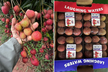
The pomegranate season started at the end of August in Spain with the harvesting of the earliest varieties, with an abundance of small sizes due to the lack of water and high temperatures. The harvest of the first native Valenciana pomegranates will start in week 37, and then will be time for the most representative variety, the Mollar, from the end of October.
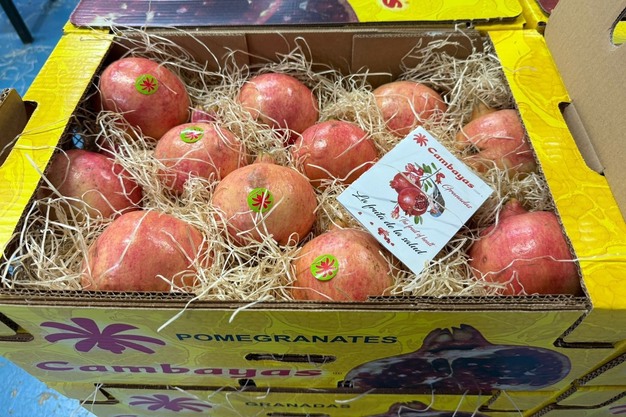 © CambayasPomegranate of the Valenciana variety.
"We have been selling the extra-early varieties Acco and Tastem for the last two weeks," says Susi Bonet, of the sales department of the Cambayas cooperative, based in the Spanish municipality of Elche, which is the main pomegranate producer in Spain, with around 15,000 tons a year.
"Due to the impact of the dry and hot weather, there's a lack of commercial sizes in the early production, with fruits falling below the 250-300 grams per piece that the market usually demands," says Bonet.
"This is why there is a big price difference between the larger sizes and the smaller fruit, because there is no stock of the former and demand exceeds supply. Around 50% of early pomegranates are left unharvested due to the lack of good calibers," he says.
In the coming weeks, in addition to continuing to work with these varieties, Cambayas will start harvesting and selling the Valenciana pomegranate, which has a pinkish internal color, fewer seeds and a sweeter flavor compared to the extra-early varieties. "Since it is harvested a little later, this variety is a little larger, although, in general, this isn't going to be a year of large sizes," says Susi Bonet.
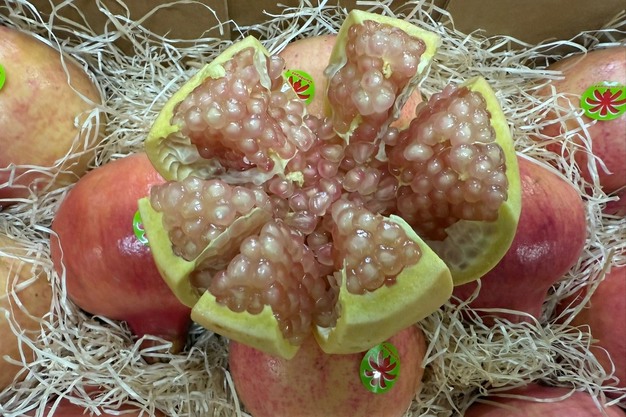 © Cambayas
Pomegranate of the Valenciana variety.
Spanish pomegranates have arrived in a European market where there was still some supply from Peru. Now there is also fruit from Egypt and Türkiye, whose production costs are lower, and this is putting pressure on sales.
In the previous season, around 60% of the Mollar de Elche pomegranate production was affected by a combination of high temperatures and the presence of the thrips Scirtothrips aurantii, a pest originating from Africa. The sector obtained exceptional European authorization for the use of active ingredients to combat it effectively.
The Cambayas cooperative will once again be present as an exhibitor at Fruit Attraction, where it will be welcoming visitors at stand 3C18 in Hall 3.
 For more information:
Susi Bonet
Cambayas Coop.V
Tel.: +34 966637588
[email protected]
www.cambayas.com